
Table of Contents
- Introduction to Medical Device ERP
- Top 12 Medical Device ERP Systems
- System Comparison Overview
- Conclusion
- FAQ
- Key Takeaway
Key Takeaways
- Choose ERP around your manufacturing requirements. Consider your company’s growth stage, production methods, engineering complexity, and quality processes when building a shortlist.
- Verify traceability through practical demonstrations. Ask vendors to connect a finished-device serial number to its component lots, manufacturing order, revision, inspection records, and shipment.
- Confirm what each application includes. Establish which manufacturing and quality functions are included, require additional modules, or depend on integrations with QMS, PLM, or MES software.
- Evaluate the full implementation scope. Request quotations covering licensing, configuration, data migration, integrations, training, support, and applicable validation activities.
- Treat software capabilities as support for your quality system. Evaluate how the proposed configuration will support your documented procedures and recordkeeping responsibilities.
Introduction to Medical Device ERP Systems
Choosing the right medical device ERP system involves more than evaluating standard manufacturing, inventory, and accounting functionality. Medical device manufacturers must also manage complex product assemblies, engineering changes, material traceability, quality management, and documentation that supports regulatory requirements.
Whether a company is preparing to bring its first medical device to market or coordinating production across multiple manufacturing facilities, its ERP software should support the processes needed to maintain product quality, production visibility, and operational control.
Regulatory considerations also play an important role in ERP selection. On February 2, 2026, the FDA’s Quality Management System Regulation (QMSR) became effective, incorporating ISO 13485:2016 by reference into the revised 21 CFR Part 820. This reinforces the importance of evaluating how manufacturing software supports controlled processes, traceability, recordkeeping, and quality management. ERP software alone, however, does not establish regulatory compliance.
Not all ERP platforms approach these requirements in the same way. Some offer functionality tailored to medical device manufacturing, while others provide broader enterprise capabilities that may require additional applications, integrations, or configuration to address industry-specific needs.
In this guide, we compare 12 medical device ERP systems, examining their manufacturing capabilities, quality and traceability features, pricing structures, advantages, limitations, and suitability for different business sizes.
The goal is to help medical device manufacturers identify which systems deserve further evaluation based on their production requirements, regulatory responsibilities, and stage of growth.
How We Evaluated These Medical Device ERP Systems
Medical device manufacturers have different ERP requirements depending on their products, production methods, organizational size, and regulatory responsibilities. A system well suited to an early-stage medical technology company may not be the best choice for a multinational manufacturer operating across multiple facilities.
To make this comparison more useful, we considered five primary evaluation areas.
1. Medical Device Manufacturing Capabilities
We examined each platform’s publicly documented manufacturing functionality, including production planning, bill of materials management, engineering changes, inventory control, work orders, and support for different manufacturing methods.
Particular consideration was given to whether the software addresses discrete medical device manufacturing, batch-based production, or broader enterprise operations.
2. Quality Management and Traceability
We reviewed available information about lot and serial number tracking, product genealogy, quality management, nonconformance handling, corrective and preventive actions (CAPA), and manufacturing documentation.
We also considered how these capabilities may support manufacturers operating under FDA requirements, ISO 13485:2016, and other applicable regulatory frameworks.
The presence of individual software features should not be interpreted as a guarantee of regulatory compliance. Manufacturers must evaluate their own processes, software configuration, validation responsibilities, and recordkeeping requirements.
3. Company Size and Manufacturing Complexity
We considered the types of organizations each ERP system is positioned to serve, including:
- Pre-revenue and early-commercialization medical device companies
- Small and midsize regulated manufacturers
- Medical device contract manufacturers
- Large manufacturers with multiple production facilities and complex supply chains
These categories represent potential buying situations rather than strict limitations on which manufacturers can use each platform.
4. Pricing and Implementation Considerations
Where vendors publish official pricing, we include relevant subscription information and distinguish between basic ERP applications and manufacturing-specific products.
For systems without publicly available pricing, we identify the pricing model as requiring a customized quote rather than relying on unverified cost estimates.
Actual costs depend on licensing, implementation, required applications, integration, training, support, and ongoing system maintenance.
5. Vendor Documentation and Independent Reviews
This comparison draws on publicly available vendor product information, technical descriptions, pricing resources, and listings on independent software review platforms, including G2, Capterra, and Gartner Peer Insights where available.
We provide links to supporting resources so readers can evaluate vendor claims and consult customer feedback when developing their ERP shortlist.
Editorial Disclosure and Limitations
This comparison is published by Expandable Software, the developer of Expandable ERP, which is one of the systems included in this article.
Vendor selections, descriptions, and recommendations reflect an editorial assessment of publicly available information and product positioning. They are not the results of standardized hands-on testing, independently audited regulatory compliance, or a quantitative scoring study.
Any Editor’s Choice designation represents the publisher’s editorial recommendation rather than an independent certification or third-party award.
Product functionality, pricing, and availability may change. Medical device manufacturers should confirm current capabilities directly with vendors and evaluate their specific manufacturing, quality, integration, and regulatory requirements before making a purchasing decision.
Picking the Right Medical Device ERP System Based On Your Buying Needs
| Buying situation | ERP system | Why it may be a good fit | What to evaluate before choosing |
|---|---|---|---|
| Pre-revenue MedTech, startups preparing for production, and growing regulated manufacturers | Expandable ERP | Designed for growing medical device companies transitioning from product development to commercial manufacturing. Offers lot and serial traceability, quality management, engineering controls, inventory, production, and integrated financials. | Confirm how the system handles prototype builds, changing BOMs, validation requirements, and implementation costs at your current stage. |
| Growing regulated manufacturers | Acumatica Cloud ERP | A cloud-based option for manufacturers expanding their operations, supplier networks, and production schedules. Its consumption-based pricing model does not charge by individual user seat. | Evaluate the configuration, integrations, and additional applications needed for medical-device-specific quality and compliance workflows. |
| Growing regulated manufacturers | Microsoft Dynamics 365 | Suited to manufacturers already invested in Microsoft technology that need connected finance, supply chain, inventory, reporting, and production operations. | Determine which Dynamics 365 applications and third-party solutions are required for device history records, quality processes, and regulatory documentation. |
| Growing regulated manufacturers | SYSPRO | A manufacturing-focused option for small and midsize medical device businesses, particularly those producing consumables and diagnostic products. Emphasizes inventory control, traceability, and quality management. | Confirm support for complex multi-site operations, reporting requirements, and the specific regulatory workflows your company must document. |
| Growing regulated manufacturers | Epicor Kinetic | Built around discrete manufacturing, production planning, inventory management, and shop-floor visibility. Worth evaluating for manufacturers with complex assemblies and changing production requirements. | Review the quality-management applications, integrations, and validation work needed for your medical device operations. |
| Growing regulated manufacturers | Infor CloudSuite Industrial | Suited to manufacturers that require detailed product records, production controls, lot and serial genealogy, and quality management. Can also support manufacturing operations within larger corporate structures. | Assess deployment complexity, user training, and whether medical-device-specific functionality requires additional configuration. |
| Growing regulated manufacturers | Rootstock | A manufacturing ERP built on the Salesforce platform. Particularly relevant to companies seeking connected sales, operations, inventory, production, and customer service data. | Evaluate the total Salesforce ecosystem cost, financial functionality, and required regulatory or quality-management integrations. |
| Growing regulated manufacturers with batch-based production | Deacom ERP | Better suited to process-oriented manufacturing, including certain diagnostic products and consumables, where batch traceability and production controls are priorities. | Confirm whether its process-manufacturing approach fits your production environment. It may be less appropriate for complex discrete medical device assemblies. |
| Contract manufacturers and shop-floor-intensive operations | DELMIAWorks | Combines ERP and manufacturing execution capabilities to improve visibility into production, scheduling, quality checks, and manufacturing records. Worth evaluating where shop-floor activity drives operational complexity. | Test customer-specific quality requirements, multiple customer BOMs, customer-owned inventory, and traceability across production orders. |
| Contract manufacturers and complex supply chains | QAD Adaptive ERP | A strong candidate for upper-mid-market manufacturers managing suppliers, outsourced production, multiple facilities, and extensive supply chain traceability. | Review implementation scope, supply chain integration requirements, and the cost of supporting multiple customers or international operations. |
| Large, multinational medical device enterprises | SAP S/4HANA | Offers extensive financial, manufacturing, supply chain, and enterprise management capabilities for organizations operating across countries and business units. | Account for implementation complexity, organizational change management, and integrations needed for specialized medical device production workflows. |
| Large, multinational medical device enterprises | Oracle Fusion Cloud ERP | Suited to organizations seeking centralized financial management, procurement, planning, and enterprise-wide reporting across multiple entities. | Determine which Oracle supply chain, manufacturing, and quality applications are required, particularly for detailed device-level production records. |
How these systems were grouped
The 12 platforms were categorized according to their primary use cases described in this comparison, including company maturity, manufacturing model, regulatory requirements, production complexity, and organizational scale.
These categories are intended to help manufacturers develop an initial shortlist, not establish that one system is objectively superior in every situation. Some platforms support multiple buying situations.
Before selecting a system, manufacturers should request demonstrations of their specific workflows, review available customer feedback, and compare total ownership costs, including licensing, implementation, integrations, data migration, validation, and ongoing support.
Top 12 Medical Device ERP Systems
Expandable ERP
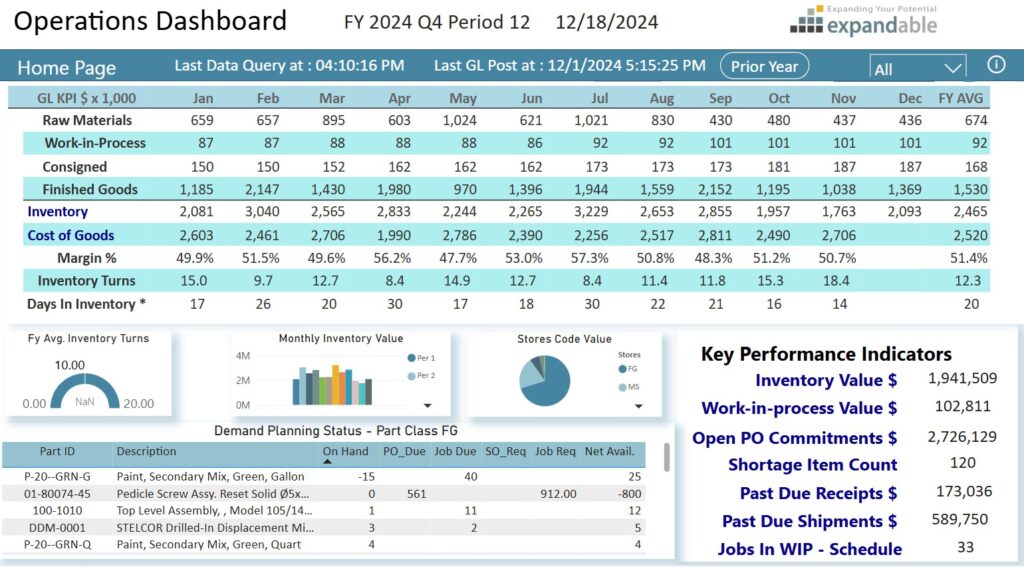
Expandable ERP is designed for growing medical device, high-technology, and regulated manufacturers that need manufacturing, engineering, quality management, inventory, and financial operations within an integrated system.
The platform is particularly relevant to MedTech companies transitioning from engineering development to commercial production. Its manufacturing capabilities support multi-level bills of materials, production control, engineering revisions, lot and serial number tracking, and different production methods, including make-to-stock and make-to-order.
For regulated manufacturers, Expandable supports product traceability, quality-related workflows, and the documentation required to maintain control over manufacturing processes. Its specialized Surgical Kit module also helps organizations manage inventory consigned to hospitals, clinics, and surgery centers.
Rather than focusing solely on large enterprise operations, Expandable serves startups and established manufacturers that need connected manufacturing and financial systems as their businesses grow.
Expandable ERP key features
- End-to-end lot and serial traceability: Tracks serialized and lot-controlled components through inventory, production, finished goods, and customer shipments, supporting forward and backward traceability.
- Quality management: Provides functionality for quality procedures, incident tracking, corrective actions, nonconformance management, and root cause analysis.
- Surgical Kit management: Tracks consigned inventory and surgical kits, including component identification, kit locations, and expiration-related information.
- Engineering and manufacturing control: Supports multi-level bills of materials, engineering revisions, production orders, and the movement of products from engineering into manufacturing.
- Mixed manufacturing methods: Accommodates make-to-stock, make-to-order, and configure-to-order requirements.
- Integrated business management: Connects manufacturing, purchasing, inventory, order management, financial reporting, and return material authorization (RMA) processes.
Expandable ERP pros and cons
Pros:
- Focuses on the needs of growing medical device and high-technology manufacturers.
- Provides specialized medical device functionality, including surgical kit and consigned inventory management.
- Connects manufacturing, quality-related operations, and financial management.
- Supports traceability and manufacturing documentation across different production workflows.
- Offers functionality relevant to both early-stage and established manufacturers.
Cons:
- Has less overall market recognition than SAP, Oracle, and Microsoft.
- Has a smaller third-party application and consulting ecosystem than the largest ERP providers.
- Requires careful planning for data migration, process configuration, and regulated-system validation.
- Organizations with highly specialized requirements should confirm module availability and deployment compatibility during evaluation.
Expandable ERP pricing
Expandable does not publish a standard per-user subscription price or fixed implementation package.
Pricing is provided through a customized quotation based on the manufacturer’s requirements, selected functionality, deployment model, and implementation scope.
Growing medical device companies should request a detailed proposal identifying software licensing, implementation, training, support, integrations, and any additional modules.
Expandable ERP best fit
Expandable is particularly well suited for:
- Pre-revenue and early-commercialization MedTech companies preparing to scale manufacturing.
- Small and midsize medical device manufacturers managing complex assemblies and traceability requirements.
- Manufacturers of diagnostic instruments, implantable devices, and specialized medical equipment.
- Companies managing surgical kits, consignment inventory, and serialized products.
- Organizations seeking integrated manufacturing and financial management without adopting a broad enterprise software suite.
Product information and independent reviews:
QAD Adaptive ERP
QAD Adaptive ERP supports medical device, pharmaceutical, and other life sciences manufacturers that need coordinated manufacturing operations, supply chain visibility, traceability, and quality management.
The platform is particularly relevant to mid-market and larger manufacturers operating across multiple facilities, countries, or outsourced production partners.
QAD combines enterprise resource planning with supply chain applications, manufacturing planning, and complementary quality management solutions. Its medical device offerings address manufacturing traceability, product genealogy, complaint management, corrective actions, and documentation used in regulated production environments.
QAD also provides tools for collaborating with external suppliers and contract manufacturing organizations, which can be important for medical device businesses with geographically distributed supply chains.
QAD key features
- Supply chain visibility: Connects manufacturers with suppliers, customers, and outsourced production partners.
- Medical device traceability: Supports lot and device genealogy, serialization, and product history across manufacturing and distribution activities.
- Quality management: QAD EQMS supports complaint management, corrective and preventive actions, quality records, and related workflows.
- Regulatory documentation: Offers functionality relevant to FDA requirements, ISO 13485, and medical device audit readiness.
- Manufacturing planning: Provides production planning, inventory management, and supply chain coordination.
- Global manufacturing operations: Supports businesses managing multiple locations, international supply chains, and complex organizational structures.
QAD pros and cons
Pros:
- Established experience serving medical device and life sciences manufacturers.
- Strong supply chain management and supplier collaboration capabilities.
- Supports regulated manufacturing processes and quality documentation.
- Well suited to manufacturers coordinating multiple production and distribution locations.
- Offers complementary quality management and connected workforce solutions.
Cons:
- Implementation scope can be significant for companies requiring multiple QAD applications.
- Smaller manufacturers may not need the platform’s broader supply chain capabilities.
- Configuration, integration, and validation requirements should be assessed carefully.
- Its consulting and implementation ecosystem may be smaller in some markets than those of SAP, Oracle, or Microsoft.
QAD pricing
QAD does not publish a universal subscription price for Adaptive ERP.
Pricing is determined through consultation and depends on organizational requirements, selected applications, users, deployment, and implementation services.
Manufacturers should confirm whether enterprise quality management, supply chain planning, and other complementary applications are included in the proposed package.
QAD best fit
QAD is a strong candidate for:
- Mid-market and larger medical device manufacturers.
- Companies with international supply chains and multiple production facilities.
- Manufacturers relying on external suppliers and contract manufacturing partners.
- Organizations requiring coordinated quality, manufacturing, and supply chain operations.
- Life sciences manufacturers managing a combination of regulated production processes.
Product information and independent reviews:
SAP S/4HANA
SAP S/4HANA is an enterprise resource planning platform that supports large and complex organizations managing manufacturing, finance, procurement, inventory, and supply chain operations across multiple locations.
For global medical device manufacturers, SAP offers integrated business processes and extensive configuration capabilities for organizations operating across different legal entities, manufacturing facilities, and regulatory jurisdictions.
SAP’s broader manufacturing portfolio includes production engineering, manufacturing operations management, production planning, scheduling, and analytics. These capabilities can help organizations coordinate product data, manufacturing activities, and financial operations across global networks.
However, medical-device-specific requirements such as device history documentation, electronic signatures, quality management, and regulatory validation should be evaluated against the exact SAP applications and integrations proposed.
SAP S/4HANA key features
- Enterprise manufacturing management: Supports production planning, manufacturing operations, engineering, and materials management.
- Integrated financial operations: Connects accounting, procurement, inventory valuation, and financial reporting.
- Production scheduling: Offers detailed planning and scheduling capabilities for complex manufacturing operations.
- Product traceability: Supports material and product tracking, with additional functionality available through relevant SAP applications.
- Manufacturing analytics: Provides operational data and reporting across production and supply chain processes.
- Global business management: Supports organizations with multiple facilities, countries, currencies, and legal entities.
SAP S/4HANA pros and cons
Pros:
- Extensive enterprise financial and manufacturing functionality.
- Supports complex global supply chains and organizational structures.
- Offers advanced planning, scheduling, and analytics.
- Provides a broad ecosystem of applications, integrations, and implementation partners.
- Suitable for standardizing operations across multiple business units.
Cons:
- Implementation and ongoing administration can be complex.
- Customization and integration requirements may increase total ownership costs.
- Smaller manufacturers may find its broader enterprise functionality unnecessary.
- Medical-device-specific workflows may require additional SAP products or specialized implementation work.
- Migration from legacy systems can require significant organizational resources.
SAP S/4HANA pricing
SAP provides enterprise-specific pricing rather than a universal manufacturing ERP subscription rate.
The total investment depends on the selected SAP edition, deployment model, required applications, user licensing, integration requirements, and implementation services.
Buyers should obtain a detailed quotation covering software subscriptions or licenses, implementation, data migration, support, and additional manufacturing or quality management products.
SAP S/4HANA best fit
SAP S/4HANA is most relevant for:
- Large medical device manufacturers operating across multiple countries.
- Organizations with complex financial and supply chain requirements.
- Manufacturers coordinating production across numerous facilities.
- Enterprises seeking to standardize manufacturing and financial operations.
- Companies already invested in the SAP technology ecosystem.
Product information and independent reviews:
Oracle Fusion Cloud ERP
Oracle Fusion Cloud ERP is an enterprise software platform designed to manage financial operations, procurement, project management, risk management, and reporting across complex organizations.
For medical device manufacturers, Oracle’s broader application portfolio can connect enterprise financial management with supply chain planning, inventory, and production operations.
An important distinction is that Oracle Fusion Cloud ERP and Oracle Fusion Cloud Supply Chain and Manufacturing are separate application families. Manufacturers requiring production planning, work orders, inventory execution, and manufacturing operations should evaluate the relevant Oracle SCM applications alongside the financial ERP platform.
Oracle Fusion Cloud Manufacturing supports discrete, process, and mixed-mode manufacturing, including selected contract manufacturing and outsourced production scenarios.
Oracle Fusion Cloud ERP key features
- Enterprise financial management: Supports accounting, financial reporting, procurement, and financial controls.
- Manufacturing execution: Oracle Fusion Cloud Manufacturing provides work orders, manufacturing processes, production execution, and resource management.
- Supply chain management: Offers inventory management, procurement, order management, and supply chain coordination through Oracle SCM applications.
- Discrete and process manufacturing: Supports multiple manufacturing methods, including mixed-mode operations.
- Enterprise analytics: Provides reporting and analysis across financial and operational activities.
- Global operations: Supports organizations with multiple entities, facilities, and international business requirements.
Oracle Fusion Cloud ERP pros and cons
Pros:
- Extensive financial management and enterprise reporting capabilities.
- Broad portfolio of supply chain and manufacturing applications.
- Supports large organizations with multiple business models.
- Provides options for connecting enterprise financial and operational data.
- Suitable for complex global business structures.
Cons:
- Manufacturing functionality requires evaluation of applications beyond the core financial ERP offering.
- Implementation may involve significant configuration and integration work.
- Licensing and total ownership costs can be difficult to assess without a detailed application-level proposal.
- Smaller medical device manufacturers may not require its enterprise-scale functionality.
- Specialized medical device workflows and regulated-system validation need to be confirmed separately.
Oracle Fusion Cloud ERP pricing
Oracle provides customized enterprise pricing based on the applications, services, and licensing requirements selected.
Manufacturers should request separate pricing for Oracle Fusion Cloud ERP and any required Supply Chain and Manufacturing applications.
Implementation costs depend on the organization’s size, required integrations, business processes, and deployment scope.
Oracle Fusion Cloud ERP best fit
Oracle is particularly relevant for:
- Large multinational medical device manufacturers.
- Enterprises managing several subsidiaries or operating divisions.
- Companies requiring extensive financial management and corporate reporting.
- Organizations coordinating complex manufacturing and supply chain operations.
- Businesses seeking integrated enterprise applications across finance, procurement, and production.
Product information and independent reviews:
- Oracle Fusion Cloud Supply Chain and Manufacturing
- Oracle Fusion Cloud ERP reviews on Gartner Peer Insights
Microsoft Dynamics 365
Microsoft Dynamics 365 offers several business management applications that medical device manufacturers can use for financial management, production, inventory, supply chain operations, and customer relationships.
For smaller and midsize manufacturers, Dynamics 365 Business Central Premium includes manufacturing functionality such as production orders, manufacturing bills of materials, and capacity planning.
Manufacturers with more complex production, warehouse, or supply chain requirements may evaluate Dynamics 365 Supply Chain Management.
The platform’s connection to Microsoft 365, Teams, Power BI, and other Microsoft applications can appeal to organizations already using the Microsoft ecosystem.
Medical device manufacturers should confirm which quality management, regulatory documentation, traceability, and validation capabilities are included in their selected applications and which require additional products or customization.
Microsoft Dynamics 365 key features
- Manufacturing management: Business Central Premium supports production orders, manufacturing bills of materials, and capacity planning.
- Inventory and material tracking: Provides inventory management and item tracking capabilities, with functionality varying by application.
- Supply chain operations: Dynamics 365 Supply Chain Management provides additional production, warehouse, procurement, and planning functionality.
- Business reporting: Integrates with Microsoft Power BI and other reporting applications.
- Document and collaboration tools: Connects with Microsoft 365 applications and related services.
- Extensibility: Supports additional business applications, integrations, and industry-specific solutions through Microsoft’s partner ecosystem.
Microsoft Dynamics 365 pros and cons
Pros:
- Familiar Microsoft application ecosystem.
- Different products are available for small, mid-market, and larger organizations.
- Extensive partner and third-party application marketplace.
- Flexible integration with reporting, collaboration, and productivity tools.
- Published subscription prices for several core applications.
Cons:
- Manufacturing capabilities differ significantly between Business Central and Supply Chain Management.
- Medical-device-specific quality and regulatory requirements may require additional applications.
- Implementation complexity depends on the selected products and integrations.
- Licensing can become more complicated when multiple Dynamics applications are required.
- Organizations should carefully define requirements before selecting a specific Dynamics product.
Microsoft Dynamics 365 pricing
Microsoft publishes separate subscription prices for its business applications.
Current U.S. list prices include:
- Business Central Essentials: $80 per user/month, paid annually.
- Business Central Premium: $110 per user/month, paid annually. This edition includes manufacturing functionality.
- Dynamics 365 Supply Chain Management: $210 per user/month, paid annually.
- Dynamics 365 Supply Chain Management Premium: $300 per user/month, paid annually.
These figures represent application licensing rather than total project costs. Implementation, integrations, partner services, and additional applications may increase the overall investment.
Microsoft Dynamics 365 best fit
Dynamics 365 is relevant for:
- Small and midsize medical device manufacturers using Business Central Premium.
- Growing manufacturers requiring more advanced supply chain capabilities.
- Organizations already invested in Microsoft applications.
- Companies seeking broad integration and reporting options.
- Manufacturers willing to evaluate industry-specific applications for specialized regulatory requirements.
Product information and independent reviews:
- Microsoft Business Central pricing
- Microsoft Supply Chain Management pricing
- Business Central reviews on G2
Acumatica Cloud ERP
Acumatica Cloud ERP provides a connected business management platform for small and midsize manufacturers seeking integrated financial management, production planning, inventory control, purchasing, and reporting.
Its manufacturing functionality supports production planning, material requirements, inventory visibility, and the coordination of manufacturing processes.
Medical device manufacturers can use Acumatica to manage important operational activities, but specialized quality management, regulatory documentation, and electronic record requirements should be evaluated carefully. Certain industry-specific capabilities may require integrations, third-party applications, or additional configuration.
One of Acumatica’s distinguishing characteristics is its licensing approach, which emphasizes applications and resource consumption rather than traditional per-user subscription charges.
Acumatica Cloud ERP key features
- Manufacturing management: Supports production orders, manufacturing planning, and material requirements.
- Inventory traceability: Provides lot and serial number tracking for inventory and manufacturing activities.
- Supply chain visibility: Connects purchasing, inventory, and production information.
- Financial management: Integrates accounting and financial reporting with operational transactions.
- Flexible integrations: Supports additional applications and specialized business requirements.
- Cloud accessibility: Enables authorized users to access business information across locations.
Acumatica Cloud ERP pros and cons
Pros:
- Consumption-based licensing with unlimited users under the applicable subscription model.
- Integrated financial, inventory, and manufacturing functionality.
- Flexible application architecture and integration capabilities.
- Scalable resource-based approach as business requirements change.
- Suitable for manufacturers seeking a modern cloud ERP platform.
Cons:
- Specialized medical device quality and compliance requirements may require additional solutions.
- Configuration and integrations can increase project complexity.
- Resource consumption and application selection affect pricing.
- Companies with limited implementation resources may need substantial partner assistance.
- Advanced workflows can require additional user training.
Acumatica Cloud ERP pricing
Acumatica offers customized pricing based on three primary factors:
- Applications selected.
- Expected usage and resource requirements.
- Deployment preferences.
Acumatica promotes unlimited-user access with its consumption-based subscription model, although resource and system constraints still apply.
The company does not publish a universal starting price for its manufacturing ERP solution.
Manufacturers should request a detailed proposal that includes manufacturing applications, implementation services, integrations, ongoing support, and expected resource usage.
Acumatica Cloud ERP best fit
Acumatica is most relevant for:
- Growing medical device manufacturers seeking connected business operations.
- Small and midsize manufacturers that need flexible ERP functionality.
- Companies looking to avoid conventional per-user licensing models.
- Organizations managing complex inventories, suppliers, and production schedules.
- Manufacturers willing to assess additional applications for specialized regulatory requirements.
Product information and independent reviews:
DELMIAWorks
DELMIAWorks, formerly IQMS, is a manufacturing ERP and manufacturing execution system (MES) offered by Dassault Systèmes.
The platform emphasizes real-time manufacturing visibility by connecting shop-floor execution with inventory management, production scheduling, quality control, purchasing, and financial operations.
Its integrated ERP and MES approach is particularly relevant to manufacturers requiring detailed production monitoring and coordination between manufacturing equipment, operators, and business systems.
For medical device manufacturers, DELMIAWorks offers industry-specific capabilities related to product identification, traceability, quality management, inspection documentation, corrective actions, and production records.
DELMIAWorks key features
- Integrated ERP and MES: Combines manufacturing execution and business management information within a connected system.
- Real-time production monitoring: Provides visibility into shop-floor activity, scheduling, and manufacturing performance.
- Manufacturing traceability: Supports product identification, lot and serial tracking, and manufacturing records.
- Quality management: Includes functionality for inspections, nonconformance management, corrective actions, and quality-related documentation.
- Production scheduling: Helps manufacturers coordinate production resources and identify scheduling constraints.
- Manufacturing analytics: Connects production information with operational and financial reporting.
DELMIAWorks pros and cons
Pros:
- Strong manufacturing and shop-floor orientation.
- Integrated ERP and MES architecture.
- Supports real-time manufacturing visibility.
- Offers functionality for quality management and production traceability.
- Relevant to manufacturing environments requiring detailed production execution.
Cons:
- Implementation can require specialized manufacturing expertise.
- Users may need substantial training to take advantage of its full functionality.
- Certain reviewers report challenges with reporting, interface usability, or specific workflows.
- Manufacturers should validate the suitability of its scheduling and materials-planning functionality for their production methods.
DELMIAWorks pricing
DELMIAWorks does not publish a universal manufacturing ERP price.
Licensing and implementation are quoted according to the manufacturer’s requirements, selected functionality, deployment preferences, and services.
Organizations should request pricing that separates ERP functionality, MES capabilities, quality management, integrations, support, and implementation.
DELMIAWorks best fit
DELMIAWorks is particularly relevant for:
- Small and midsize medical device manufacturers.
- Manufacturers needing integrated ERP and shop-floor execution.
- Companies producing high volumes of precision components or assemblies.
- Contract manufacturers requiring detailed production visibility.
- Organizations prioritizing manufacturing traceability, quality, and production monitoring.
Product information and independent reviews:
SYSPRO
SYSPRO is a manufacturing and distribution ERP platform that supports inventory management, production planning, procurement, engineering change control, quality management, and supply chain visibility.
Its medical device manufacturing offering addresses the requirements of manufacturers producing regulated products, including medical equipment, diagnostic instruments, and consumables.
SYSPRO emphasizes manufacturing traceability, electronic records, production management, and documentation supporting regulated operations.
Its medical industry capabilities also include engineering change control, product history tracking, and quality-related workflows that can help manufacturers maintain oversight of production and product revisions.
SYSPRO key features
- Lot and serial traceability: Tracks materials and finished products across manufacturing and distribution operations.
- Engineering change control: Supports structured approval workflows, revision history, and changes to manufacturing specifications.
- Quality management: Provides functionality for inspections, quality-related records, and manufacturing controls.
- Manufacturing operations: Includes production planning, scheduling, and shop-floor visibility.
- Inventory management: Supports stock control, material planning, and supply chain coordination.
- Regulatory documentation: Offers capabilities relevant to electronic records, device production history, and quality system requirements.
SYSPRO pros and cons
Pros:
- Manufacturing and distribution functionality within one ERP platform.
- Supports detailed inventory tracking and product genealogy.
- Offers medical device manufacturing capabilities.
- Includes engineering change and quality-related functionality.
- Relevant to manufacturers seeking operational control without adopting a broad global enterprise ERP suite.
Cons:
- Implementation and configuration can require experienced technical resources.
- Some users report challenges with interface modernization or reporting workflows.
- Specialized compliance requirements should be verified against specific modules and configurations.
- Advanced organizational or multinational requirements should be evaluated during demonstrations.
SYSPRO pricing
SYSPRO provides customized ERP pricing based on the manufacturer’s users, required applications, deployment, and implementation needs.
The company does not publish a universal manufacturing ERP starting price or minimum-user requirement suitable for all buyers.
Prospective customers should obtain a quotation covering licenses, implementation, integrations, training, maintenance, and support.
SYSPRO best fit
SYSPRO may be a good fit for:
- Small and midsize medical device manufacturers.
- Diagnostic equipment and medical consumables producers.
- Organizations requiring inventory traceability and manufacturing controls.
- Manufacturers managing engineering changes and multiple product revisions.
- Companies combining production and distribution operations.
Product information and independent reviews:
Epicor Kinetic
Epicor Kinetic is a manufacturing-focused ERP platform designed for companies operating in discrete and other manufacturing environments.
Its medical device offering addresses production planning, engineering management, inventory control, traceability, quality management, and regulated manufacturing requirements.
Epicor also provides Life Sciences Cloud infrastructure and related services intended to help manufacturers manage software validation and cloud operations in regulated environments.
The platform supports connected manufacturing workflows and provides options for integrating enterprise quality management, document management, and product lifecycle management applications.
Epicor Kinetic is particularly relevant to manufacturers producing engineered devices, diagnostic equipment, and complex assemblies.
Epicor Kinetic key features
- Manufacturing planning and execution: Supports production orders, materials planning, and manufacturing operations.
- Lot and serial tracking: Provides component and product traceability across manufacturing processes.
- Engineering and product management: Supports manufacturing bills of materials, engineering information, and related product data workflows.
- Quality management: Offers quality-related functionality and complementary Epicor QMS applications for more extensive requirements.
- Life Sciences Cloud: Provides infrastructure and services intended to support regulated cloud operations and software validation.
- Manufacturing analytics: Includes reporting and visibility tools for inventory, scheduling, and production performance.
Epicor Kinetic pros and cons
Pros:
- Strong manufacturing-specific functionality.
- Suitable for discrete and engineered-product manufacturing.
- Offers dedicated medical device industry positioning.
- Provides complementary quality management and document management applications.
- Supports cloud deployment and ongoing product enhancements.
Cons:
- Some advanced quality and compliance functionality may involve additional applications.
- Implementation and configuration can require specialized expertise.
- Reviewers report mixed experiences with reporting, scheduling, and user interface workflows.
- Licensing and implementation costs depend on the selected application scope.
Epicor Kinetic pricing
Epicor does not publish a universal per-user subscription price for Kinetic manufacturing ERP.
Pricing depends on the manufacturer’s requirements, selected applications, deployment, and implementation services.
Medical device manufacturers should confirm whether Life Sciences Cloud, Epicor QMS, document management, and other relevant applications are included in the proposed quotation.
Epicor Kinetic best fit
Epicor Kinetic is particularly relevant for:
- Small and midsize discrete medical device manufacturers.
- Manufacturers of diagnostic equipment and specialized instruments.
- Companies managing complex assemblies and engineered products.
- Organizations requiring detailed inventory and production control.
- Growing manufacturers evaluating complementary quality and product lifecycle applications.
Product information and independent reviews:
Infor CloudSuite Industrial
Infor CloudSuite Industrial, also known as SyteLine, is a manufacturing ERP platform that connects financial management, purchasing, inventory, production planning, shop-floor activity, and quality-related operations.
The solution serves small and midsize manufacturers that need to coordinate complex production schedules, materials, and manufacturing costs.
For medical device manufacturers, Infor CloudSuite Industrial offers manufacturing traceability, inventory controls, quality management functionality, and support for controlled production workflows.
Infor’s October 2026 release introduced enhancements to advanced planning and scheduling, financial reporting, quality visibility, and manufacturing analytics.
One addition, the Enterprise Quality Hub, provides a consolidated view of information related to corrective actions, complaints, calibration schedules, and nonconformance activities.
Infor CloudSuite Industrial key features
- Manufacturing planning: Supports production scheduling, material requirements, and manufacturing execution.
- Lot and serial traceability: Provides inventory and material tracking across manufacturing activities.
- Quality management: Offers quality-related workflows and visibility into production and inspection information.
- Enterprise Quality Hub: Brings corrective actions, complaints, calibration, and nonconformance information into a consolidated view.
- Advanced planning and scheduling: Supports scheduling decisions that consider material timing and production constraints.
- Financial and operational reporting: Connects manufacturing information with costs, inventory, and financial performance.
Infor CloudSuite Industrial pros and cons
Pros:
- Extensive manufacturing and production planning capabilities.
- Integrated financial, inventory, and manufacturing operations.
- Advanced planning and scheduling functionality.
- Quality management and reporting capabilities.
- Ongoing product enhancements focused on usability, analytics, and manufacturing visibility.
Cons:
- Configuration and implementation may require specialized manufacturing expertise.
- Extensive functionality can create additional training requirements.
- Reviewers report mixed experiences with interface usability and some operational workflows.
- Specialized medical device compliance and validation needs should be assessed against the proposed implementation.
Infor CloudSuite Industrial pricing
Infor provides customized CloudSuite Industrial pricing.
The total cost depends on the selected applications, deployment, users, implementation scope, and services.
Manufacturers should confirm which quality, planning, reporting, and manufacturing extensions are included in the subscription and which may require additional licensing.
Infor CloudSuite Industrial best fit
Infor CloudSuite Industrial is relevant for:
- Small and midsize medical device manufacturers.
- Companies with complex production planning requirements.
- Manufacturers managing detailed inventory and quality-related workflows.
- Organizations requiring integrated financial and manufacturing management.
- Businesses seeking advanced scheduling and operational visibility.
Product information and independent reviews:
Rootstock Cloud ERP
Rootstock Cloud ERP is a manufacturing-focused ERP platform built natively on Salesforce.
It connects manufacturing operations, inventory, procurement, order management, financial management, and customer-related business processes.
For medical device manufacturers, Rootstock provides functionality for bills of materials, production planning, engineering changes, work orders, inventory management, and lot and serial traceability.
Its Salesforce-native architecture can be particularly attractive to manufacturers that want manufacturing and operational information connected to customer management, sales, and service activities.
Although Rootstock can offer additional advantages to existing Salesforce users, companies do not need to be current Salesforce CRM customers to evaluate or implement the ERP platform.
Rootstock key features
- Salesforce-native architecture: Operates on the Salesforce platform and connects ERP data with related business applications.
- Manufacturing control: Supports bills of materials, routings, work orders, and production planning.
- Inventory traceability: Provides lot and serial tracking for inventory and manufacturing transactions.
- Engineering change management: Supports controlled product and manufacturing data updates.
- Order and supply chain management: Connects purchasing, inventory, production, and order processing.
- Financial management: Offers financial functionality and reporting connected to operational processes.
Rootstock pros and cons
Pros:
- Native integration with the Salesforce platform.
- Connects manufacturing and customer-related business information.
- Flexible configuration and integration capabilities.
- Supports inventory traceability and engineered manufacturing workflows.
- Suitable for organizations seeking connected production, finance, and customer operations.
Cons:
- Platform configuration and administration can require Salesforce-specific expertise.
- Some reviewers report challenges with financial functionality and older interface components.
- Implementation complexity can increase as organizations add custom workflows.
- Medical-device-specific quality and regulatory workflows should be evaluated separately.
Rootstock pricing
Rootstock provides customized pricing based on applications, licensing requirements, organizational size, and implementation scope.
Current official pricing should be obtained through Rootstock rather than relying on older published per-user estimates.
Manufacturers should confirm pricing for ERP applications, financial management, integrations, implementation, and ongoing support.
Rootstock best fit
Rootstock is especially relevant for:
- Medical device manufacturers using Salesforce.
- Growing manufacturers seeking connected customer and operational data.
- Companies requiring production planning, inventory management, and product traceability.
- Businesses seeking configurable manufacturing ERP functionality.
- Organizations integrating manufacturing, sales, and service activities.
Product information and independent reviews:
Deacom ERP
Deacom ERP, offered by ECI Software Solutions, is an integrated ERP platform designed primarily for batch and process manufacturing.
Unlike ERP systems that focus on discrete assemblies and engineered products, Deacom specializes in production environments involving formulations, recipes, batch management, raw materials, and controlled manufacturing processes.
Its functionality includes lot traceability, quality management, inventory control, supply chain planning, document management, and financial operations.
For medical-related manufacturing, Deacom is particularly relevant to companies producing diagnostic reagents, pharmaceuticals, and other regulated products that rely on batch-based production.
Companies manufacturing complex discrete devices should carefully evaluate whether Deacom’s production model aligns with their manufacturing requirements.
Deacom ERP key features
- Batch and process manufacturing: Supports formula-based and batch-oriented production processes.
- Lot traceability: Tracks materials and production lots through inventory and manufacturing operations.
- Quality control: Provides functionality for quality checkpoints, production controls, and related documentation.
- Document management: Supports manufacturing documentation, specifications, and business records.
- Supply chain planning: Connects purchasing, material requirements, production, and inventory management.
- Integrated operations: Combines manufacturing, inventory, and business management within a unified ERP platform.
Deacom ERP pros and cons
Pros:
- Strong specialization in batch and process manufacturing.
- Integrated formulation, inventory, and production management.
- Supports lot tracking and regulated manufacturing documentation.
- Offers Essentials and Enterprise packages for different operational needs.
- Provides specialized services related to FDA software validation.
Cons:
- Less aligned with complex discrete medical device assembly.
- Manufacturers using extensive engineering bills of materials and discrete routing structures should carefully evaluate fit.
- Some specialized functionality differs between the Essentials and Enterprise packages.
- Implementation and validation requirements depend on the selected package and production environment.
Deacom ERP pricing
Deacom offers two primary packages:
- Deacom Essentials: Designed for manufacturers seeking an integrated process manufacturing ERP solution.
- Deacom Enterprise: Intended for manufacturers with more complex requirements and includes FDA Validation in the published package comparison.
Deacom’s pricing page identifies a minimum of five concurrent users for its process manufacturing software packages.
Pricing is available through a customized quotation. Manufacturers should confirm their required modules, validation services, implementation, and ongoing support costs.
Deacom ERP best fit
Deacom is most relevant for:
- Manufacturers of diagnostic reagents and related batch-produced products.
- Pharmaceutical and life sciences manufacturers.
- Companies managing formulation-based or process manufacturing.
- Regulated manufacturers requiring lot traceability and batch production controls.
- Organizations seeking integrated process manufacturing and financial management.
Product information and independent reviews:
System Comparison Overview
The table below provides a side-by-side comparison of key specifications across all 12 medical device ERP systems. This reference helps manufacturers evaluate options based on their specific operational requirements and budget constraints.
Conclusion
Selecting an ERP system represents a pivotal business decision for medical device manufacturers operating under strict regulatory oversight and operational pressures. Our analysis of these 12 solutions reveals distinct patterns in how different platforms serve various market segments within this highly regulated industry.
The medical device market’s rapid expansion means manufacturers face mounting pressure to maintain compliance while optimizing production efficiency. Your specific requirements for traceability, quality management, and regulatory adherence should drive the selection process.
Enterprise manufacturers with revenues exceeding $1 billion typically require the comprehensive capabilities of SAP S/4 HANA or Oracle Cloud ERP, which deliver robust financial controls and global supply chain visibility. Mid-market organizations often find better value in Microsoft Dynamics 365 or QAD due to balanced functionality and reasonable implementation costs. Growing medical device companies may benefit most from Expandable ERP or Acumatica, which provide industry-specific compliance features without enterprise-level complexity.
The right ERP solution must address your regulatory requirements—FDA compliance, ISO 13485 certification, UDI tracking. These systems become the operational backbone for maintaining audit trails, managing device history records, and ensuring complete lot and serial traceability.
Evaluate potential solutions based on your manufacturing approach, company size, budget parameters, and compliance obligations. Implementation timeframes, user experience, and ongoing support quality matter as much as core functionality when making this decision.
Medical device manufacturers implementing specialized ERP systems typically see improved compliance rates, enhanced operational efficiency, and reduced recall risk. This technology investment protects both business reputation and patient safety—two factors that define success in this critical industry.
The bottom line: choose a system that grows with your business while ensuring you never compromise on the regulatory compliance that keeps patients safe.
FAQs
Q1. What are the key features to look for in a medical device ERP system? Essential features include end-to-end traceability, quality management tools, regulatory compliance support (e.g., FDA 21 CFR Part 11), and integrated document management. Look for systems that offer real-time visibility into manufacturing processes and supply chain operations.
Q2. How does ERP software help medical device manufacturers maintain compliance? ERP systems designed for medical device manufacturers provide tools for maintaining detailed audit trails, managing device history records, and ensuring complete lot and serial traceability. They automate many compliance processes, reducing the risk of human error and supporting adherence to FDA, ISO 13485, and other regulatory standards.
Q3. What are the differences between ERP solutions for large enterprises versus small to medium-sized medical device companies? Large enterprise solutions like SAP S/4 HANA and Oracle Cloud ERP offer comprehensive functionality and global scalability but come with higher costs and complexity. Smaller companies often benefit from more specialized systems like Expandable ERP or Acumatica, which provide industry-specific features at a lower price point and are easier to implement.
Q4. How much does a medical device ERP system typically cost? Costs vary widely based on the size of the organization and the complexity of the system. Small to medium-sized businesses might spend $25,000 to $100,000 for implementation, while large enterprise solutions can exceed $250,000. Monthly per-user fees typically range from $100 to $500, with some vendors offering consumption-based pricing models.
Q5. What benefits can medical device manufacturers expect from implementing a specialized ERP system?Manufacturers implementing industry-specific ERP systems often see improved compliance rates, enhanced operational efficiency, and reduced risk of costly recalls. Benefits can include faster product delivery times, improved order fulfillment rates, better inventory management, and streamlined quality control processes. The right system serves as a backbone for maintaining regulatory compliance while optimizing business operations.