In our latest exclusive educational customer session, we invited our partners at Avalara showcase how a simple integration can help them move from 14-month-long “nightmare” audits to one-day reviews.
As we discussed the session, sales tax has moved beyond simple math into a high-risk manual burden. In 2023 alone, there were nearly 86,000 taxability updates across North America. Tracking these changes manually is no longer a viable business strategy.
The New Reality of “Nexus”
Many businesses mistakenly believe they only owe tax where they have an office or warehouse. Today, compliance is triggered by:
Physical Nexus: Includes remote employees, attending trade shows, or storing inventory in third-party fulfillment centers.
Economic Nexus: Most states trigger registration once you hit thresholds (commonly $100,000 in sales or 200 transactions).
The Exemption Trap: 36 states require you to register and file returns even if 100% of your sales are tax-exempt.
The Precision Gap
Standard zip codes aren’t precise enough for the 13,000+ U.S. tax jurisdictions. Boundaries can change mid-building, and neighbors in the same town often pay different rates. Beyond geography, rules vary by product use; equipment might be exempt if used for production 51% of the time, but taxable at 49%.
The $43,000 Error: Exemption Certificates
Exemption certificates (resale, nonprofit, etc.) are a major audit risk. They expire at different intervals—Florida’s annually, while California’s are “evergreen.”
If an auditor finds one invalid certificate on a $15,000 sale, they don’t just charge you the missing tax. They extrapolate that error across years of records. A single missing form can result in over $40,000 in penalties and interest.
The Expandable + Avalara Integration
Leveraging a dynamic API, the integration allows Expandable ERP to remain your operational “source of truth,” while Avalara handles the compliance logic in the background:
Real-Time Calculation: When you create an invoice in Expandable, Avalara instantly calculates the precise tax based on the latest jurisdiction rules.
Automated Filing: Avalara uses your transaction data to prepare and file returns across all registered states.
Certificate Management: Avalara digitizes your certificates, validates them against state requirements, and automatically alerts you when renewals are needed.
The Bottom Line
Research shows manufacturers spend an average of $14,000 per month on manual tax tasks—time that generates zero revenue. Automation offers an average ROI of 102% within six months.
The policy environment shaping U.S. manufacturing—and today’s competitive landscape with China—is extremely complex. On March 19, 2026, fresh from a visit to China, Bruce Graham, investor, advisor, and board member, shared firsthand insights and real-world examples of how innovation is helping American manufacturers gain an edge and turn advanced technology into a competitive advantage. The discussion took place during Sip Club, hosted by Expandable Software, MIE Solutions, and Mirador Software Group.
Our discussion focused on three main areas:
Policy Overview: How government policies, such as “Made in America” rules and tariffs, protect routine production.
Innovation: Real examples of U.S. manufacturers succeeding through innovation rather than competing solely on cost or policy.
China: China’s role in global manufacturing today, including geopolitical and trade realities.
Context: U.S. policy initiatives
Manufacturing has a high multiplier effect in the economy. It is estimated that there is a $1.81 return for every $1.00 invested in manufacturing.
One manufacturing job supports four additional jobs elsewhere.
Manufacturing accounts for approximately 11% of U.S. GNP.
The Trump administration has discussed significantly expanding investment in advanced manufacturing through a coordinated, multi-agency strategy focused on workforce development, supply chain resilience, and emerging technologies such as semiconductors and next-generation materials. However, it remains to be seen when—and if—these initiatives will fully materialize. The U.S. government does not turn on a dime.
Key initiatives include:
Department of Defense: ManTech
National Institute of Standards and Technology (NIST): Manufacturing Extension Partnership (training)
CHIPS Act: Semiconductor investment
Department of Energy: Next-generation materials
Departments of Commerce, Defense, and Energy: 17 research institutes focused on emerging manufacturing technologies
Opportunities exist through Department of Defense and Department of Energy grants and loans, as well as subcontracting under larger awarded contracts. However, the cost of preparing proposals and meeting ongoing reporting requirements can be significant—there is no free lunch.
Support for navigating these programs can be found in Decoding Grant Management by Lucy Morgan and at www.myfedtrainer.com.
Tens of billions of dollars in manufacturing investments have been announced—but when will they materialize?
Announced investments from companies such as Merck, AstraZeneca, Amgen, Novartis, Jabil, Hyundai, GE Appliances, Johnson & Johnson, and ABB
Nation-state commitments totaling approximately $1 trillion from the UAE, Saudi Arabia, Japan, Qatar, and South Korea
Enforcement is expected to tighten in 2025 with new legislation and administrative changes. Some startups are beginning to feel momentum building. However, government strategy documents often overlook a critical factor: fundability. This remains a central issue.
How does the U.S. succeed in this new global environment? Innovation. There are significant opportunities for leverage in U.S. manufacturing, including:
Simulation and digital twins (dynamic virtual replicas synchronized with real-time IoT and AI data)
Robotics to augment a constrained workforce
Integration of fragmented data systems and siloed organizations
Scaling effectively beyond Proof of Concept (PoC)
Common themes for improvement include supply chain resiliency, workforce development, and accelerating the transition from PoC to full-scale production.
Crossing the Chasm by Geoffrey Moore describes the challenge of moving from early adopters to the early majority. To scale successfully, companies must target a specific niche, deliver a complete “whole product,” and shift from technology-centric to value-based messaging.
Some U.S. manufacturers are succeeding through innovation—often by moving beyond commodity production toward differentiated products and new architectures that disrupt value and supply chains. Commodity widgets rely on barriers to trade and pressures from Made in America. Innovation is arguably a more sustainable/defensible place to play than relying on trade protections.
Graham provided examples of companies that have succeeded leveraging a strategy of innovation during the webinar:
Roll-to-roll manufacturing innovation enabling large-area, highly conductive power circuitsDeep IP and advanced technology create a strong competitive moatA DOE grant supported the construction of a 300,000 sq. ft. facility near Austin, Texas
“Made in America” policies and tariffs have helped drive increased domestic demand
Pivoted from commercial refrigeration efficiency to data center cooling
Growth driven by the rapid expansion of AI-powered data centers
The elephant in the room: China
In the last 20 years, China has developed the ability to iterate, learn and scale VERY rapidly. XPeng (Alibaba backed) and Xiao Mi (an Apple plus Whirlpool type entity) have done this with Electric Vehicle (EV) production, supported by capital efficiency driven by grants, subsidies, and tax incentives.
At the same time, increased adoption of robotics and openness to cross-border collaboration have significantly improved capital and production efficiency.
Despite its large labor force, China is also heavily investing in automation, with approximately 150 humanoid robotics startups currently active. This pattern of overinvestment and overcapacity mirrors previous industrial waves.
As a result, China has achieved major advances in:
High-speed rail
Electric vehicles (e.g., BYD)
5G and broadband (e.g., Huawei)
Robotics
Semiconductors
Pharmaceuticals
Closing thoughts
There is no single “silver bullet.” (Is there ever?) The key takeaway is that the United States must focus on its strengths—particularly innovation and invention. Groups like The Council on Competitiveness, a U.S.-based nonprofit based in Washington D.C., work to strengthen economic competitiveness by bringing together leaders from business, labor, academia, and government to address key challenges and deliver high-value opportunities to the United States. This is accomplished through the sponsorship of conferences, seminars, and other special events used to develop new ideas and to circulate the council’s findings. The council makes recommendations that are presented to experts, government officials, media, policy makers, and the general public.
Other bright spots are that there are clear areas where the U.S. is succeeding, including:
Rapid innovation cycles
Supply chain efficiency improvements
AI-enabled productivity and training
Examples include:
LG LFP battery production in Michigan for Tesla
Investment in reliable, clean baseload energy (fission and fusion)
Jeff Bezos’ proposed $100B AI-driven manufacturing fund
Ford’s BlueOval City initiative in Tennessee
U.S. rare earth metal initiatives
About Sip Club
Sip Club is a monthly, online knowledge-sharing event sponsored by Mirador Software Group and its subsidiary companies. It is designed for manufacturing professionals in operations, finance, and IT. Each session provides a space to exchange ideas, learn from peers, and gain fresh perspectives from industry leaders.
About the Speakers
Bruce Graham is an investor, advisor, and board member with 22 successful liquidity events. Since 1991, he has helped scale high-value startups as a venture capitalist and co-founder. His portfolio includes companies such as LatentAI, Limber Robotics, CelLink, Scalvy, SkyCool, and Aquatrino.
Jeff Osorio is a consulting CFO with over 40 years of experience across companies ranging from pre-revenue to $4B. He has led more than 40 ERP implementations and currently advises emerging companies. He is also a former adjunct professor in the MBA program at Santa Clara University’s Leavey School of Business.
Rapid growth—or rapid decline—can shake even the most confident companies. In younger organizations, it often leads to mixed messages, rushed decisions, and a general sense of “too much happening at once.”
Leaders don’t just need to keep the wheels on the bus. They need to keep the team aligned, protect the business, and still leave room for innovation.
Three Helpful Lenses
1. The Entrepreneur’s Dilemma
Entrepreneurs constantly juggle two tough tradeoffs:
Spend now or conserve cash?
Chase growth or protect profitability? You usually can’t prioritize both, and that tension creates pressure.
2. The Innovator’s Dilemma
Christensen’s classic idea: big companies lose ground because they keep improving high-end products, while smaller players quietly improve the low-end until—suddenly—they’re competitive. It raises a practical question: do you push the cutting edge, or deliver a simpler version that wins on cost and speed?
3. The Investor View: “RIP Good Times”
Sequoia’s 2008 memo was blunt: reduce risk, cut unnecessary spending, move quickly, and don’t assume growth will save you. The takeaway for today: speed and clarity matter. In uncertain environments, hesitation is expensive.
What Leaders Can Do Right Now
1. Make finance a true partner
Your finance team shouldn’t just report what happened—they should help forecast what’s coming, highlight risks, and support decisions.
2. Look ahead, not just backward
Companies need a shared sense of direction. Forward-looking data—not just last quarter’s results—should guide decisions.
3. Strengthen processes before buying more tools
Great software won’t fix unclear processes. Build the foundation first, then make sure your systems can scale with you.
4. Treat planning as a cycle, not an annual event
Plans should be updated often and communicated quickly. Short, frequent planning beats long, rigid plans every time.
5. Be honest about what the numbers actually say
Avoid building plans around the rosiest assumptions. Make decisions based on reality, even when it’s inconvenient.
6. Build teams you trust—and let them work
The right people make everything easier. Hire well, delegate, and avoid the trap of micromanaging.
7. Protect cash
Cash gives you options. Keep it top of mind, plan for multiple scenarios, and reduce unnecessary risk where you can.
What High-Performing Companies Have in Common
Top companies tend to be really good at a few things:
They focus the team around a clear direction
They communicate quickly and often
Their systems and processes scale
Their decisions are grounded in insight, not wishful thinking
They hire talented people and give them space to deliver
Jeff Osorio is a Consulting CFO with over 30 years of experience in operationally oriented companies ranging from pre-Revenue to $4B with over 40 ERP implementations in his portfolio. He is also an Adjunct Professor in the MBA program of the Leavey School of Business at Santa Clara University.
5David AJ Axson, “Collecting More Data But Gaining Less Insight” Financial Executive, vol. 14, no. 3, May-June 1998, pp. 16+. Gale Academic OneFile, link.gale.com/apps/doc/A20929784/AONE?u=anon~f92c2cbc&sid=googleScholar&xid=cb530cf4
6“If You’re the Smartest Guy at the Table, You’re in Trouble” Presentation by Marthin De Beer, SVP Emerging Technologies, Cisco Systems
We talk with a lot of manufacturing leaders, and we’ve noticed the same challenges come up again and again in Sales and Operations Planning. Maybe these sound familiar:
Building a “forecast” by taking one big order from a customer and dividing it by 12 months, generating an inaccurate or obsolete forecast causing unnecessary inventory build-up.
Finding out that sales and operations “leaned forward” on procurement of inventory to meet lead time on a large upcoming order, only to find out it was delayed or cancelled, uselessly tying up cash.
Planning production based on only what’s already in the order backlog, instead of aligning with true future demand, causing extended lead times and potential lost sales.
Focusing on unit volumes only, and not factoring in product mix, seasonality, or margin impact, unnecessarily constraining available manufacturing capacity to handle spikes in demand.
These kinds of shortcuts feel efficient in the moment, but they often lead to missed targets, stockouts, reduction of cash, increase in inventory and misalignment between sales, operations and finance.
These problems and more were the focus of the new Sip Club, hosted by Expandable Software and MIE Solutions (subsidiaries of Mirador Software Group) on September 18th, 2025. Once again, industry leaders gathered to discuss issues and share insights on their solutions, with David Gavlik, Chief Financial Officer of BSC Industries, as the featured guest.
So, what is sales and operations planning?
Sales and Operations Planning, or the S&OP Process, is a process by which a company consolidates forecast information from the various functions of the enterprise in a structured manner to prepare a business plan for the company and communicate and establish coordinated priorities for all parts of the organization.
“Sales and operations planning is a widely used, effective tool for gaining a greater degree of control over [a] company’s operations. Though the use of this tool, a company can coordinate the actions of each functional area through consistent, frequent links between the business plan and each department’s operations by
Orchestrating communications
Developing a realistic plan capable of achieving company objectives
Ensuring that each business decision is made with a deliberate view of its impact on the entire organization
Ensuring that purchasing is buying the correct items, manufacturing has the capacity to make items, and finance can pay for and forecast results, all in an effort to ensure customer demand is met.
“This dynamic process enables a company’s sales and marketing groups to carefully coordinate the impact of market demand with departments such as manufacturing, engineering and finance. The net result is a dramatically increased ability to anticipate changes in customer needs.” [1]
All companies perform this process in some sort of manner (though some are very informal) but if not organized and cross-functional, it can lead to incorrect, costly decisions.
Who needs to be involved in sales and operations planning?
The short answer is any function in the company that is involved with selling, producing and delivering products to customers. They include:
Marketing: Providing input regarding programs and company initiatives to promote various product lines and programs to influence future customer buying behavior.
Sales: The direct interface to the customer and product demand
Purchasing: To ensure they have the information needed to procure inventory in a timely fashion.
Operations: To ensure they have capacity and plans in place to handle upcoming customer needs.
Finance: Sometimes forgotten in this process, finance is the gatekeeper in challenging assumptions, monitoring cash flow, and updating financial projections and the impact to gross margin and overall profitability.
What are some typical S&OP failures?
Inventory buildup – With inaccurate or incomplete forecasts and being unable to react quickly enough to changing demand, inventories can increase dramatically.
Tying up available cash– “Leaning forward” on inventory purchases (aggressive forecasting) for large orders that are delayed or cancelled uselessly consumes cash.
Stock outs and/or long lead times impacting sales – Buying only to current demand and not to forecasted demand and sales can create shortages and missed revenue opportunities.
Uneven manufacturing capacity – Leading to long lead times and excess spending to compensate for demand spikes (this can occur by not considering seasonality of the industry or customer buying patterns).
To ensure and drive alignment across the organization on S&OP decisions, best practice says this is a formal recurring process and integrated with the financial planning process and projections.
What is the typical S&OP process?
Ideally in a manufacturing environment, this should be a regularly scheduled recurring meeting. In some cases, finance may lead the meeting as the coordinator and facilitator across the various functions.
Depending on the volatility, cycle times, size and complexity of the company, this meeting can be scheduled biweekly. If held too often, it can lose meaning and becomes repetitive; if not often enough, decisions can be missed; if not scheduled, it can lead to poor decisions.
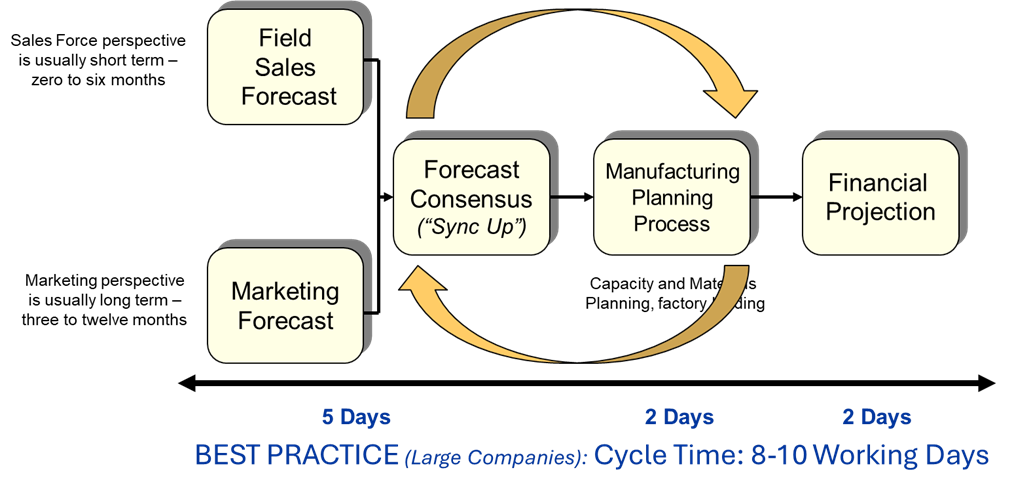
The process is a cycle. Sales and marketing provide forecast data from their various perspectives which “syncs up” into a demand forecast (what I want). This is provided to manufacturing (including purchasing) to generate material and capacity planning and a response to the demand forecast (what I can produce). There may be multiple cycles here, but eventually a consensus is reached and provided to finance to generate the financial forecast. [2]
Who makes the decisions?
Ideally, it’s a group consensus with alignment. However, it is important to have an escalation process or overall decision maker.
Is someone in the S&OP meeting the final decision maker? OR
What is the process to decide if and when there is an impasse? (CEO/CFO/COO, etc.)
What’s the feedback mechanism?
For the S&OP process to be most effective, there needs to be a solid feedback loop to all the constituents. Specific details need to be provided to all involved as an outcome of the process.
Sales and marketing need to know what volume and mix of products will be available to sell.
Purchasing and manufacturing need to know what to buy and what to build.
Finance needs to know what will be built, what will be bought, what will be sold, and, most importantly, when, to build an attainable financial forecast and cash plan.
There is also a need for ongoing feedback during the ensuing period: sales communicating “what’s selling” and manufacturing providing what’s available (“what I’ve got”), turning the sales funnel into a megaphone (i.e., “I’m out of Prime Rib! Push the Meatloaf!”)
Turning the Sales Funnel Into a Megaphone [2]
What’s the bottom line?
The S&OP process works. It can be painful to start, but once it’s operating, it adds immense value to your business.
Thanks and credit to David Gavlik for his contributions and insights for the Sip Club.
David Gavlik is an operationally focused finance professional with 25+ years of financial experience in multiple products and industries (including biological products, complex hardware solutions, and storage / workspace equipment manufacturing and distribution) in companies ranging from $50-100M. https://www.linkedin.com/in/david-gavlik-7924666/
Jeff Osorio is a Consulting CFO with over 30 years of experience in operationally oriented companies ranging from pre-Revenue to $4B with over 40 ERP implementations in his portfolio. He is also an Adjunct Professor in the MBA program of the Leavey School of Business at Santa Clara University. https://www.linkedin.com/in/jeff-osorio-1412181/
[1]“Orchestrating Success”, Richard C. Ling and Walter E. Goddard, Copyright 1988 by John Wliey & Sons, Inc
[2]“Managing For Performance”, Jeff Osorio, Copyright 2024
On Thursday, June 19th, 2025, the new Sip Club, hosted by Expandable Software, MIE Solutions, and Mirador Software Group, gathered nearly 50 leaders from across the industry for a real-talk look at how AI is being used today—on the floor, in the field, and beyond. From Hype to Hands-On: How AI is Changing Manufacturing featured Jaime Portocarrero and his endless energy and enthusiasm for the topic.
A Quick Survey
The session began with a quick survey of the participants on their current level of understanding or experience with AI, from “None: I’m a deer in the headlights” to “Experienced: I’m using AI successfully in many areas.” The good news is that while 58 percent responded that their experience to date was limited, 33 percent responded that they were either planning or developing an AI strategy and assessing tools—or adopting and using AI tools in a few key areas … thus validating that the AI evolution/revolution is here!
The State of AI in Manufacturing
The simple definition of AI is when machines can learn, think, make decisions, and perform tasks autonomously, as well as—or often better than—humans. This exists at several levels:
Narrow/Weak AI: Performs only the tasks it was programmed or trained for. Limited to a specific purpose or domain. (Where we are today)
General/Strong AI: Would be able to reason, solve problems, make judgments under uncertainty, plan, learn, and communicate in natural language. Multi-domain capable. (5 years out, ~ 2025 – 2040)
Super Intelligent AI (SAI): Would outperform the best human brains in practically every field. (Anyone’s guess 2045 – 2050)
RPA (Robotic Process Automation) and AI (Artificial Intelligence) are NOT the same
In general, RPA is a fixed (pre-defined) rule-based automation based on lookup tables: If, Then, Do. There is no learning or adaptation; rulesresponses don’t change. RPA lacks cognitive capabilities. It does not use an AI engine, it just follows the rules. Examples of this would include automating invoice entry or form completion.
On the contrary, Narrow or Weak AI, at today’s level, is AI that performs a specific intelligent task on the fly based on a given context. It can learn from data (e.g., Machine-Learning [ML] models). Responses can change and adapt to change. It mimics human-like decision-making and uses an AI engine for pattern matching. ChatGPT, MS CoPilot, facial recognition, and spam filters are examples of this technology.
A Massive Amount of Money and Effort is Being Invested in AI
$1.4 trillion has been invested in AI, with more to come. As of 2025, there are approximately 70,000 AI companies—companies offering Machine Learning, Natural Language Processing, Computer Vision, predictive analytics, and others across all markets—worldwide. According to Stanford’s 2024 AI Index Report, there were approximately 10,095 AI startups across the top ten countries leading in artificial intelligence innovation.
McKinsey and Company reports that for many technical capabilities, Generative AI (GAI) will perform at a median level of human performance by the end of this decade (2030). They project its performance will compete with the top 25 percent of people completing any and all of these tasks before 2040. In some cases, that’s 40 years faster than experts previously thought!
But AI is not replacing ERP; a system of record is and will always be required.
AI enhances ERP automation, predictive analytics, and data-driven decision-making, making enterprise systems more intelligent, responsive and productive.
The 2024 Gartner Hype Cycle for ERP sees these key themes for AI:
Generative AI in ERP – Automating workflows, enhancing decision-making, and improving efficiency.
Sustainability in ERP – Embedding ESG (Environmental, Social, and Governance) data into ERP systems.
Extended Planning & Analysis (xP&A) for ERP – Enhancing financial forecasting and business planning.
Composable ERP Strategies – Building adaptable, modular ERP ecosystems for increased agility.
How are Manufacturers Using AI Today
The use of AI is rapidly proceeding in leading major manufacturers today. These include mega-manufacturers like Boeng, GM, Ford, Tesla, Intel, GE, Proctor & Gamble, 3M, Lockheed Martin and John Deere, along with many others. Their applications include:
Predictive Maintenance: AI is used to monitor machinery to predict failures before they happen.
Robotic Process Optimization: AI is used to adjust robotic arms in real time to improve efficiency.
Quality Assurance (QA): AI is used to inspect products for defects using high-speed cameras.
Supply Chain Optimization: AI is used to predict demand and adjust logistics in real time.
Generative AI for Documentation: AI is used to draft Standard Operating Procedures (SOPs), maintenance logs, and part descriptions.
Product Innovation & Simulation: AI is used to simulate new materials or part designs before prototyping.
What’s Our Call to Action?
Using a crawl, walk, run approach is widely considered to be a smart and effective strategy, especially for organizations that are early in their AI journey. We’re not changing “the what” we do, but “the how” and “the who.” We need to welcome the age of AI agents.
Data accuracy and quality are critical. Success is data quality dependent—and a disaster without it. But remember, it’s not that complicated! Adoption will take a bit of up-front hard work (which is temporary) but once organized and mobilized, it gets easier.
How Do We Start?
Every journey requires that first step—that leap of faith. But it always helps to have a roadmap, a plan for how to get there.
Secure Executive Ownership & Accountability: This secures “skin-in-the-game,” no “opting-out,” and “failure is not an option.” Drive for strategic alignment and resource allocation—play to win!
Define Clear Business Objectives: AI should solve real business problems, not be just a technology experiment.
Establish Governance and Ethics Framework: Responsible AI use builds trust and ensures compliance.
Assess Data Readiness: AI thrives on quality data.
Build a Cross-Functional AI Team: AI success requires collaboration between domain experts, data scientists, and IT.
Start Small with Pilot Projects: Small wins build momentum and reduce risk.
Invest in Scalable AI Infrastructure: AI workloads require robust computing and storage.
Focus on Change Management and Training: AI adoption is as much about people as it is about technology.
What’s the Bottom Line?
AI is coming. The Grinch couldn’t prevent Christmas from coming, and we can’t stop the driving force of AI. AI is not a strategy, but a tool for business transformation and scale. It needs to be a commitment to forever change the DNA of the business. This is not an “opting-out” situation. You can either be an ostrich and put your head in the sand and hope it goes away or embrace AI and soar with the eagles.
Thanks and credit to Jaime Portocarrero for his contributions and insights for the Sip Club.
Jaime Portocarrero is a self-proclaimed “Silicon Valley kid” with over 25 years of experience helping companies scale their businesses and enabling competitive advantage via frictionless / LEAN process re-engineering and automation. He has strong cross-functional experience across Idea-to-Offer, Quote-to-Cash, Demand-to-Supply and Source-to-Pay. He specializes in ERP, CRM, high-tech sales, finance, operations execution and supply chain optimization. Jamie is a sourcing and procurement expert, contracts negotiator and SRM (Supplier Relationship Management) Program leader. https://www.linkedin.com/in/jaimeportocarrero/
Jeff Osorio is a Consulting CFO with over 30 years of experience in operationally oriented companies ranging from pre-Revenue to $4B with over 40 ERP implementations in his portfolio. He is also an Adjunct Professor in the MBA program of the Leavey School of Business at Santa Clara University.