The medical device industry operates under some of the most stringent regulatory requirements in manufacturing. From FDA compliance to ISO 13485 standards, manufacturers face complex challenges that demand precision, traceability, and operational excellence. A robust medical device erp system serves as the foundation for operational excellence in today’s regulated manufacturing environment, enabling companies to navigate these complexities while maintaining growth and profitability.
The bottom line on operational excellence in medical device manufacturing is clear: companies that implement comprehensive ERP medical device solutions consistently outperform those relying on disconnected systems. Leading manufacturers have discovered that implementing a medical device erp system dramatically improves their compliance and efficiency, with some reporting up to 14% faster product delivery times and 10% improvement in on-time order delivery.
The Challenge: Navigating Complex Regulatory Requirements
Medical device manufacturers face unique operational challenges that set them apart from other industries. The regulatory landscape demands complete traceability from raw materials to finished products, comprehensive documentation for every process, and the ability to quickly respond to quality issues or recalls.
What makes this particularly challenging is the need to balance regulatory compliance with operational efficiency. Many growing medical device companies find themselves caught between basic accounting software that can’t handle their complexity and enterprise solutions that are too expensive or cumbersome for their current size.
The manufacturing environment itself adds another layer of complexity. Whether producing surgical instruments, diagnostic equipment, or implantable devices, manufacturers must maintain lot tracking, manage consigned inventory, and coordinate with multiple suppliers while ensuring every step meets regulatory standards.
Real-World Success: How Trimedyne Transformed Operations
Trimedyne, a surgical laser manufacturer, exemplifies how the right medical device manufacturing software can transform operations. Before implementing Expandable’s ERP solution, the company struggled with limited control and visibility across their operations, relying on standalone systems that couldn’t provide the integrated view necessary for effective decision-making.
The challenge was particularly acute in their FDA compliance management. With surgical lasers requiring precise documentation and traceability, Trimedyne needed a system that could track every component through the manufacturing process while maintaining the detailed records required for regulatory submissions.
When evaluating ERP medical device solutions, Trimedyne prioritized integration capabilities and regulatory compliance features. The implementation of Expandable’s system provided them with a single database that integrated all their operations, from procurement through shipping.
The results were immediate and measurable. Trimedyne gained comprehensive transaction tracking across all departments, enhanced FDA compliance management through automated documentation, and improved operational control that allowed them to scale their operations efficiently. The single database approach eliminated the data silos that had previously hampered their ability to respond quickly to quality issues or customer inquiries.
As one Trimedyne executive noted, the transformation wasn’t just about technology—it was about gaining the visibility and control necessary to operate at the level their customers and regulators expected.
Scaling Success: IntegenX’s Growth Journey
IntegenX represents another compelling case study in how a medical device erp system can support rapid growth while maintaining compliance standards. As a med-tech startup, IntegenX initially operated with basic accounting software and spreadsheets—a common scenario for early-stage medical device companies.
The limitations of this approach became apparent as the company began scaling operations. Managing bill of materials, tracking lot numbers, coordinating with contract manufacturers, and maintaining the documentation required for FDA submissions became increasingly complex and error-prone.
The company recognized that their growth trajectory required more sophisticated medical device manufacturing software that could grow with them. The implementation of Expandable’s ERP system marked a turning point in their operational capabilities.
The transformation was comprehensive. IntegenX established robust processes that automated many of their previously manual operations, gained enhanced production visibility that allowed them to identify bottlenecks before they impacted delivery schedules, and improved their coordination with contract manufacturers through better data sharing and communication.
Perhaps most importantly, the system provided the scalability they needed. As IntegenX continued to grow, their ERP system adapted to support new product lines, additional manufacturing partners, and expanded regulatory requirements without requiring a complete system overhaul.
The company successfully scaled their operations while maintaining compliance, demonstrating how the right technology foundation can support sustainable growth in the medical device industry.
Industry Trends Driving ERP Adoption
The medical device industry is experiencing significant transformation, with several trends driving increased adoption of integrated ERP medical device solutions. Supply chain reconfiguration, particularly the shift toward onshoring and nearshoring, requires manufacturers to manage more complex multi-site operations while maintaining visibility and control.
The integration of artificial intelligence and advanced analytics into manufacturing processes demands systems that can collect, analyze, and act on data in real-time. Traditional standalone systems simply cannot provide the integrated data foundation necessary for these advanced capabilities.
Regulatory requirements continue to evolve, with increasing emphasis on digital documentation and traceability. The FDA’s focus on software as a medical device (SaMD) and the growing complexity of connected medical devices require manufacturers to maintain even more detailed records and demonstrate comprehensive quality management.
Workforce transformation is another critical factor. As the industry faces skills shortages and the need for digital literacy, user-friendly systems that can support both experienced professionals and new hires become essential for maintaining operational continuity.
Key Benefits Driving Operational Excellence
Modern medical device manufacturing software delivers operational excellence through several key capabilities. Complete traceability from raw materials through finished products ensures regulatory compliance while providing the visibility necessary for quality management and recall procedures.
Integrated quality management systems automate many compliance procedures, reducing the risk of human error while ensuring consistent application of quality standards. This integration is particularly valuable for managing corrective and preventive actions (CAPA), which require coordination across multiple departments and detailed documentation.
Financial control and cost management capabilities provide manufacturers with real-time visibility into production costs, material usage, and labor efficiency. This visibility enables more accurate pricing decisions and helps identify opportunities for operational improvement.
The ability to support multiple manufacturing modes—discrete, process, and project-based production—within a single system is particularly valuable for medical device manufacturers who often produce different product types requiring different approaches.
Implementation Best Practices for Success
Successful implementation of a medical device erp system requires careful planning and attention to industry-specific requirements. The most successful implementations begin with a clear understanding of regulatory requirements and how the system will support compliance processes.
Change management is particularly critical in the medical device industry, where established procedures and documentation practices are often deeply ingrained. Training programs must address not just how to use the new system, but how it supports and enhances existing quality management practices.
Data migration requires special attention to maintaining traceability and audit trails. Medical device manufacturers cannot afford to lose historical data that may be required for regulatory submissions or recall procedures.
Integration with existing systems, particularly quality management and document control systems, must be planned carefully to ensure seamless operations during the transition period.
The Path Forward: Choosing the Right Solution
For medical device manufacturers evaluating ERP solutions, the focus should be on systems specifically designed for regulated industries. Generic ERP systems often lack the specialized features necessary for medical device compliance and traceability requirements.
Expandable’s medical device ERP system provides the industry-specific functionality that growing medical device manufacturers need, with features like surgical kit modules, integrated quality management, and comprehensive traceability capabilities.
The investment in a proper medical device erp system pays dividends through improved efficiency, reduced compliance risk, and the scalability necessary to support growth. As the case studies of Trimedyne and IntegenX demonstrate, the right system becomes a competitive advantage that enables operational excellence.
Companies ready to explore how ERP can transform their operations can learn more about Expandable’s success storiesand see how other medical device manufacturers have achieved operational excellence through strategic technology implementation.
The bottom line is clear: in an industry where precision, compliance, and efficiency are non-negotiable, a specialized medical device erp system isn’t just a technology investment—it’s a strategic imperative for sustainable growth and operational excellence.
The medical device manufacturing industry stands at a critical juncture. Rising costs for materials and staffing, coupled with increasingly complex regulatory requirements, have pushed traditional enterprise resource planning systems to their breaking point. For medical device manufacturers looking to remain competitive in a fast-paced market, the integration of artificial intelligence and Internet of Things technologies into their ERP infrastructure isn’t just an upgrade—it’s a necessity.
A modern medical device erp system integrates AI and IoT technologies to address these critical operational challenges. While implementing these advanced systems requires careful planning and investment, the risks of not doing so can far outweigh the initial costs. Inefficient processes, limited visibility, poor customer satisfaction, and compliance challenges can erode profitability and stifle growth in an industry where precision and reliability are paramount.
Why Traditional Medical Device ERP Systems Fall Short
Medical device manufacturers are facing significant challenges with legacy systems that struggle to keep pace with modern requirements. Traditional medical device erp solutions often struggle with real-time data integration and predictive analytics, leaving manufacturers vulnerable to supply chain disruptions and compliance gaps.
The core issues plaguing conventional systems include fragmented operational views that prevent decision-makers from seeing the complete picture of their manufacturing processes. When production data exists in silos, separated from quality control metrics and supply chain information, manufacturers lose the ability to make informed decisions quickly. This fragmentation becomes particularly problematic when dealing with FDA audits or ISO 13485 compliance requirements, where complete traceability is essential.
Supply chain disruptions have become increasingly common, with traditional systems offering little warning before critical components become unavailable. Without predictive capabilities, manufacturers often discover shortages only when production lines halt, leading to delayed deliveries and frustrated customers. The recent global supply chain challenges have highlighted how vulnerable medical device manufacturers are when they rely on reactive rather than proactive inventory management.
Compliance risks represent another significant challenge. Medical device manufacturing operates under strict regulatory oversight, with the FDA requiring detailed documentation and traceability for every component and process. Legacy systems often require manual data entry and reporting, creating opportunities for human error that can result in costly compliance violations or product recalls.
The evolution of medical device erp system capabilities has been driven by the need for better compliance and efficiency. Modern AI-integrated systems are delivering remarkable operational improvements, with manufacturers reporting 25-30% time savings in processing and decision-making tasks, along with up to 60% improvement in decision accuracy.
Predictive analytics represents one of the most powerful AI applications in medical device manufacturing. By analyzing historical data patterns, supply chain trends, and market conditions, AI algorithms can forecast potential disruptions weeks or months in advance. This capability allows manufacturers to adjust procurement schedules, identify alternative suppliers, and maintain production continuity even when facing unexpected challenges.
Machine learning algorithms excel at quality control applications, where they can identify subtle patterns in manufacturing data that human operators might miss. These systems continuously learn from production data, becoming more accurate over time at predicting when equipment maintenance is needed or when process parameters drift outside acceptable ranges. For medical device manufacturers, this translates to fewer defective products, reduced waste, and improved patient safety outcomes.
Automated compliance tracking represents another significant advancement. AI-powered systems can monitor every aspect of the manufacturing process, automatically generating the documentation required for regulatory submissions. When auditors request specific information about a particular batch or component, the system can instantly provide complete traceability records, reducing audit preparation time from weeks to hours.
Implementing an advanced medical device erp system can deliver up to 60% improvement in decision accuracy by providing real-time insights into production performance, quality metrics, and supply chain status. This enhanced visibility enables manufacturers to respond quickly to changing conditions and make data-driven decisions that improve both efficiency and compliance.
IoT Integration: Real-Time Monitoring and Data Collection
The Internet of Things has revolutionized how medical device manufacturers collect and utilize operational data. IoT sensors and connected devices provide continuous monitoring of equipment performance, environmental conditions, and product quality throughout the manufacturing process.
Real-time equipment monitoring through IoT sensors enables predictive maintenance strategies that prevent unexpected downtime. Sensors can detect subtle changes in vibration patterns, temperature fluctuations, or power consumption that indicate potential equipment failures. This early warning system allows maintenance teams to schedule repairs during planned downtime rather than responding to emergency breakdowns that disrupt production schedules.
Environmental monitoring becomes particularly critical in medical device manufacturing, where cleanroom conditions and precise temperature control are essential for product quality. IoT sensors continuously track humidity, temperature, particle counts, and other environmental factors, automatically alerting operators when conditions drift outside acceptable parameters. This real-time monitoring ensures that products meet quality standards and reduces the risk of batch failures.
Connected devices throughout the production line enable seamless data flow between different manufacturing stages. When a component moves from one workstation to another, IoT tags automatically update the system with location, processing status, and quality check results. This automated data collection eliminates manual entry errors and provides complete visibility into work-in-progress inventory.
Edge computing capabilities allow IoT devices to process data locally, reducing latency and enabling immediate responses to critical situations. For example, if a sensor detects a temperature excursion in a sterilization process, the system can immediately alert operators and adjust process parameters without waiting for data to travel to a central server.
Implementation Challenges and Strategic Solutions
While the benefits of AI and IoT integration are clear, medical device manufacturers face several technical and organizational challenges when implementing these advanced systems. Understanding what an erp system in healthcare context does can help manufacturers appreciate the complexity of integrating multiple technologies while maintaining regulatory compliance.
Enterprise application integration represents one of the most significant technical hurdles. Medical device manufacturers typically operate multiple software systems for different functions—quality management, regulatory compliance, supply chain management, and production control. Creating seamless communication between these systems requires careful planning and often custom integration work.
Scalability concerns arise when manufacturers need to expand their operations or add new product lines. The integration of ai in medical device manufacturing has revolutionized predictive maintenance and quality assurance, but these systems must be designed to handle increasing data volumes and processing requirements as operations grow. Reusable programming frameworks and cloud-based architectures help address these scalability challenges.
Security vulnerabilities become more complex as manufacturers connect more devices and systems to their networks. IoT devices can create new entry points for cyber attacks, while AI systems require access to sensitive production and quality data. Robust cybersecurity measures, including network segmentation, encryption, and regular security audits, are essential for protecting operations.
Change management represents a significant organizational challenge. Employees who have worked with traditional systems for years may resist new technologies or struggle to adapt to AI-driven workflows. Successful implementations require comprehensive training programs and clear communication about how new technologies will enhance rather than replace human expertise.
Real-World Success Stories and Case Studies
The practical benefits of AI and IoT integration become clear when examining real-world implementations. A leading vaccine manufacturer achieved over €10 million in annual economic value by implementing AI-driven predictive maintenance and supply chain optimization. Their system now predicts equipment failures with 95% accuracy, allowing maintenance teams to prevent disruptions before they occur.
Next-generation medical device manufacturing software incorporates machine learning algorithms for quality control, as demonstrated by several innovative companies. Bloomlife successfully used AI-powered systems to fast-track their market access, streamlining compliance processes that traditionally take months or years. Their connected maternal health monitoring devices now provide real-time data that improves patient outcomes while maintaining strict regulatory compliance.
Theranica leveraged big data integration to create the world’s largest migraine registry, demonstrating how AI and IoT can transform not just manufacturing but also post-market surveillance and clinical research. Their wearable neuromodulation device collects continuous patient data, providing insights that drive product improvements and support regulatory submissions.
Edge AI applications have proven particularly valuable in surgical robotics and diagnostic equipment. Neurosurgery robots now incorporate embedded computing systems that provide zero-latency processing for critical procedures. AI-enhanced endoscopy systems use compact single-board computers to improve diagnostic accuracy while maintaining the portability required for clinical use.
These success stories share common elements: careful planning, phased implementation approaches, and strong partnerships with technology providers who understand the unique requirements of medical device manufacturing.
Regulatory Compliance in the AI and IoT Era
Understanding what is an erp system in healthcare context requires recognizing the critical importance of regulatory compliance. The FDA has established specific requirements for Software as Medical Device (SaMD) classification, which affects how AI algorithms must be validated and documented. Risk-based categorization determines the level of clinical evidence required, with higher-risk applications requiring more extensive validation protocols.
The right erp for medical device manufacturers must balance regulatory compliance with operational efficiency. Modern systems automatically generate the documentation required for FDA submissions, including design controls, risk management files, and clinical evaluation reports. This automation reduces the administrative burden on quality teams while ensuring that all regulatory requirements are met consistently.
Data protection requirements, including HIPAA compliance for systems that handle patient information, add another layer of complexity. AI and IoT systems must implement robust security measures to protect sensitive data while enabling the real-time processing required for operational efficiency. Encryption, access controls, and audit trails become essential components of any implementation.
ISO 13485 compliance requires detailed documentation of all processes and procedures. AI-powered systems can automatically generate this documentation, tracking every change to software configurations, process parameters, and quality procedures. This automated approach reduces compliance costs while improving audit readiness.
Clinical investigation requirements for AI-enabled medical devices continue to evolve as regulators develop new frameworks for evaluating machine learning algorithms. Manufacturers must stay current with changing requirements and ensure their systems can adapt to new regulatory expectations.
Future Trends
The medical device industry is poised for significant technological advancement over the next two years. Autonomous AI agents will automate complex workflow management tasks, reducing the need for manual intervention in routine operations. These systems will learn from operational patterns and automatically optimize processes for efficiency and compliance.
Conversational AI interfaces will simplify user interactions with complex ERP systems, allowing operators to query systems using natural language rather than navigating complex menu structures. This advancement will reduce training requirements and improve system adoption rates across manufacturing teams.
Real-time analytics capabilities will expand beyond current monitoring applications to provide predictive insights into market demand, regulatory changes, and supply chain risks. Manufacturers will be able to anticipate challenges and opportunities with greater accuracy, enabling more strategic decision-making.
Quantum-resistant security measures will become essential as quantum computing capabilities advance. Medical device manufacturers must prepare for new cybersecurity challenges while maintaining the connectivity required for AI and IoT applications.
Sustainability optimization will become increasingly important as manufacturers face pressure to reduce environmental impact. AI systems will optimize energy consumption, reduce waste, and improve resource utilization while maintaining product quality and regulatory compliance.
Choosing the Right Medical Device Manufacturing Software
Selecting the appropriate technology platform requires careful evaluation of current needs and future growth plans. The ideal medical device erp system should provide comprehensive traceability, automated compliance reporting, and seamless integration with existing quality management systems.
Key evaluation criteria include the system’s ability to handle complex bill-of-materials structures, support for serialized inventory tracking, and integration with laboratory information management systems. The platform should also provide robust reporting capabilities that support both internal decision-making and regulatory submissions.
Cloud-based solutions offer significant advantages in terms of scalability, security, and maintenance requirements. However, manufacturers must ensure that cloud providers meet the strict security and compliance requirements of the medical device industry.
Vendor selection should prioritize companies with proven experience in medical device manufacturing and a clear understanding of regulatory requirements. The implementation partner should provide comprehensive training, ongoing support, and a clear roadmap for future enhancements.
For manufacturers ready to explore advanced ERP solutions, comprehensive medical device ERP systems offer the integrated capabilities needed to compete in today’s demanding market environment.
Conclusion: Embracing the Future of Medical Device Manufacturing
The integration of AI and IoT technologies into medical device ERP systems represents more than just a technological upgrade—it’s a fundamental shift toward more intelligent, responsive, and compliant manufacturing operations. As we’ve seen, manufacturers who embrace these technologies are achieving significant improvements in efficiency, quality, and regulatory compliance.
The evidence is clear: companies implementing AI-enhanced systems report 25-30% improvements in operational efficiency and up to 60% better decision accuracy. These aren’t just incremental improvements—they represent the kind of competitive advantages that separate industry leaders from followers.
The path forward requires careful planning, strategic investment, and partnerships with experienced technology providers. However, the risks of maintaining the status quo far outweigh the challenges of implementation. In an industry where patient safety, regulatory compliance, and operational efficiency are paramount, the question isn’t whether to adopt AI and IoT technologies—it’s how quickly you can implement them effectively.
For medical device manufacturers ready to transform their operations, the future of intelligent, connected manufacturing is available today. The companies that act now will be best positioned to thrive in an increasingly competitive and regulated industry.
What is Backflushing?
From a functional perspective, backflushing automates the issuing of material to the manufacturing floor upon the completion of the production process, which the ERP system defines as the point when the manufactured part is transacted into Finished Goods.
From a backflushing evangelist’s perspective, Backflushing is a way to significantly increase manufacturing efficiencies by eliminating manufacturing Work Orders and its associated task of issuing material to the Work Order.
How does Backflushing Work?
The actual backflushing process is really quite simple and contains a few basic steps:
MANUFACTURING LOGISTICS
Employees use the materials it needs to manufacture the quantity of the Part ID for a particular manufacturing schedule
Scrap is tracked
When the Part ID is ready to be transferred to another Inventory location (e.g., Finished Goods) the following information is entered into the ERP system:
Part ID manufactured
Quantity manufactured
Scrap incurred
ERP SYSTEM CALCULATIONS and AUTOMATED ENTRIES
The ERP system will reduce the amount of raw materials and/or any sub-assemblies for the:
Increase the inventory in Finished Goods for the quantity of the part that was manufactured
One can certainly make an argument that any one of the above examples where the prevention of an error, cost avoidance, and/or process improvement could very easily pay for the cost of an alerts module all by itself.
Follow-up Analysis and the Importance of Cycle Counting
By definition, if the BOM is accurate and all scrap is recorded, the only material manufacturing variance should be for any scrap recorded over/under the yield in the BOM. The only way to verify the accuracy of the backflush process is to establish and follow an efficient and regular cycle count program. If the cycle counts result in significant material quantity variances, then either the BOM is not accurate or scrap is not being recorded properly and corrective action must be taken immediately.
Keys to Success
To have a successful backflush process there are a few important things to ensure:
The BOM must be extremely accurate in terms of quantities, expected yield and structure (raw materials vs. sub-assemblies) and contain few if any variable components
Scrap for the production run are recorded on a timely basis
Production cycles are relatively quick
A strong cycle counting program is up and running
While there is no hard and fast rule on what is acceptable or required, most companies categorize their inventory into three classifications; 1) “A” items which typically represent 15-20% of the quantity and 75-80% of the total inventory value, 2) “B” items which usually comprise 15-25% and 10-20% of the quantity and value respectively and 3) “C” items comprising the balance and therefore having about 65-70% of the quantity, but only around 5% of the value.
This inventory value distribution is used primarily for inventory control purposes. Inventory control can include various forms including how tightly a particular inventory item is secured and the accuracy of purchase quantities and cycle counting. In essence, the main purpose is to focus a company’s inventory control on mainly the “A” items, less so on the “B’ items and even less on the “C” items. For example, a company may decide to cycle count their “A” inventory once a week or once a month, the “B” inventory once a quarter or twice a year and the “C” items once a year. Similarly, the “A” inventory items will get the most review and analysis of the purchasing recommendation provided by the MRP.
The benefit of focus is the reason why most companies do categorize their inventory in this manner. Without this tool manufacturing, purchasing and finance personnel will end up spending an inappropriate amount of time reviewing purchases and cycle counts on parts that do not warrant such attention.
The “D” category (which I chose to define it for this blog) mentioned in the title is a bit of a misnomer as it really is not a category, because it represents items of such little value they should be expensed upon receipt; i.e. not classified as inventory for financial reporting purposes. A good example of such “inventory” would be any inexpensive nuts, bolts or washers. Obviously, for “D” parts there would be no need to cycle count nor spend a lot of time analyzing the inventory as the decision was already made by management to expense it.
With the above as context, a reasonable question that finance and manufacturing should ask is should we reclassify some of our existing “C” inventory to a more appropriate expense item. By definition, there will be a one-time charge to the P&L when the existing inventory is expensed, but the charge should be immaterial given the low-value of the parts being reclassified.
Bottom-line: at a minimum, a once a year review of all your inventory items should be done so that all parts are classified appropriately in order maintain the appropriate level of management and control of the inventory. This review should also include analyzing “C” items to determine if certain items should be expensed upon receipt.
One of the more common axioms in the manufacturing world is “Inventory is Evil”, because too much inventory can only lead to problems. The most common problems often sited are the cash consumed purchasing the inventory, increased warehouse costs to store excess inventory, higher obsolescence write-offs when a particular part is classified as obsolete or inactive, and extra manpower to count, review and manage the inventory.
So, how does a company, even a well-managed one, get into inventory trouble in the first place? Two obvious reasons include poor forecasting by sales and unexpected inventory obsolescence due to a technology change. However, to list all the potential reasons for high inventory levels is beyond the scope of this narrative as the intent is to help you to discover ways to reduce your inventory levels without making overhauling your current basic processes; in other words quick fixes that can have dramatic results.
One of operations’ key responsibilities is to ensure the appropriate level of inventory is on-hand to support sales. With this in mind there are four important points to consider:
The main tool that operations use to recommend inventory purchases is Material Requirements Planning (MRP).
The basic assumptions that drive purchase recommendations by the MRP are forecasted total sales, sales orders already in backlog, bill-of-materials (BOM), vendor and in-house lead times, and safety stock levels.
The basic stereotypical trait of most manufacturing people is risk avoidance
The general philosophy of most companies, particularly companies experiencing high growth (e.g. start-ups), is to not lose a sale due to lack of inventory. In addition, it is my experience from working for manufacturing companies in fast paced Silicon Valley, a manufacturing manager or purchasing employee is much more likely to get fired for missing a sale than ending up with excess inventory. Playing it safe thereby becomes a basic survival strategy.
Since the BOM, including yield percentages, always needs be accurate as possible and backlog is a known quantity, operations have only a few remaining ways to insert some conservatism (i.e., playing it safe) into the MRP output. They can increase the demand side of the calculation by nudging the Sales forecast up a bit or increase the supply requirements by ratcheting up either the lead times or safety stock levels of all purchased and manufactured inventory.
The analysis and impact of safety stock is pretty straightforward so I won’t spend much time here, but lead time is a bit more challenging and therefore probably warrants a more frequent review than safety stock levels. In fact, Supply Chain Digest published an article on May 4, 2006 titled ‘The Impact of Lead Time Variability’ highlighting “Preliminary Research out of Georgia Tech finds there’s a lot more variability on inbound deliveries than many companies may realize” and as Georgia Tech’s Dr. Donald Ratliff noted that “not only does lead time variability impact a variety of supply chain cost and performance metrics, the impact of variability is actually greater the more efficient a company’s supply chain is.”
That is a rather thought provoking mouthful. In essence, even though lead time variability impact is more prevalent than believed, the impact is greater on well-run supply chains.
Given that a very common way to be conservative in inventory planning is to increase lead times and the implications on lead time variability per the Georgia Tech study, it warrants a more frequent review than it probably is receiving today. To complicate matters just a bit, there are numerous places where lead times can be used or “hidden”. However, a great place to start is the lead time for the receiving department to receive inventory and then place the item into its appropriate stock location in the warehouse. Depending on your particular situation, this particular lead time might even be considered superfluous, because if there is an urgent need for specific material, manufacturing will not only be aware of its arrival at the dock, they will find a way to expedite the material out of receiving and onto the production floor.
Coming from my finance background, conservatism does have its place. However, the impact of being conservative should at the very least be understood by all so that any conservatism becomes a conscious decision by the executive team. For example, let’s assume that the annual COGS for a company is $10,000,000 and the inventory level is $2,500,000. This equates to an inventory turn of 4.0 or having 91.25 days of inventory on hand. If the company has a 1 day lead time for material receipts, then by eliminating this lead time, will by definition, reduce inventory to 90.25 days in inventory. This reduction will result in an inventory being reduced by 1.1% / $110,000 as the company’s MRP will now calculate the inventory purchase requirements based on a shorter lead time.
Bottom line: both lead times and safety stock are typically set and reviewed infrequently. However, as their impact can be a significant drain on cash and a cause of an increase in inventory obsolescence expenses when parts are classified as inactive, they both should be reviewed and analyzed for appropriateness and accuracy at least once a year to ensure that all inventory conservatism is known and understood by all so that appropriate action can be taken.
The three main benefits of lean manufacturing, if implemented correctly, are 1) a reduction in inventory levels 2) it exposes inefficiencies on the production floor and 3) it reduces waste. One of the key elements of lean manufacturing is the deployment of a Kanban system.
While there different types of Kanban systems, a simplistic definition is it represents a Demand-Pull production approach where customer orders dictate what is manufactured as opposed to the more traditional Demand-Push where the manufacturing organization is tasked with producing specific quantities for specific parts to meet an approved sales forecast for a given period. One of the critical keys to success of a Kanban system is to have an efficient/effective Just-in-Time inventory system so that inventory can be delivered to the factory quickly to satisfy inventory requirements for an order received.
Technically, a Kanban inventory system uses a Kanban (a graphic or visual signal; e.g. color coded cards or lights) that indicate to manufacturing to produce another unit or to replenish inventory on-the-manufacturing-line. Its intent is to minimize inventory levels on the manufacturing floor and to control the quantity of production for a particular product.
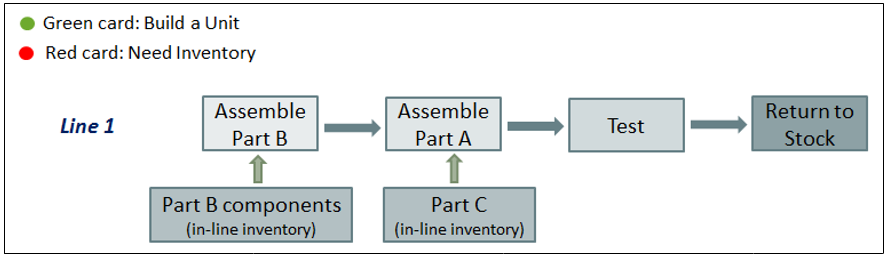
A simple example is described below in Scenario 1:
An order is received for 10 units of Part A
Part A’s top level Bill-of-Material is sub-assemblies B plus one Part C
The manufacturing floor is comprised one line with a 3 step process:
Process 1: Build sub-assembly B
Line 2: Build Part A (Part B + Part C)
Test
Scenario 1
The manufacturing process would be:
Issue a Green card to Line 1 to build 10 units
In-line inventory actions:
If all inventory levels were sufficient at the time the green card was received, use in-line inventory to assemble 10 of Part B and 10 of Part A
If after manufacturing the order, additional in-line inventory is required the impacted manufacturing location(s) will post a Red card.
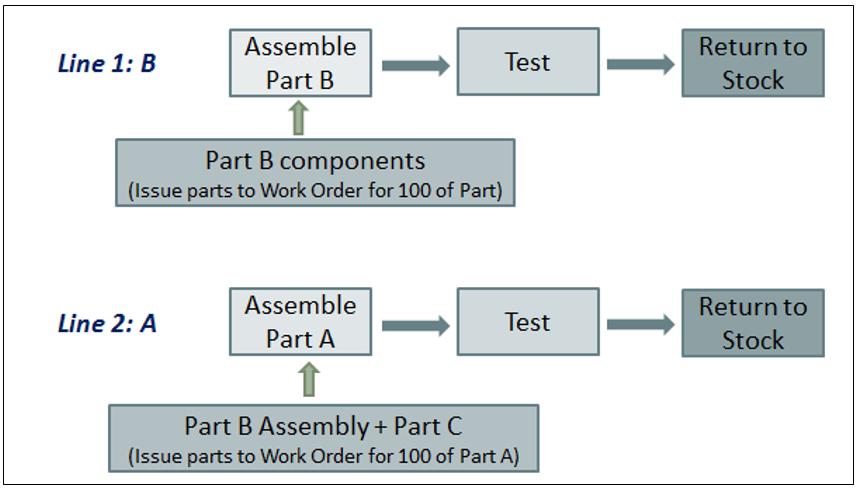
In comparison, if a Work Order system is used (Scenario 2) then the below manufacturing process would be used. The important element in this scenario is the 10 units for Part A were considered part of the 100 unit forecast that manufacturing used in their production planning.
Scenario 2
The two biggest risks that often are associated with Kanban are 1) if a large order quantity is received, the Kanban system may find it difficult to produce the required quantity in time for the requested delivery date to the customer and 2) If the manufacturing production cycles are long the manufacturing floor space required to keep the production flowing might become extensive.
Recently I was walking through a warehouse with the owner of a small distributor, when one of his employees brought him a widget that had been damaged by a forklift. The owner told him to trash the widget, and tell accounting to write it off; the value of this widget, $170. This got me thinking, “are they aware of the cost to replace this widget?”
Later, I asked the warehouse person how much they would need in sales to replace this widget; he said $170. Well, not exactly, let me explain.
In order to replace the cost of the damaged widget, the money must come from the margin of future sales. This company earns a 2% margin for this widget, so they must sell 50 widgets, just to pay for the widget that was damaged! That is $8,500 in additional sales!
$170/.02 = $8,500 in new sales needed to replace damaged widget
$8,500/$170 = 50 widgets
This example doesn’t take into account carrying costs; if carrying costs were 30%, the replacement cost would be $11,050!
This chart illustrates additional sales required to make up for lost/stolen/damaged inventory:
Gross Margin
Item Value
2%
3%
4%
5%
6%
$25
$1,250
$833
625
$500
$417
$50
$2,500
$1,667
$1,250
$1,000
$833
$100
$5,000
$3,333
$2,500
$2,000
$1,667
$200
$1,0000
$6,667
$5,000
$4,000
$3,333
$500
$2,5000
$1,6667
$12,500
$10,000
$8,333
$1,000
$50,000
$33,333
$25,000
$20,0000
$16,667
Again, to breakeven on lost, damaged or stolen inventory, the replacement cost comes from future profits! How much harder must your sales team work to make up for damaged, lost or stolen inventory?
These little inventory costs that occur daily and weekly add up over time, and at the end of the year, these “little” costs can have a substantial effect on the bottom line. Therefore, it is important for employees to understand costs associated with inventory, and the impact it has on the company’s financials.