Quality 4.0 combines AI, machine learning, and IoT with traditional quality management principles—shifting manufacturing operations from reactive problem-solving to proactive defect prevention.
Measurable Impact on Operations:
AI-powered inspection systems achieve 95-99% defect detection accuracy, processing over 10,000 parts per hour, eliminating the 20-30% miss rate of human inspectors and cutting customer complaints by 85%.
Quality 4.0 delivers 10-15% productivity gains and enables predictive maintenance that cuts costs by 25-40% while reducing unexpected equipment downtime by 70-75%.
Real-time data integration across ERP systems allows manufacturers to detect quality issues hours before traditional checks, automatically adjust production parameters, and respond to market trends 4.3 times faster than competitors.
Machine learning changes supplier quality management by analyzing historical performance data to predict delivery risks and flag high-risk suppliers before orders are placed—preventing costly disruptions before they start.
Critical Success Factors:
Technology alone won’t get you there. 70% of digital transformations fail due to employee resistance rather than technical limitations. Organizations that apply structured change management see a 52% higher probability of achieving project goals—making upskilling and cultural change just as important as the tools themselves.
Quality 4.0 can increase productivity by 10-15 percent. At the heart of this is ERP quality management enhanced by AI and machine learning. Traditional quality control struggles with complexity and inconsistency. Quality 4.0 addresses this directly—integrating digital technologies like AI, IoT, and analytics into quality management, so manufacturers can detect issues early and optimize processes continuously.
The quality management module in ERP systems now uses predictive analytics and real-time data to move from reactive to proactive control. The result? These advancements in quality management ERP software reduce the cost of poor quality while improving efficiency across operations.
What does that mean in practice? This article examines how AI and machine learning are reshaping ERP quality management modules—and what it means for your manufacturing operation.
Understanding Quality 4.0 and ERP Integration
What Quality 4.0 Means for Manufacturing
Quality 4.0 is the application of Industry 4.0 digital technologies—AI, IoT, advanced analytics—to strengthen traditional quality management practices. The key word here is “strengthen.” This is not about discarding what works. Root Cause Analysis, Lean, Six Sigma—these remain foundational. Quality 4.0 identifies the gaps where digital tools can deliver step-change improvements on top of these proven methods.
The scope goes well beyond technology adoption. Quality 4.0 connects people, processes, and technology across the entire value chain—engineering, manufacturing, maintenance, and external stakeholders including suppliers and customers. Manufacturing companies pursuing these initiatives are targeting double-digit improvements in both operational and financial metrics.
Predictive quality management sits at the core of this approach. The goal is to detect defects before mass production begins, using historical product data to build predictive models. The result: physical quality tests get replaced with forecasts, quality management costs come down, and products get better.
Data and Connectivity in Modern ERP Systems
ERP systems serve as the central data hub—providing full traceability of parts and products across multiple levels of the supply chain. The problem arises when quality management operates in isolation. Data collected in a standalone quality system cannot communicate with transaction data in ERP or logistics data in supply chain management systems. That disconnect creates a very real, very quantifiable financial drag.
Modern ERP quality management addresses this through a centralized data model—quality software running off the same master data that ERP and SCM systems use. This shifts quality from an oversight function to an anticipatory component of daily operations. The downstream effect is significant. Decisions become faster, forecasts grow more accurate, and teams stop second-guessing the numbers.
IoT integration takes this connectivity further. Sensors monitor variables like temperature, pressure, and assembly speed in real time, with ERP systems storing that data for pattern analysis. Consistent product standards become easier to maintain, defective units decrease, and customer confidence strengthens.
The Shift from Reactive to Proactive Quality Control
What is the real difference between reactive and proactive quality management? Reactive methods address issues after they emerge—often without clear processes for reporting or resolution. Proactive approaches anticipate future risks and prevent them from escalating in the first place.
This distinction matters increasingly at a regulatory level, too. ISO 9001:2015 mandates risk-based thinking in quality management. ISO 13485:2016 goes further, requiring proactive risk management to continuously monitor and mitigate quality risks. Organizations that use predictive analytics to capture nonconformance trends early can identify error patterns before they become costly problems. The principle is straightforward: capture and analyze data so that defects never reach end-users.
How AI Is Changing ERP Quality Management
Manufacturing operations have moved well beyond what traditional quality methods can handle alone. AI-powered solutions now address quality challenges at speeds and accuracy levels that simply weren’t achievable before. The quality management module in ERP systems has gained significant new capabilities—machine learning algorithms analyze production data continuously, flag failures before they occur, and optimize processes in real time.
Automated Inspection and Defect Detection
The numbers here are hard to ignore. AI vision inspection systems achieve 95-99% detection accuracy while processing 10,000+ parts per hour at sub-100ms inference speed. Human inspection, by contrast, misses 20-30% of defects under real production conditions. Convolutional Neural Networks analyze images from cameras, borescopes, and robotic crawlers to identify patterns and anomalies that even experienced inspectors overlook.
The financial impact is measurable:
Manufacturers report 37% defect reduction and 85% fewer customer complaints after implementing AI defect detection
Leading automotive manufacturers document a 60% reduction in warranty claims across production lines
Every decision is logged with image, timestamp, defect category, and severity score—creating complete, auditable quality records
That last point matters more than it might seem. Full traceability isn’t just good practice; it’s often a compliance requirement.
Predictive Maintenance Through Machine Learning
Scheduled maintenance has a fundamental flaw: it doesn’t account for actual equipment condition. Machine learning changes that. Sensors capture vibration rates, oil pressure, and temperature data, which AI algorithms analyze to forecast equipment deterioration before it causes a problem.
The result? Manufacturers achieve 35-45% reduction in downtime, 70-75% elimination of unexpected breakdowns, and 25-30% reduction in maintenance costs. That’s a meaningful shift—from responding to failures to preventing them.
Quality Forecasting Across Production Batches
Pharmaceutical manufacturers offer a clear example of what’s now possible. Using process data from historians, AI models built on reactor temperature, volume, and concentration enable modifications during production—before batches require scrapping. Instead of waiting hours for lab results, quality teams get near real-time batch quality predictions. The savings run into the millions, driven by fewer out-of-specification batches and real-time parameter adjustments.
This is predictive quality management in practice. Catch the issue during production, not after.
Reducing Cost of Quality with AI-Driven Insights
Poor data quality issues carry a steep price tag. Over a quarter of organizations lose more than $5 million annually because of data quality problems, and 43% of chief operations officers identify this as their most significant data priority. The connection to AI performance is direct—bad data produces bad outputs. Unity Technologies reported approximately $110 million in lost revenue when inaccurate data corrupted the machine learning models supporting their advertising algorithms.
Clean data isn’t a nice-to-have. It’s the foundation everything else is built on.
Real-Time Compliance Management
Compliance management has traditionally been labor-intensive and reactive. AI changes that equation significantly. Automated documentation and monitoring deliver a 99%+ reduction in audit findings, while proactive CAPA workflows improve compliance audit scores by 25-40% through systematic root cause analysis and predictive insights. Real-time monitoring systems continuously scan activities, detect anomalies, and flag potential violations as they occur—well before they become reportable incidents.
For manufacturers operating in regulated environments, this capability alone justifies the investment.
Machine Learning Applications in Quality Management Modules
The AI capabilities covered above don’t operate in isolation—they plug directly into the quality management module, working alongside established methodologies to sharpen their output.
Statistical Process Control Gets Smarter
Statistical Process Control has always enforced disciplined data collection. That discipline is exactly what machine learning requires to perform well. Organizations that tightened data discipline before adding analytics cut data cleansing time by 45%—a meaningful head start when deploying AI models.
SPC alone delivers 37% defect reduction and $1.20M in annual savings. Combine it with machine learning, and manufacturers achieve 50%+ defect reduction with annual savings climbing to $1.80M–$2.50M. The reason is straightforward: machine learning correlates supplier lot attributes with final yield, blends tool wear trends with vibration signatures, and forecasts failures days ahead of the event. SPC sets the foundation; machine learning builds on it.
Supplier Quality Management Optimization
Supplier risk has always been difficult to quantify until something goes wrong. Machine learning changes that. AI tools within the quality management module automate PPAP document reviews and conduct root cause analysis through pattern recognition—tasks that previously required significant manual effort and specialist judgment.
The real value, though, is predictive. Machine learning models assess supplier risk across economic, environmental, and social dimensions by analyzing historical ERP data—delivery performance, quality metrics, compliance records. These systems identify high-risk suppliers and predict late delivery probability before orders are placed. That means procurement decisions are informed by forward-looking risk signals, not just past performance.
Yield Optimization Through Data Analysis
What if quality issues could be flagged hours before they show up in a traditional quality check? That’s exactly what advanced algorithms make possible, analyzing real-time process data to detect yield problems well ahead of schedule.
The specificity is what makes this valuable. Semiconductor manufacturers have found, for example, that material from particular suppliers produces 3% more defects under certain temperature conditions. Once that pattern is identified, systems automatically adjust process parameters within safety limits to maintain optimal yield—without waiting for a defect to surface.
Learning from Historical Quality Data
Historical data is only useful if it’s clean. Machine learning expedites data cleaning activities, reducing what were once weeks of work down to hours. Algorithms identify missing records, fill data gaps using historical relationships, and correct entry errors that standard validation would miss.
The practical impact is significant. Quality management ERP software is only as reliable as the data it runs on—and machine learning ensures that foundation is sound.
Challenges and Benefits of Quality 4.0 Implementation
The technology itself is only part of the story. Getting Quality 4.0 to deliver results requires addressing factors that are harder to measure than processing speeds or defect rates—and easier to underestimate.
Overcoming Resistance to Digital Transformation
Here’s a sobering statistic: nearly 70% of digital transformations fail—not because the technology doesn’t work, but because the people using it resist the change. Employee resistance derails 70% of change efforts despite substantial technology investments. Meanwhile, 60% of employees work in environments where a culture of quality simply doesn’t exist.
Technology alone won’t fix this. If the workforce isn’t brought along on the journey, even the most capable AI-powered quality system will underperform. The good news? Organizations that apply structured change management see a 52% higher probability of achieving their project goals. Upskilling and cultural alignment matter just as much as the software itself.
Data Integration Across Legacy Systems
Fragmented data is the top obstacle for 37% of companies pursuing quality improvements. Legacy systems compound the problem—creating format incompatibilities, performance bottlenecks, and security vulnerabilities that modern workloads quickly expose. Successful integration demands robust data transformation layers and updated security protocols. Without this foundation, even the best machine learning models will operate on unreliable inputs.
Building Analytical Skills in Quality Teams
Only 25% of companies feel adequately equipped to meet their current analytics needs. Yet 82% acknowledge that analytics will be critical to their operations within five years. The gap is real—and it’s closing through training rather than hiring. Nearly half of organizations (47%) are prioritizing upskilling programs to address this. Quality professionals are evolving from data analysts into data management roles—a shift that reflects just how central data has become to modern quality operations.
Measurable Benefits: Productivity and Cost Reduction
The case for Quality 4.0 is well-supported by the numbers:
10-15% productivity improvements across manufacturing operations
25-40% reduction in maintenance costs, with downtime cut by 35-45% through AI-driven predictive maintenance
60% efficiency gains on specific tasks where automation is applied
These aren’t marginal gains. For a manufacturer operating at scale, even a 10% productivity improvement can represent millions in recovered capacity.
Enhanced Decision-Making with Real-Time Visibility
Static reports tell you what happened. Real-time data tells you what’s happening—and what to do next. Organizations with real-time analytics capabilities respond to market trends 4.3 times faster than competitors. That speed advantage compounds over time, creating a widening gap between manufacturers who act on live data and those still waiting for end-of-week summaries.
Scalability and Flexibility Advantages
Cloud-based quality management ERP software eliminates the need for extensive infrastructure planning. Systems deploy quickly and scale as business needs grow—which matters for manufacturers who can’t afford to outgrow their software every few years.
The bottom line: the benefits of Quality 4.0 are real and measurable. But so are the barriers. Addressing both—with equal seriousness—is what separates a successful implementation from an expensive one.
Conclusion
Quality 4.0 represents a fundamental shift in how manufacturers approach quality management. We explored how AI and machine learning transform ERP quality modules through automated inspection, predictive maintenance, and real-time compliance monitoring. These technologies deliver measurable results: 10-15% productivity improvements, 25-40% cost reductions, and drastically fewer defects. As a matter of fact, the manufacturers who embrace these capabilities today position themselves to compete more effectively tomorrow. Your journey toward proactive, data-driven quality management starts with understanding these transformative technologies.
FAQs
Q1. What is Quality 4.0 and how does it differ from traditional quality management? Quality 4.0 applies Industry 4.0 digital technologies like AI, IoT, and analytics to enhance traditional quality management practices. Rather than replacing proven methods like Six Sigma or Lean, it builds upon them by integrating people, processes, and technology across the entire value chain. This approach shifts quality management from reactive problem-solving to proactive defect prevention through predictive analytics and real-time monitoring.
Q2. How much can manufacturers expect to improve productivity with Quality 4.0 implementation? Manufacturers implementing Quality 4.0 typically achieve productivity improvements of 10-15%. Beyond productivity gains, organizations also experience 25-40% reductions in maintenance costs, 35-45% decreases in equipment downtime, and 37% defect reduction. Some specific tasks can see efficiency gains as high as 60%, with annual savings ranging from $1.80M to $2.50M when AI is combined with statistical process control.
Q3. What role does AI play in automated quality inspection? AI-powered vision inspection systems achieve 95-99% detection accuracy while processing over 10,000 parts per hour at speeds under 100 milliseconds. These systems use Convolutional Neural Networks to analyze images and identify defects that human inspectors often miss—traditional human inspection misses 20-30% of defects under real production conditions. Manufacturers report 37% defect reduction and 85% fewer customer complaints after implementing AI defect detection.
Q4. Why do so many Quality 4.0 digital transformation initiatives fail? Approximately 70% of digital transformations fail primarily due to human factors rather than technical issues. Employee resistance to change is the leading cause, with 60% of employees working in environments that lack a quality culture. Organizations that apply structured change management approaches see a 52% higher probability of achieving their project goals, demonstrating that addressing the people side of transformation is as critical as implementing the technology.
Q5. How does machine learning improve supplier quality management in ERP systems? Machine learning enhances supplier quality management by automating document reviews, conducting pattern-based root cause analysis, and assessing supplier risk across multiple dimensions. These systems analyze historical ERP data including delivery performance, quality metrics, and compliance records to identify high-risk suppliers and predict late delivery probability before orders are placed. This proactive approach helps manufacturers optimize their supply chain quality and reduce disruptions.
Medical device ERP systems that haven’t been updated in years are silently draining healthcare providers’ resources at an alarming rate. Outdated technology infrastructure forces clinical staff to rely on manual processes, creating costly inefficiencies throughout operations. Healthcare organizations using legacy systems report spending 30-40% more on administrative overhead than those with modern solutions.
Despite significant advancements in medical device manufacturing technologies, many healthcare providers continue struggling with legacy systems that cannot keep pace with today’s demands. The resistance to digital transformation often stems from concerns about disruption to daily operations during ERP implementation. However, the financial impact of maintaining outdated systems far exceeds the initial investment in modernization. Furthermore, evolving medical device regulations require sophisticated compliance tracking capabilities that legacy platforms simply cannot provide. This article examines seven critical areas where outdated ERP systems are causing massive financial losses and operational inefficiencies for healthcare organizations.
Disconnected Financial Systems and Budgeting Gaps
Legacy medical device ERP systems create critical gaps between financial planning and accounting functions that drain resources and compromise decision quality. Healthcare organizations report losing substantial revenue because of inefficient data utilization, with 90% of healthcare executives confirming this costly trend. These disconnected systems force financial teams to operate in fragmented environments while attempting to manage increasingly complex healthcare budgets.
Lack of integration between FP&A and accounting modules
When financial planning and analysis (FP&A) functions remain disconnected from accounting systems, healthcare organizations struggle with incomplete and inaccurate financial reporting. Although medical device ERP systems are marketed as end-to-end financial management solutions, they frequently lack the granular detail needed for strategic planning tasks like performance forecasting, profit margin analysis, and scenario planning. This integration gap means that 66% of finance leaders see immediate opportunities for improvement in explaining forecast and budget variances.
Manual forecasting leads to budget inaccuracies
Most healthcare organizations continue to rely on spreadsheets for financial planning, creating what finance leaders describe as “entity sprawl,” where each clinic, hospital, or division maintains separate worksheets. This manual approach introduces multiple points of failure:
Broken formulas and disconnected links between spreadsheets
Version control chaos with multiple “final” documents
Manual consolidation processes taking days to complete
Inconsistent data formats across departments
Financial teams spend excessive time manually fixing broken formulas and reconciling reimbursement assumptions instead of providing strategic guidance. Additionally, data silos prevent the integration of operational metrics with financial planning, leading to misaligned budgets and ineffective resource allocation.
Delayed financial reports severely impact healthcare providers’ ability to make timely strategic decisions. Organizations with month-long reporting delays frequently miss reimbursement deadlines from programs like Medicare and Medicaid, causing cash shortages and forcing reliance on costly short-term financing. According to a 2024 Deloitte report, organizations consistently filing late financial reports experience 23% more compliance issues than those with efficient processes.
Healthcare organizations must navigate complex reimbursement models that require real-time visibility into financial performance. Consequently, institutions with disconnected systems face compounding challenges as they attempt to adapt their budgets to accommodate fluctuating reimbursement rates. Without integrated systems connecting clinical and financial data, healthcare providers struggle to calculate service line profitability or make informed investments in patient care.
Manual Payroll and Human Capital Management Processes
Healthcare providers using outdated payroll systems within legacy medical device ERP platforms face mounting labor management challenges that directly impact profitability. With labor representing approximately 60% of hospital costs, inefficient payroll systems create financial losses that grow exponentially across large healthcare organizations.
No link between payroll and financial systems
Many healthcare organizations continue operating with disconnected human capital and financial management systems. This separation forces finance teams to rely on manual imports and journal entries to integrate payroll data with accounting platforms. Such fragmentation creates significant operational barriers as clinics and hospitals struggle to maintain accurate financial records. Without integrated systems, healthcare organizations cannot properly allocate staffing resources based on patient needs or budgetary constraints.
The consequences extend beyond mere inconvenience. Finance teams waste valuable time reconciling multiple, often conflicting reports to understand true labor utilization. Notably, since these reports frequently rely on payroll data that is weeks old, managers essentially monitor labor costs “through the rearview mirror”, making proactive financial management impossible.
Inability to track labor costs per department or grant
Legacy medical device ERP systems particularly struggle with departmental cost allocation. Specifically, these outdated platforms offer limited visibility into labor costs across hospital units, making budget forecasting and resource allocation extraordinarily difficult. Organizations relying on manual processes report persistent challenges:
Difficulty tracking shift differentials and variable pay rates across departments
Manual calculation errors in overtime, bonuses, and premium pay affecting employee satisfaction
Delays processing multi-department payrolls spanning different facilities
Inability to estimate human capital needed per grant or staff allocation
Moreover, when patient volumes fluctuate unexpectedly, these limitations place additional strain on already struggling budgets. Given that definition of volume statistics often varies across healthcare systems, organizations cannot effectively compare departments or intervene in problem areas.
High administrative overhead from manual journal entries
Manual payroll journal entries represent a significant administrative burden that directly impacts healthcare providers’ financial performance. In fact, manual journal entries account for over 25% of financial restatements, creating compliance risks and potential penalties. Without automation, finance teams resort to spreadsheets and disconnected systems for critical payroll accounting.
Manual processes dramatically increase the likelihood of calculation errors and inconsistent reporting. Ultimately, healthcare organizations using automated solutions reduce payroll journal processing time from 40 to 8 hours, freeing finance teams to focus on strategic initiatives rather than data entry. Organizations investing in payroll software eliminate the need for manual journal entries while ensuring proper tracking of expenses, substantially improving both accuracy and compliance.
Inefficient Supply Chain and Inventory Tracking
Inventory management inefficiencies within legacy medical device ERP systems drain healthcare organizations of billions annually. Indeed, outdated inventory practices cost U.S. hospitals over $25 billion each year, creating financial burdens that ripple throughout operations. The inability to properly track medical supplies undermines both financial stability and patient care quality.
No real-time visibility into inventory levels
Traditional inventory systems create dangerous blind spots between consumption and recording. In reality, when supply usage is tracked manually or after procedures, healthcare providers face serious consequences:
Missed charges and lost revenue
Compliance risks from poor documentation
Inventory waste through expiration or overordering
Patient safety concerns from expired products
Nearly one in four hospital staff members report seeing recalled or expired products used on patients, highlighting the life-threatening implications of poor inventory visibility. Ultimately, demand unpredictability exacerbates these challenges, as sudden disease outbreaks can quickly deplete essential supplies.
Manual procurement processes increase material costs
Manual procurement workflows impose unnecessary time and energy burdens, especially in smaller operations like specialty clinics. These outdated processes take longer, increase error and fraud risks, and reduce operational visibility across the supply chain. At the same time, decentralized procurement causes confusion, erodes trust, and substantially increases costs through missed opportunities to consolidate orders.
Staff reports spending 10+ hours weekly mitigating supply chain challenges, with nearly 40% of providers forced to cancel or reschedule cases quarterly due to product shortages. This redirection of clinical staff time from patient care to inventory management fundamentally undermines healthcare delivery.
Lack of barcode scanning and OCR for inventory control
Legacy systems lacking modern scanning capabilities create significant tracking challenges. Medical and surgical devices store critical data in barcodes or direct part marks that require reliable scanning technology for proper identification. Subsequently, when manufacturers, suppliers, or end-users cannot read these codes, they risk noncompliance, fines, reduced supply chain visibility, and compromised patient safety.
Implementing barcode scanning and optical character recognition (OCR) solutions improves read rates, ensures compliance, reduces liability, identifies root causes, and improves overall supply chain clarity. These technologies support accurate tracking of surgical instruments—essential for regulatory compliance, quality assurance, and operational efficiency across healthcare facilities.
Inadequate Grant Management and Compliance Tracking
Healthcare organizations relying on legacy medical device ERP systems face significant challenges with grant management, often resulting in substantial financial leakage. Grant management requires specialized capabilities that traditional ERP platforms typically lack, forcing healthcare providers to adopt disjointed processes that undermine both compliance and funding outcomes.
Grants tracked outside ERP in spreadsheets
Most healthcare organizations manage grants through scattered spreadsheets and email threads outside their primary systems. This fragmented approach creates numerous problems:
Complex compliance mandates become difficult to monitor
Tight deadlines are frequently missed
Distributed workflows create version control problems
Manual reconciliation processes introduce errors
Healthcare grant seekers report spending excessive time on administrative tasks rather than strategic work related to their mission. Typically, these spreadsheet-based systems lack critical compliance tracking functions, audit trails, and proper documentation capabilities that modern grant management requires.
Difficulty aligning funding with actual impact
Legacy systems fail to connect financial data with measurable outcomes, creating a critical disconnect between funding decisions and real-world results. Healthcare funders increasingly demand evidence that grants produce tangible improvements like enhanced community health outcomes or increased education access. Without integrated systems, healthcare organizations struggle to demonstrate that their funding directly contributes to mission objectives.
Modern grant management systems address this challenge by unifying task tracking, compliance monitoring, financial management, and reporting into collaborative workspaces. These capabilities allow healthcare providers to track how every dollar ties directly to meaningful, measurable impact rather than just activities or outputs.
Missed opportunities for future funding due to poor reporting
Poor reporting capabilities ultimately cost healthcare organizations millions in missed funding opportunities. Organizations using legacy systems for grant management report struggling with complex reporting requirements including compliance documentation, financial reporting, performance metrics, and audit preparation.
Healthcare providers need robust tools for capturing and analyzing grant performance data to secure future funding. Without proper reporting infrastructure, they miss strategic opportunities and risk inequitable distribution of funds. Additionally, integrated grant management solutions with customizable dashboards and real-time metrics demonstrate how funding decisions translate into mission-driven results, substantially improving future funding prospects.
Siloed EHR and Financial Data Systems
The persistent separation between clinical and financial systems represents a fundamental weakness in most medical device ERP implementations. This divide prevents healthcare organizations from linking patient care data with financial outcomes, significantly hampering operational efficiency. Dashboards combining clinical, billing and financial data would help organizations run their businesses more effectively.
EHR data not connected to cost or revenue analysis
Between the EHR and ERP, patient and service line data typically exists in separate silos from enterprise-level financial records. Hence, healthcare organizations face technical challenges including data migration issues, interoperability problems, and system compatibility constraints. Beyond the technical hurdles, integrating clinical and financial data requires collaboration across different stakeholders—clinicians, administrators, IT professionals, and finance staff.
Inability to calculate service line profitability
Without reliable accounting information, healthcare providers have limited ability to determine which types of patients should be targeted for retention and growth strategies. Ultimately, a profit-and-loss statement should be measured and reported for each patient stay and across each patient’s history within the health system. Financial staff could then discuss operational, financial, or clinical adjustments that improve profitability while maintaining patient outcomes and satisfaction.
Delayed insights into patient care investments
The patchwork of disparate business operation systems prevents healthcare providers from accessing the information needed for real-time, data-driven decision-making. Meanwhile, healthcare organizations that continue investing in outdated platforms are merely “paying interest on technical debt”. The finance and billing segment leads the healthcare ERP market, accounting for 30.4% of total share, emphasizing the critical importance of revenue and financial visibility in ERP adoption decisions. Forward-thinking organizations now prioritize systems that centralize information across the enterprise, creating a single source of truth.
Unintegrated CRM and Patient Experience Systems
Fragmented patient management tools across healthcare organizations create costly operational inefficiencies when customer relationship management (CRM) systems exist separately from core medical device ERP infrastructure. Many business leaders view these systems simply as separate platforms with separate purposes, overlooking critical integration opportunities.
CRM not connected to ERP or EHR platforms
Disconnected CRM systems create substantial visibility problems for both clinical and financial teams. When these platforms operate independently, sales teams lack real-time access to essential data, primarily because systems don’t effectively communicate with each other. As a result, healthcare providers struggle to generate accurate customer quotes, maintain realistic timelines, or optimize inventory management.
No automation in patient engagement workflows
Patient interaction processes frequently remain manual, creating significant administrative burdens. Without integrated systems, healthcare staff waste valuable time on routine tasks like appointment scheduling, prescription refills, and payment processing. Thus, organizations miss opportunities to implement automated solutions that could reduce patient no-shows and help patients arrive better prepared for appointments.
Inconsistent patient experience across touchpoints
Ultimately, fragmented systems slow down care delivery, increase administrative burdens, and lead to inconsistent patient experiences. Yet modern healthcare consumers increasingly demand seamless digital interactions. Organizations with disconnected patient touchpoints fail to deliver the personalized service that acknowledges unique patient needs, undermining both satisfaction and long-term loyalty.
Lack of Centralized Data and Analytics Infrastructure
Healthcare organizations are drowning in data yet starving for actionable insights, primarily because legacy medical device ERP systems lack centralized analytics infrastructure. Poor data quality costs businesses an average of $12.90 million annually, with healthcare organizations particularly vulnerable to these losses.
No unified data warehouse for reporting
Healthcare data volumes are expanding at a staggering 36% annual growth rate, yet nearly 97% of this information goes unused. Without a centralized data warehouse, organizations struggle to integrate critical information from EHRs, billing systems, and medical device records. Fragmented healthcare data reduces potential ROI by 15-20% through inefficiency, compliance risks, and delayed decisions. Currently, only 13% of countries have established complex data architectures for healthcare, highlighting this global challenge.
Disparate data sources reduce data quality
Data quality deteriorates significantly in fragmented systems. EHR-related medication errors comprise 34% of all medication errors in ICUs, with one-third having life-threatening potential. Across healthcare organizations:
Missing or incomplete medication histories compromise treatment decisions
Duplicate records distort population health metrics
Invalid data from typos and outdated codes increase clinical errors
Cross-institutional studies reveal dramatic variability in data quality that severely limits analytical model reliability.
Inability to generate real-time operational insights
Without centralized analytics, healthcare organizations cannot monitor operations effectively. ICU physicians respond to an average of 187 EHR alerts per patient daily, creating significant alarm fatigue. Critically, when clinical, claims, and operational data remain separated, organizations cannot develop actionable insights into population health, readmission risks, or treatment outcomes. Unfortunately, this disconnection ultimately jeopardizes both financial sustainability and patient safety.
Conclusion
Healthcare organizations face staggering financial losses due to their continued reliance on outdated medical device ERP systems. Throughout this article, we examined seven critical areas where these legacy systems create costly inefficiencies that directly impact both operational performance and patient care quality.
Disconnected financial systems stand as perhaps the most immediately damaging issue, causing budget inaccuracies and delayed financial reporting that hamper strategic decision-making. Additionally, manual payroll processes waste valuable staff time while simultaneously increasing labor costs through calculation errors and inefficient resource allocation.
Supply chain inefficiencies certainly rank among the most expensive problems, costing U.S. hospitals over $25 billion annually through expired inventory, missed charges, and emergency procurement. Meanwhile, inadequate grant management capabilities lead to missed funding opportunities and compliance risks that further strain already tight budgets.
The persistent separation between clinical and financial data systems prevents healthcare organizations from calculating service line profitability or making informed patient care investments. Similarly, unintegrated CRM systems create inconsistent patient experiences across different touchpoints, undermining both satisfaction and long-term loyalty.
Last but certainly not least, the lack of centralized data infrastructure means healthcare organizations cannot generate real-time operational insights despite collecting massive amounts of potentially valuable information.
Healthcare providers must recognize that these legacy systems no longer represent mere technological inconveniences but rather significant financial burdens that grow more costly each year. The resistance to modernization often stems from concerns about implementation disruption; however, the financial impact of maintaining outdated systems far exceeds the initial investment required for digital transformation.
Therefore, healthcare organizations should view ERP modernization as an essential strategic priority rather than an optional IT project. Modern, integrated systems eliminate manual processes, connect previously siloed data, and enable real-time insights that support both financial sustainability and improved patient outcomes. After all, in today’s healthcare environment, operational efficiency and clinical excellence have become inseparable goals that require modern technological infrastructure.
It seems like everyone has a story (or two) about their ERP system – some good, some not so great. Whether you’re in the middle of an implementation, optimizing what you already have, or just trying to make it all run a little smoother, there’s always something to talk about.
What are companies really saying about their ERP implementations?
Why do some of them miss the mark – or get a bad rap?
How can we make the most of the systems we already have to deliver real value for the business?
And most importantly, how do we change the game to make ERP a true win?
On November 20, 2025, the new Sip Club, hosted by Expandable Software, MIE Solutions and the Mirador Software Group, was pleased to welcome Peter Adams, Vice President of Business Strategy at BACS, as the featured speaker at the Sip Club to share his experience, insights and solutions on this topic.
What are the common characteristics of really poorly operating ERP’s?
In order to understand what enables a Company to operate an efficient ERP, sometimes it is easier to define what a really poor system looks like. Common characteristics of poor systems we see include
The Staff has no confidence in the system
The Staff doesn’t use the system/worked around it and outside it
Too much reliance on spreadsheets
Poor business processes
Poor data quality
Manual integration of basic applications
Multiple systems doing the same thing getting different answers
These are all symptoms of a disaffected Team – not engaged, not aligned, and not committed.
ERP as a Strategic Resource
Have you seen a business strategy that wants to know less about how the business is functioning, doesn’t care how they do what they do, doesn’t need to report financials to someone (IRS, Board, Auditors), or doesn’t want to compare themselves to other industry players? Of course not!
Those are exactly the reasons ERP exists and what it should solve for you.
ERPs come in many flavors; you need to make sure you get one that generally matches your business structure and operations. A bit of a secret here – most if not all ERP solutions will meet the financial requirements, but only a few will match your operational structure or strategy.
ERP enforces processes, and data is the result.
The goal, then, is to select an ERP system that meets the operational process requirements of your business and can hold the data elements you want to report/analyze.
If you are a manufacturer, but all manufacturing is outsourced, you might not actually need an MRP-heavy ERP system. You might actually align more naturally with a Distribution-oriented system.
On the other hand, the reverse is equally true. If you do manufacture or assemble in-house, then you might value the MRP functions within an ERP and select an ERP accordingly.
The point here is that there is a business strategy element to ERP, it isn’t one-size fits all or just go buy one that worked for some other company.
User Feedback
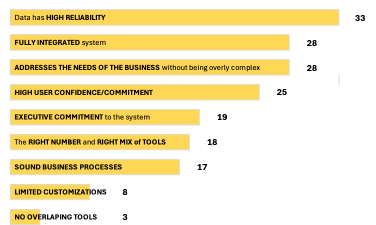
We asked our Sip Club participants regardless of the system used, what are the characteristics of the best ERP’s you have experienced? The responses were as follows:
Other responses included
Intuitive – easy to train new users on
Having ongoing user training, remote or user conferences with breakout sessions to address how system handles business is very helpful
Consistent architecture within the software
Ability to modify reports easily to tailor the Company’s KPI’s and daily production, including managing Operations
Visualization of the data
Easy integration with other tools such as automation and reporting
Ease of report customization to develop tools for business use
Overcoming Real-World Hurdles: Insights from the Trenches
While frameworks and theories are essential, the real work happens when the rubber meets the road. During the Sip Club session, participants and experts engaged in a candid dialogue about the friction points that inevitably arise during ERP adoption.
We have grouped their feedback and questions into four key areas: The ROI Mindset, Process Alignment, Data Integrity, and Re-implementation Strategies.
1. The ROI Mindset: Moving Past the Sticker Shock
For many organizations, the initial barrier is simply the commitment to invest. One participant, Sean D, shared his experience across the spectrum of business sizes:
“I’ve experienced ERPs anywhere from a startup to the enterprise level… The upfront cost may be daunting, but the ROI speaks for itself with keeping your data intact, secure and with more accuracy. Manual data can always experience ‘human error’… ERP implementations or migrations can be scary, but trust me, it will pay off in the end.”
2. Process Alignment: Don’t Pave the Cow Path
A recurring theme was the tension between existing business habits and software capabilities. Paul S emphasized that software cannot fix a broken process:
“Choosing the right ERP is essential, but establishing strong, well-defined processes first is critical to ensuring successful implementation.”
But what happens when the software feels restrictive? One user asked:
“What do you do when your ERP constrains you to a specific process? It’s easy to blue-sky a process, but I often find my ERP doesn’t support [what I want].”
The answer is two-fold. First, deep due diligence during selection is required to ensure the system generally matches your business structure. However, the second answer requires self-reflection: If a leading ERP solution supports a large customer base with a standard process, why do you need to do something different?. You must ask yourself: Are you really unique, or are you just stuck in “what you’ve always done”?.
3. Data Integrity: The “Garbage In, Garbage Out” Reality
Data quality creates the most visible symptoms of a failing ERP. Karen W put it bluntly:
“Clean your data prior to input into a new system. Garbage In = Garbage out. Don’t try to recreate your current system in your new system.”
This challenge often manifests in specific operational headaches. One participant asked:
“What would you say to a company who has negative quantity on hand on various parts every single day, and sells parts that are flagged as Obsolete regularly too?”
This is not uncommon, but it requires immediate triage. The recommended approach is:
Stop the bleeding: Implement robust cycle counting immediately to eliminate negative balances.
Find the root cause: Investigate why these balances occur—whether it is a lack of training, process gaps, or personnel issues.
Automate controls: Implement alert systems for obsolete parts and physically segregate obsolete inventory in the system so it cannot be shipped.
If you are unsure where to start, getting an experienced set of “outside eyes” to help audit your data integrity is often the best first step. Start by scrubbing your Master Data Files (Customer, Vendor, Item Masters, BOMs) and performing a pareto analysis on your errors to tackle the biggest issues first.
4. The “Re-Implementation”: Fixing a Stalled System
Industry data suggests that the average utilization of ERP capabilities is only 31%. Many companies simply run out of energy after the initial go-live. One user presented a common scenario:
“We are in a position where our ERP implementation set it up as an offline database. We would like to utilize our systems more… How should we go about re-implementing an ERP system into an already existing ERP system?”
Trying to “remodel” a live database is risky—it is like trying to repair an engine while the plane is flying. A common, effective strategy is to set up a clean, new database. This allows you to scrub your Master Data, upgrade software, and refine processes in a safe environment before transitioning over.
The Path Forward: Building Value Brick by Brick
As Hadrian said regarding rebuilding Rome, “Brick by brick, my citizens, brick by brick”
The goal isn’t installing software. It is achieving the vision of the business through better processes, automation, better data and better analytics. This means that your team must be engaged, aligned, and committed. You can’t hire someone else to implement your ERP, they will implement their ERP, not yours!
Only you can drive the implementation of your ERP for your benefit. The best the rest of us can do is be guides and taskmasters.
Change Management is the key to adoption. It starts at the very beginning and runs PAST go-live. Adoption is everything, don’t miss this critical aspect.Get commitment early and engage the nay-sayers
Eliminate old systems and crutches – “Burn the ships”“When Cortez reached the new world, he burned his ships. As a result, his men were well-motivated.”
Address the needs of the business without being overly complex
Right Number and mix of tools
Limit Customizations – Ask yourself why you are different than the other 10,000 Customers using the system
Eliminate overlapping tools – Single source of the Truth
Select an ERP system that meets the operational process requirements of your business and can hold the data elements you want to report/analyze.
Make people’s lives and work easier
Tweak the system to use the language/nomenclature people use in your Company.
Order the fields on the screens in the way people think about their job.
Change the colors to reflect the corporate colors/logos.
Instill High user confidence and commitment in the data generated
Integrated Solutions
“Single Source of the Truth”
Adequate tools supporting solid processes: Adequate tools supporting solid processes generates good data. Great tools with bad processes generate poor data – bad data faster
Optimize process to eliminate “stupid” processes. If you don’t know which ones are stupid, just ask your people, they always know!
Thanks and credit to Peter Adams and all our Sip Club Participants for their contributions and insights for the Sip Club.
Peter Adams is an accomplished executive who has built and sold multiple businesses. Peter helps business leaders build and run better businesses by combining strategic insight with pragmatic processes to improve productivity and business outcomes and helps generate real value from technology in the areas of leadership, process optimization and automation, reporting, and analytics. https://www.linkedin.com/in/petercadams/
Jeff Osorio is a Consulting CFO with over 30 years of experience in operationally oriented companies ranging from pre-Revenue to $4B with over 40 ERP implementations in his portfolio. He is also an Adjunct Professor in the MBA program of the Leavey School of Business at Santa Clara University. https://www.linkedin.com/in/jeff-osorio-1412181/