I’ve been working with MRP systems for a long time. A long, long time.
Long enough that when I say things like AVL or talk about APICS certification, some people stare at me like I’m describing cave paintings. But the fundamentals of MRP haven’t changed — and the companies that get the most value out of it all tend to follow the same basic principles.
Before we get into the mechanics, let me set expectations.
My goal here isn’t just to answer questions about MRP. It’s to raise a few new ones. Ideally you’ll read some of this and think:
“Yeah, yeah, I know that.” …and then hit a few moments where you go, “Wait — I didn’t know that.”
Those are the good parts.
First, a Quick Reality Check About MRP
MRP only really tells you three things:
What you need
How much you need
When you need it
That’s it.
If your system is doing those three things well, you’re in good shape.
If it isn’t, the problem is almost never the math.
MRP is basically a big, very fast calculator. It’s really good at remembering things and really good at math. What it’s notgood at is questioning the data you give it.
It will believe you completely.
Which brings us to the most important rule of MRP.
Garbage In, Garbage Out (Yes, Really)
I once visited a company that told me our MRP system didn’t work.
“Your MRP is a piece of junk,” they said. “It doesn’t tell us the truth.”
After spending a day with them, I realized the system wasn’t the problem.
Everyone in the company had quietly added their own buffers:
Sales set every order to ship immediately so theirs would get priority.
Purchasing inflated lead times so they wouldn’t get blamed if something was late.
Production added their own cushions in the schedule.
The result?
Everything was urgent. Everything was late. And the MRP output was completely useless.
Not because the math was wrong — because the inputs were.
The Three Things That Must Be Accurate
If you want MRP to work, three things have to be right.
According to the old APICS guidance (which I still like), the critical data elements are:
Inventory accuracy
Bills of material
Lead times
Inventory and BOMs need to be nearly perfect. If those are wrong, parts will either appear when they shouldn’t — or worse, not appear when you actually need them.
Lead times matter too, but they’re a little more forgiving. If they’re off, the system will still show the demand — just not always on the right date.
But if your inventory or BOMs are wrong, the system may not show the requirement at all.
Another Surprise: MRP Doesn’t Actually Do Anything
This is something that surprises people.
MRP doesn’t automatically create purchase orders. It doesn’t schedule jobs. It doesn’t call your suppliers.
And honestly, you probably don’t want it to.
What it does is calculate the plan and show you what should happen.
That’s why buyers and planners still matter. Humans can look at the plan and say things like:
“If I combine these orders I get a better price.”
“That supplier ships on Tuesdays — I should move this.”
“This order isn’t really urgent.”
MRP gives you the information. People still make the decisions.
The Best Way to Improve Your MRP
Here’s something I tell customers all the time:
Run MRP even if your data isn’t perfect.
You won’t break anything.
Instead, you’ll get a report that tells a story — and that story will highlight exactly where your data needs improvement.
For example:
If MRP says you need to buy something you already have, your inventory is wrong.
If it doesn’t show a requirement you know exists, your BOM is wrong.
If everything shows up too early or too late, your lead times are wrong.
Each run helps you fix a little more data.
Over time, the plan gets cleaner.
Eventually you reach the point where people say:
“Yeah — we live and die by the MRP.”
That’s the goal.
One Last Thought
MRP works best when people treat it as a system for learning, not just a report for purchasing.
Run it regularly. Question the output. Fix the underlying data.
Do that consistently and something interesting happens:
The system starts telling the truth.
And when your MRP tells the truth, planning gets a whole lot easier.
The Bottom Line on Medical Device ERP Implementation
Medical device ERP projects fail when companies underestimate the specialized requirements of regulated manufacturing. The stakes are substantial: healthcare data breaches average $10.1 million per incident, and the global healthcare ERP market reached $7.42 billion in 2023, projected to grow 7.2% annually through 2030.
Here’s what matters for successful implementation:
• Build FDA compliance into your foundation – Systems lacking built-in 21 CFR Part 11 compliance and automated audit trails create costly regulatory violations and recall scenarios
• Plan for the real costs, not just software licensing – Implementation expenses, training, data migration, and customization typically account for 70-80% of total investment beyond the initial purchase
• Choose vendors who understand your industry – Generic ERP platforms require extensive customization while specialized vendors cut implementation costs by up to 50% and improve product delivery times by 14%
• Establish complete traceability from raw materials through distribution – Unit-level serialization and real-time tracking capabilities are essential for FDA compliance and managing supply chains that represent over 40% of device costs
• Select systems designed for growth – With medical device industry expansion approaching 6% annually, your ERP must scale globally without operational disruption
The medical device sector’s regulatory complexity and growth trajectory make vendor selection critical. Medical device ERP implementation demands specialized expertise that generic business software cannot provide. Companies that address these five implementation challenges systematically avoid the multimillion-dollar consequences of compliance failures and operational breakdowns.
Pitfall 1: Failing to Align ERP with FDA and GMP Requirements
Regulatory compliance represents the fundamental divide between generic business software and medical device ERP systems. Standard ERP platforms simply weren’t built for the specialized frameworks that medical device manufacturers need to meet FDA and international regulatory demands.
Understanding FDA 21 CFR Part 11 and GMP Standards
FDA 21 CFR Part 11 establishes the criteria under which electronic records and electronic signatures are considered trustworthy, reliable, and equivalent to paper records and handwritten signatures. Enacted in 1997, this regulation mandates authentication, integrity, and non-repudiation for all electronic documentation used in FDA-regulated work.
The regulation applies when your organization uses an electronic system to create, modify, maintain, archive, retrieve, or transmit records required by FDA regulations. This typically includes QMS platforms, manufacturing records, laboratory systems, and clinical systems that generate or manage required records.
Good Manufacturing Practice compliance means adhering to guidelines that ensure products are consistently produced and controlled according to quality standards. Regulatory bodies such as the FDA, European Medicines Agency, and World Health Organization enforce GMP regulations globally. For medical device manufacturers, GMP requirements intersect with FDA 21 CFR Part 820 QMS requirements and ISO 13485 standards.
Medical device manufacturers face additional complexity with the Medical Device Regulation, fully applicable since May 2021, which places higher demands on safety and performance. According to a survey conducted by MedTech Europe in 2024, 62% of companies report a doubling of approval times, with 37% reporting an increase of over 200%. The three most common challenges include adaptation of technical documentation (67%), high certification costs (59%), and complexity of the regulation (58%).
A validation-ready ERP system helps medical device companies meet regulatory requirements such as MDR, ISO 13485, and FDA 21 CFR Part 11. Critical aspects include data integrity and security, with every system change thoroughly documented. Automatic backup mechanisms and access controls ensure sensitive information stays protected from unauthorized access or accidental data loss.
Why Compliance Failures Cost Medical Device Companies
Non-compliance creates immediate financial consequences. Heavy fines from bodies like the FDA or EMA, costly product recalls, and delays in product approvals that impact revenue. When non-compliance blocks market access entirely, it cuts off essential revenue streams and threatens long-term viability.
Regulators demand deeper traceability, faster reporting, and stronger post-market oversight. They expect real-time visibility across design, manufacturing, distribution, and complaint handling. When systems lack integration or visibility, small gaps expand rapidly and carry multimillion-dollar consequences.
Financial loss appears first, but operational disruption follows. Failing to meet manufacturing standards or quality control protocols can halt production entirely or lead to product rejections, disrupting supply chains and draining resources. Delayed product approvals hinder market entry, affecting growth and competitiveness.
Reputational damage proves most profound. Non-compliance undermines trust in a field where patient safety is paramount. Negative media coverage, recalls, or safety issues erode customer confidence and deter investors, making recovery lengthy and challenging.
At least 17 medical device and technology recalls were recorded by November 2025. The list includes safety alerts tied to cybersecurity risks, device component failures, infusion pump defects, and products linked to patient injuries and deaths. Each recall disrupts distribution, increases scrutiny, and demands internal audits.
Standard ERP systems lack the built-in compliance frameworks necessary for tracking requirements. Companies find themselves building custom tracking mechanisms or relying on manual processes that create compliance gaps. General ERP systems often lack the specialized security features needed to maintain compliant audit trails and protect sensitive data.
Building Audit-Ready ERP for Medical Device Operations
Audit trail functionality forms the backbone of FDA-compliant operations. Effective medical device ERP software automatically generates time-stamped records of all activities, creating secure, computer-generated audit trails that record user identities and track every action performed on electronic records. FDA 21 CFR Part 11 mandates that these systems ensure all previously recorded information remains intact, preventing deletion or overwriting of data.
An audit trail is a secure, computer-generated, time-stamped record that chronologically documents the creation, modification, or deletion of electronic records. The audit trail must capture who made changes, what was changed, and when the change occurred. Preventing unauthorized access or alterations to the audit trail proves equally important.
Specialized ERP systems provide integrated FDA 21 CFR Part 11 compliance, automated lot traceability, and built-in quality management for CAPA tracking. Companies using these purpose-built solutions can reduce software validation efforts for FDA 21 CFR Part 11 compliance by up to 50%.
User and access management requires granular control over system access based on role-based permissions, ensuring that only authorized personnel access relevant areas of the system. Regular reviews of user rights further enhance the security and integrity of the system.
A validation-ready ERP system supports electronic signatures in compliance with 21 CFR Part 11. Workflows ensure that critical processes adhere to defined procedures and all necessary approvals are obtained. An integrated document management system handles standard operating procedures, specifications, and other regulatory documents. Automatic version control prevents the use of outdated documentation.
Medical device ERP implementation requires Computer System Validation according to GAMP 5. This includes capturing IQ/OQ/PQ evidence showing eSignature workflows work as designed under normal and edge-case scenarios. Integrated compliance functions shorten the time needed for regulatory approvals. Complete documentation and traceable processes expedite approval procedures, while automated compliance checks minimize human error risk.
Pitfall 2: Inadequate Cost Planning and ROI Analysis
Pitfall 2: Inadequate Cost Planning and ROI Analysis
Budget overruns destroy medical device ERP projects. The culprit isn’t always poor planning—it’s the dangerous habit of focusing on software licensing fees while ignoring what actually drives project costs.
Understanding the complete financial picture separates implementations that succeed from those that collapse halfway through when funding runs dry.
ERP vendors structure their pricing to make initial costs appear manageable. Perpetual licenses demand large upfront payments for indefinite usage rights, though most agreements now require ongoing maintenance fees to keep support active. Subscription models used for cloud ERP bundle support and maintenance into monthly payments.
The shift to cloud ERP changes how you budget. Instead of major capital expenditures, you face predictable operational expenses through consistent monthly or annual payments. This approach simplifies budget planning, though lifetime costs may eventually exceed on-premise alternatives. Cloud-based medical device ERP solutions typically cost $50-250 per user monthly.
Small manufacturers with revenue under $10M face $2,000-6,000 monthly subscriptions with $50,000-100,000 implementation costs. Mid-sized manufacturers earning $10M-100M pay $5,000-15,000 monthly with $100,000-250,000+ implementation expenses. Large enterprises exceeding $100M revenue spend over $1M for implementation alone.
These expenses cover project management, software configuration, integration with existing systems, and employee training. Implementation services range from $10,000 to $100,000, including consulting fees for business process analysis, data migration from legacy systems, customization and configuration, plus system integration with MES, PLM, and CRM systems.
Maintenance costs consume around 20% of the purchase price annually for on-premise systems, covering support, bug fixes, and system updates. Cloud-based systems include automatic updates, maintenance, and security patches in subscription fees. On-premises ERP systems require 18-22% of initial software license costs yearly for support and updates.
Hidden Expenses That Derail Projects
Labor represents the biggest surprise cost. The average budget per user stands at $7,200, though some sources place this figure at $9,000. Data conversion from legacy systems demands extensive work. Expect that data in one table must be converted into multiple tables and that data in multiple tables will be consolidated into a single table. People handle these conversions, and costs can be controlled by limiting historical data moved.
Your project team members stay on payroll while working significant overtime. Meanwhile, their regular job responsibilities still need fulfillment. Plan on adding temporary staff and hiring new people for those roles. IT staff needs supplementation since every existing system requires continued business support while IT people support the implementation project.
Consultant expertise proves invaluable yet expensive. Many businesses hire consultants from their ERP provider to perform work and share expertise during projects. Those consultants bill at several hundred dollars hourly.
Training investments remain frequently underestimated yet essential for achieving ERP benefits. Training budgets must account for both direct expenses and temporary productivity impacts during transition periods. Your team’s productivity will drop significantly the moment you go live due to adjustment time with the new system. Plan for days or weeks where operational efficiency decreases.
Change management differs from training. Training shows someone how to use the new system; change management convinces them why they should. Senior leaders must spend considerable time communicating the vision. You may need to invest in internal marketing workshops, newsletters, and Q&A sessions.
Testing demands continuous attention throughout implementation. Begin with simple, single operation tests. You need hundreds, if not thousands, of test scripts checking every process in every functional area. Automated testing applications should be strongly considered since these run continuously retesting the same scripts.
Data requires cleansing before migration. There’s a high chance your data is messy, unstructured, and filled with duplicates. The process of extracting, cleansing, transforming, and loading this data becomes a massive, time-consuming sub-project. Multiple trial runs ensure data maps correctly into the new system, meaning more billable hours from your implementation partner.
Customization adds premium-rate custom coding charges. Each customization extends the testing and deployment timeline, requiring payment for extended hours. Integration with other business applications becomes another expense. Many integrations require purchasing pre-built connectors from third-party vendors with subscription fees. Sometimes you’ll need to build custom API integrations.
Calculating and Maximizing Your ERP ROI
The basic ROI formula reads: ROI = (total value of investment – total cost of investment) / total cost of investment x 100. The first step calculates total cost of ownership: TCO = purchase price + implementation costs + operating costs for a span of years, often five to 10 years.
ERP ROI represents the ratio of gains resulting from an ERP investment in dollars to the TCO, expressed as a percentage. The higher the ratio of gains to TCO, the better the ROI.
A mid-sized medical device manufacturer investing $480,000 over three years in cloud ERP generated $720,000 in quantifiable benefits, achieving a 50% return primarily through reduced compliance issues, improved production efficiency, and optimized inventory management.
Legacy ERP systems impose quantifiable costs. Manufacturers relying on older systems face real pressure as challenges outpace what these systems were designed for. Teams wrestle with manual schedules, chase scattered data, pay for last-minute freight, and react to breakdowns instead of preventing them. Limited visibility creates business consequences that gradually erode accuracy, customer trust, and margin.
Bringing on new employees with outmoded systems takes longer. Managing the workforce eats up more time and money. Compliance becomes difficult because locating necessary records for audits proves challenging. Technical debt accumulates as years of custom fixes make upgrades more difficult.
ROI metrics include increased revenues, cost reductions, efficiency improvements, and quality improvements. Without pre-defining important metrics to be improved by implementing a new ERP system, determining if the investment was worthwhile becomes difficult. Defining the business case as part of the selection process provides information for making good system selections, aligning implementation projects with business objectives, monitoring the business as implementation moves through phases, and defining performance benchmarks after implementation.
Pitfall 3: Weak Vendor Selection and Partnership
Vendor selection determines whether your medical device ERP investment delivers results or becomes an expensive mistake. With medical device recalls hitting a 15-year high, the stakes couldn’t be higher. Yet 67% of medical device manufacturers struggle without specialized ERP systems.
The bottom line: choosing a vendor with deep medical device expertise isn’t optional—it’s critical to your success.
Why Generic ERP Solutions Miss the Mark
Generic ERP systems handle basic accounting and finance tasks well enough, but they fall short when it comes to operations. These broad-market platforms lack the depth required for regulated manufacturing environments.
Companies implementing specialized manufacturing ERP software report 14% faster product delivery times and 10% more orders delivered on schedule. The difference comes down to industry focus. When you use generic software, your team ends up teaching developers about medical device manufacturing—a costly and risky approach that often leads to regulatory violations.
Medical device ERP systems must maintain strict controls to safeguard electronic records. Generic platforms simply don’t have the specialized security features needed for compliant audit trails. The best systems integrate non-conformance tracking with CAPA management, allowing you to escalate issues appropriately and conduct root cause analysis.
Vendor Red Flags to Watch For
Backward compatibility problems signal trouble ahead. When a vendor demands upgrades to all your existing systems just to make their solution work, you’re looking at unnecessary time and expense. This is particularly concerning when integration should be straightforward with your current setup.
Vendors without clear business plans raise questions about long-term support. You’re building a relationship that needs to last years, not months. Whether they’ll still be around in five years matters.
Be wary of vendors promising their single solution fixes every problem in your organization. This one-size-fits-all thinking doesn’t work for businesses with unique challenges. You need realistic assurances tailored to your specific needs.
Unwillingness to work with your existing systems represents another warning sign. A vendor reluctant to help with integration—especially when it’s technically feasible—should raise concerns. Similarly, vendors offering no open API create integration headaches with existing and future systems. Without open API access, developers can’t customize or integrate software according to your needs.
Limited industry experience presents serious risks. Vendors may claim manufacturing experience but lack deep knowledge of medical device requirements. Ask whether they’ve implemented systems specifically for your device type. Vendors unfamiliar with medical-grade device materials should set off alarms.
Reluctance to provide customer references signals potential issues. Don’t accept hand-picked references from different industries. Insist on unpaid references from organizations similar to yours, using the same system you’re considering, who’ve been live for at least a year.
Selecting the Right ERP Partner
Look for vendors with longstanding experience serving medical device manufacturers. This experience translates to deeper understanding of regulatory requirements and industry-specific processes. Companies like ECI Solutions have worked with medical device manufacturers for over two decades, building expertise in efficiency, quality, and compliance requirements.
Examine the vendor’s existing medical device client base—this provides valuable insight into their industry expertise. The higher a vendor’s market share among medical device companies, the more valuable their industry templates become. Evaluate management’s commitment to the product roadmap specifically for medical device companies.
Competent ERP vendors know the ins and outs of businesses similar to yours. If an implementer has completed significant projects with your specific ERP package, they should have project templates, data conversion tools, and user training documentation ready.
Adequate resources matter. Most ERP projects require a project manager, financial consultant, inventory and production consultant, and technical consultant. Committed team members who help manage both the project and your technical environment prove essential.
Remember that hidden costs often represent 70-80% of total investment beyond the initial purchase. Customer support structure varies significantly among vendors, and understanding support depth can make or break your long-term experience. Seek vendors offering multi-tiered support covering technical challenges, user training, and strategic guidance.
Client testimonials and case studies offer valuable insights into vendor real-world performance. Look beyond generic praise for substantive narratives demonstrating measurable business improvements. Ask references about setup and implementation, compatibility challenges, customer support, the upgrade process, user satisfaction, and benefits realized.
Pitfall 4: Insufficient Supply Chain and Traceability Planning
Pitfall 4: Insufficient Supply Chain and Traceability Planning
Supply chain costs consume more than 40% of total medical device expenses. Natural disasters, political instability, and labor shortages create disruptions that demand visibility into inventory levels, demand forecasts, and supplier performance to maintain material availability. Companies that underestimate traceability complexity face operational breakdowns extending far beyond their initial implementation timeline.
The Reality of Medical Device Supply Chain Complexity
The “last-mile” problem plagues healthcare supply chains regularly. Field inventory sits in sales representatives’ vehicles, accumulates on hospital shelves as consignment inventory under pay-as-you-use arrangements, or remains in transit between hospitals and clinics. Geographic distribution creates operational fragmentation. Poor oversight increases risks of falsified and substandard medical products while creating stock-out and expired product problems.
Medical device ERP systems deliver real-time visibility, demand forecasting, and automated procurement capabilities. They maintain regulatory compliance, reduce lead times, and strengthen supplier collaboration for timely production. Approved supplier workflows, inspection requirements, quarantine processes, and component traceability become essential for preventing defects and ensuring availability. Manufacturers require visibility across device genealogy, production performance, scrap, complaints, supplier metrics, and cost trends to support continuous improvement.
FDA Tracking Requirements: From Source to Patient
FDA medical device tracking regulations under 21 CFR Part 821 require manufacturers to track specific devices from manufacture through distribution when the FDA orders tracking system implementation. This regulation enables manufacturers to locate devices quickly in commercial distribution. Tracking information supports notifications and recalls when devices present serious health risks.
Tracking applies to devices whose failure would reasonably cause serious adverse health consequences, devices intended for human implantation exceeding one year, or life-sustaining or life-supporting devices used outside device user facilities. Manufacturers have three working days to provide critical information about undistributed devices, including exact location and distribution status. For distributed devices, manufacturers have 10 working days to provide identical information.
Unit-level serialization creates substantial complexity compared to lot-level compliance regarding data storage requirements. Lot-level tracking applies a single batch number to hundreds or thousands of units, while serialization demands unique identification numbers for every salable unit. Since November 2019, wholesalers must verify they receive and sell only serialized products, re-verifying four data elements for every returned product’s unique identifier before resale: Global Trade Item Number, lot number, expiry date, and serial number.
ERP System Requirements for Complete Traceability
Medical device ERP software must consolidate multiple serialized, tracked, and traced parts into single serialized units before customer shipment. Lot and serial tracking must span from raw materials to finished goods, capturing complete component history supporting electronic device history records and device master records requirements. Cloud-based ERP systems automate serial number tracking and bills of materials, maintaining production process awareness: required materials and components for each device, their current location, correct assembly procedures, and destination after assembly completion.
Serialization solution integration creates technical compatibility challenges requiring careful management to ensure interoperability. Legacy ERP systems, already extensively customized, face substantial failure risk when adding serialization performance requirements at scale. 2023 requirements for all-electronic traceability at unit level mean ERP systems not designed for large transactional data volumes using multi-layer EPCIS data models will reach performance limits.
Real-time product tracking from manufacturing through distribution creates supply chain transparency. This synchronizes product information, batch details, and supplier data while reducing redundancy and ensuring data integrity. Real-time transport status and delivery timeline updates ensure serialized products can be documented and traced accurately at every journey stage.
Pitfall 5: Overlooking Scalability and Future Growth Needs
Medical device manufacturers face a fundamental question: build for today’s needs or tomorrow’s opportunities? The medical device industry shows impressive growth trajectory with forecasts indicating a compound annual growth rate nearing 6% by the year 2030. This expansion creates operational pressures that static systems simply cannot accommodate.
What appears adequate during initial implementation often becomes the biggest constraint to growth. Long-term operational sustainability depends on selecting ERP systems designed to evolve alongside your business rather than limit it.
Why Short-Term Thinking Leads to ERP Failures
Medical device startups transitioning from prototype to production face critical decisions that determine their operational ceiling for years to come. Legacy ERP systems create barriers when manufacturers attempt to scale operations, and the timing of these decisions matters more than most realize.
Implementing the right ERP system earlier rather than later proves more cost effective, as years of history and ingrained processes make later migrations exponentially harder. What starts as a simple cost-cutting measure—choosing the cheapest option available—evolves into a strategic mistake that constrains every aspect of growth.
Systems that initially seem adequate become constraints as product lines expand and regulatory requirements multiply. You can add users, but can the system handle the data load? You can add locations, but does the architecture support multi-site operations? These questions become expensive problems when the foundation wasn’t built to scale.
An ERP system that scales with your business allows you to add functionalities and users without significant disruptions, ensuring seamless transitions from startup phase to full-scale production. This scalability encompasses both underlying technology and system configurability—specifically how easily you can add new modules or implement new software portions.
Anticipating Regulatory and Business Changes
The medical device industry’s diverse segments, from consumables to large capital equipment, require specialized integration capabilities that grow with changing business needs. Manufacturers must plan for evolving compliance landscapes before they impact operations.
Proactive compliance involves anticipating regulatory shifts and adjusting policies accordingly. Organizations that actively anticipate regulatory changes minimize risk of penalties while maintaining operational efficiency. This forward-thinking approach separates successful manufacturers from those constantly reacting to new requirements.
Modern medical device manufacturing ERP systems support multi-language, multi-currency, and multi-country operations, making them ideal for manufacturers operating across regions. This global capability becomes essential as companies expand into new markets with varying regulatory frameworks.
Consider the trajectory: a successful medical device company today will likely operate in multiple countries within five years. Your ERP decision today determines whether that expansion requires a complete system replacement or simple configuration changes.
Designing Flexible Medical Device Manufacturing ERP Architecture
Cloud environments scale effortlessly compared to rigid on-premise systems, adapting to growing demands. Whether managing real-time data, increasing workloads, or accommodating new users, scalable systems ensure business continuity during growth periods.
Cloud-based ERP for medical device manufacturing delivers the flexibility and scalability necessary to keep pace with dynamic demands presented by global markets and regulatory compliance across borders. The architectural choice you make today sets the operational parameters for years to come.
Preconfigured industry scenarios enable rapid deployment, with some cloud-based medical device ERP systems implemented within weeks rather than months. Quarterly innovation updates occur without disruption, while low-code extensibility platforms allow customization as requirements evolve.
This approach creates future-ready healthcare ERP infrastructure that expands as operations grow globally. You’re not just buying software—you’re choosing the operational framework that will either enable or constrain your next decade of growth.
The Bottom Line: What Medical Device Manufacturers Need to Know
Pitfall
What It Is
Financial and Operational Impact
Must-Have Requirements
Our Recommendations
The Numbers That Matter
Pitfall 1: Failing to Align ERP with FDA and GMP Requirements
Standard ERP platforms lack the specialized frameworks medical device manufacturers need for FDA and international regulatory compliance
Heavy fines from FDA/EMA, costly product recalls, delayed approvals, blocked market access, production shutdowns, reputation damage
FDA 21 CFR Part 11 compliance, GMP adherence, automated audit trails, electronic signatures, data integrity controls
Select validation-ready ERP with integrated compliance, automated lot traceability, built-in CAPA management, Computer System Validation per GAMP 5
17+ medical device recalls by November 2025; 62% of companies report doubled approval times; 67% struggle with technical documentation; specialized ERP cuts validation efforts by 50%
Pitfall 2: Inadequate Cost Planning and ROI Analysis
Organizations focus on licensing fees while missing the complete financial picture and hidden implementation costs
Budget overruns, stalled projects, underestimated training costs, productivity drops during transition, funding gaps
Define business case upfront, pre-establish metrics, use ROI formula: (total value – total cost) / total cost x 100, budget for 18-22% annual maintenance
Cloud ERP runs $50-250 per user monthly; small manufacturers: $50K-100K implementation; mid-sized: $100K-250K+; large: $1M+; average $7,200 per user; one mid-sized manufacturer achieved 50% ROI ($720K benefits from $480K investment)
Pitfall 3: Weak Vendor Selection and Partnership
Choosing vendors without deep medical device industry expertise creates regulatory violations and expensive oversights
Industry-specific experience, existing medical device client base, committed resources and team, multi-tiered support, open API access
Choose vendors with 20+ years medical device experience, demand unpaid references from similar organizations, verify dedicated project team, evaluate support structure depth
Medical device recalls at 15-year high; 67% of manufacturers struggle without specialized ERP; specialized systems deliver 14% faster product delivery, 10% more on-time orders; hidden costs represent 70-80% of total investment
Pitfall 4: Insufficient Supply Chain and Traceability Planning
Underestimating traceability complexity and supply chain visibility needs leads to operational breakdowns extending beyond implementation
Last-mile inventory issues, stock-outs, expired products, inability to meet FDA tracking requirements, recall management difficulties
Real-time visibility, unit-level serialization, lot tracking from raw materials through finished goods, FDA 21 CFR Part 821 compliance, serialization solution integration
Implement ERP with automated serial number tracking, EPCIS data models, real-time manufacturing-to-distribution tracking, device genealogy visibility
Supply chain expenses exceed 40% of total device costs; manufacturers get 3 working days to provide device location info (10 days if distributed); serialization required for all units by 2023 with unique GTIN, lot number, expiry date, serial number
Pitfall 5: Overlooking Scalability and Future Growth Needs
Selecting static systems unable to evolve with business growth and changing regulatory requirements
Choose cloud ERP with preconfigured industry scenarios, scalable infrastructure, module addition without disruption, global compliance capabilities
Medical device industry CAGR approaches 6% by 2030; healthcare ERP market reached $7.42B in 2023, projected 7.2% annual growth through 2030; cloud systems deploy in weeks versus months
Conclusion
Medical device ERP implementation carries extraordinarily high stakes, but these five pitfalls don’t have to derail your project. Indeed, addressing regulatory compliance, comprehensive cost planning, vendor selection, supply chain traceability, and scalability from day one significantly increases your chances of success. Although tackling all these challenges simultaneously might seem overwhelming initially, you can approach them methodically. First, assess your regulatory requirements and verify your ERP vendor’s medical device expertise. Then, build a realistic budget that accounts for hidden costs. Most importantly, choose a scalable system designed specifically for your industry’s unique demands rather than forcing a generic solution to fit specialized needs.
FAQs
Q1. What are the main regulatory compliance requirements for medical device ERP systems? Medical device ERP systems must comply with FDA 21 CFR Part 11, which establishes criteria for electronic records and signatures to be considered trustworthy and equivalent to paper records. The system needs to provide automated audit trails that are time-stamped and secure, support electronic signatures, ensure data integrity and security, and align with GMP standards and ISO 13485. Additionally, the ERP must maintain appropriate controls to safeguard the authenticity, integrity, and confidentiality of electronic records throughout their lifecycle.
Q2. How much does it typically cost to implement a medical device ERP system? Implementation costs vary significantly based on company size. Small manufacturers with revenue under $10 million typically face $50,000-$100,000 in implementation costs plus $2,000-$6,000 monthly subscriptions. Mid-sized manufacturers earning $10-$100 million pay $100,000-$250,000+ for implementation with $5,000-$15,000 monthly fees. Large enterprises exceeding $100 million in revenue often spend over $1 million for implementation alone. These costs include software licensing, configuration, integration, training, data migration, and ongoing maintenance which typically runs 18-22% of initial license costs annually.
Q3. Why do generic ERP systems fail to meet medical device manufacturing needs? Generic ERP systems lack the specialized functionality required for regulated medical device operations. They address basic accounting and finance adequately but require extensive customizations, modifications, and integrations to support essential medical device workflows like lot traceability, CAPA management, and FDA compliance. These platforms don’t include built-in audit trails, electronic signature capabilities, or specialized security features needed for regulatory compliance. Companies using specialized medical device ERP software report 14% faster product delivery times and 10% more on-time orders compared to those using generic systems.
Q4. What traceability capabilities must a medical device ERP system provide? A medical device ERP must support unit-level serialization with unique identifiers for each product, including Global Trade Item Number, lot number, expiry date, and serial number. The system needs to track devices from raw materials through finished goods and distribution, maintaining complete device genealogy and history records. It must comply with FDA 21 CFR Part 821 tracking regulations, allowing manufacturers to locate devices within 3 working days for undistributed products and 10 working days for distributed ones. Real-time visibility across the entire supply chain, from manufacturing through distribution, is essential for regulatory compliance and recall management.
Q5. How can I ensure my medical device ERP system will scale with business growth? Choose a cloud-based ERP system designed specifically for medical device manufacturing that offers modular architecture and low-code extensibility. The system should support multi-language, multi-currency, and multi-country operations to accommodate global expansion. Look for platforms with preconfigured industry scenarios that enable rapid deployment and quarterly innovation updates without disruption. Ensure the vendor has a proven track record with medical device manufacturers and can demonstrate how their system handles increasing workloads, additional users, and evolving regulatory requirements without requiring complete system replacements or major disruptions to operations.
The medical device industry operates under some of the most stringent regulatory requirements in manufacturing. From FDA compliance to ISO 13485 standards, manufacturers face complex challenges that demand precision, traceability, and operational excellence. A robust medical device erp system serves as the foundation for operational excellence in today’s regulated manufacturing environment, enabling companies to navigate these complexities while maintaining growth and profitability.
The bottom line on operational excellence in medical device manufacturing is clear: companies that implement comprehensive ERP medical device solutions consistently outperform those relying on disconnected systems. Leading manufacturers have discovered that implementing a medical device erp system dramatically improves their compliance and efficiency, with some reporting up to 14% faster product delivery times and 10% improvement in on-time order delivery.
The Challenge: Navigating Complex Regulatory Requirements
Medical device manufacturers face unique operational challenges that set them apart from other industries. The regulatory landscape demands complete traceability from raw materials to finished products, comprehensive documentation for every process, and the ability to quickly respond to quality issues or recalls.
What makes this particularly challenging is the need to balance regulatory compliance with operational efficiency. Many growing medical device companies find themselves caught between basic accounting software that can’t handle their complexity and enterprise solutions that are too expensive or cumbersome for their current size.
The manufacturing environment itself adds another layer of complexity. Whether producing surgical instruments, diagnostic equipment, or implantable devices, manufacturers must maintain lot tracking, manage consigned inventory, and coordinate with multiple suppliers while ensuring every step meets regulatory standards.
Real-World Success: How Trimedyne Transformed Operations
Trimedyne, a surgical laser manufacturer, exemplifies how the right medical device manufacturing software can transform operations. Before implementing Expandable’s ERP solution, the company struggled with limited control and visibility across their operations, relying on standalone systems that couldn’t provide the integrated view necessary for effective decision-making.
The challenge was particularly acute in their FDA compliance management. With surgical lasers requiring precise documentation and traceability, Trimedyne needed a system that could track every component through the manufacturing process while maintaining the detailed records required for regulatory submissions.
When evaluating ERP medical device solutions, Trimedyne prioritized integration capabilities and regulatory compliance features. The implementation of Expandable’s system provided them with a single database that integrated all their operations, from procurement through shipping.
The results were immediate and measurable. Trimedyne gained comprehensive transaction tracking across all departments, enhanced FDA compliance management through automated documentation, and improved operational control that allowed them to scale their operations efficiently. The single database approach eliminated the data silos that had previously hampered their ability to respond quickly to quality issues or customer inquiries.
As one Trimedyne executive noted, the transformation wasn’t just about technology—it was about gaining the visibility and control necessary to operate at the level their customers and regulators expected.
Scaling Success: IntegenX’s Growth Journey
IntegenX represents another compelling case study in how a medical device erp system can support rapid growth while maintaining compliance standards. As a med-tech startup, IntegenX initially operated with basic accounting software and spreadsheets—a common scenario for early-stage medical device companies.
The limitations of this approach became apparent as the company began scaling operations. Managing bill of materials, tracking lot numbers, coordinating with contract manufacturers, and maintaining the documentation required for FDA submissions became increasingly complex and error-prone.
The company recognized that their growth trajectory required more sophisticated medical device manufacturing software that could grow with them. The implementation of Expandable’s ERP system marked a turning point in their operational capabilities.
The transformation was comprehensive. IntegenX established robust processes that automated many of their previously manual operations, gained enhanced production visibility that allowed them to identify bottlenecks before they impacted delivery schedules, and improved their coordination with contract manufacturers through better data sharing and communication.
Perhaps most importantly, the system provided the scalability they needed. As IntegenX continued to grow, their ERP system adapted to support new product lines, additional manufacturing partners, and expanded regulatory requirements without requiring a complete system overhaul.
The company successfully scaled their operations while maintaining compliance, demonstrating how the right technology foundation can support sustainable growth in the medical device industry.
Industry Trends Driving ERP Adoption
The medical device industry is experiencing significant transformation, with several trends driving increased adoption of integrated ERP medical device solutions. Supply chain reconfiguration, particularly the shift toward onshoring and nearshoring, requires manufacturers to manage more complex multi-site operations while maintaining visibility and control.
The integration of artificial intelligence and advanced analytics into manufacturing processes demands systems that can collect, analyze, and act on data in real-time. Traditional standalone systems simply cannot provide the integrated data foundation necessary for these advanced capabilities.
Regulatory requirements continue to evolve, with increasing emphasis on digital documentation and traceability. The FDA’s focus on software as a medical device (SaMD) and the growing complexity of connected medical devices require manufacturers to maintain even more detailed records and demonstrate comprehensive quality management.
Workforce transformation is another critical factor. As the industry faces skills shortages and the need for digital literacy, user-friendly systems that can support both experienced professionals and new hires become essential for maintaining operational continuity.
Key Benefits Driving Operational Excellence
Modern medical device manufacturing software delivers operational excellence through several key capabilities. Complete traceability from raw materials through finished products ensures regulatory compliance while providing the visibility necessary for quality management and recall procedures.
Integrated quality management systems automate many compliance procedures, reducing the risk of human error while ensuring consistent application of quality standards. This integration is particularly valuable for managing corrective and preventive actions (CAPA), which require coordination across multiple departments and detailed documentation.
Financial control and cost management capabilities provide manufacturers with real-time visibility into production costs, material usage, and labor efficiency. This visibility enables more accurate pricing decisions and helps identify opportunities for operational improvement.
The ability to support multiple manufacturing modes—discrete, process, and project-based production—within a single system is particularly valuable for medical device manufacturers who often produce different product types requiring different approaches.
Implementation Best Practices for Success
Successful implementation of a medical device erp system requires careful planning and attention to industry-specific requirements. The most successful implementations begin with a clear understanding of regulatory requirements and how the system will support compliance processes.
Change management is particularly critical in the medical device industry, where established procedures and documentation practices are often deeply ingrained. Training programs must address not just how to use the new system, but how it supports and enhances existing quality management practices.
Data migration requires special attention to maintaining traceability and audit trails. Medical device manufacturers cannot afford to lose historical data that may be required for regulatory submissions or recall procedures.
Integration with existing systems, particularly quality management and document control systems, must be planned carefully to ensure seamless operations during the transition period.
The Path Forward: Choosing the Right Solution
For medical device manufacturers evaluating ERP solutions, the focus should be on systems specifically designed for regulated industries. Generic ERP systems often lack the specialized features necessary for medical device compliance and traceability requirements.
Expandable’s medical device ERP system provides the industry-specific functionality that growing medical device manufacturers need, with features like surgical kit modules, integrated quality management, and comprehensive traceability capabilities.
The investment in a proper medical device erp system pays dividends through improved efficiency, reduced compliance risk, and the scalability necessary to support growth. As the case studies of Trimedyne and IntegenX demonstrate, the right system becomes a competitive advantage that enables operational excellence.
Companies ready to explore how ERP can transform their operations can learn more about Expandable’s success storiesand see how other medical device manufacturers have achieved operational excellence through strategic technology implementation.
The bottom line is clear: in an industry where precision, compliance, and efficiency are non-negotiable, a specialized medical device erp system isn’t just a technology investment—it’s a strategic imperative for sustainable growth and operational excellence.
The medical device manufacturing industry stands at a critical juncture. Rising costs for materials and staffing, coupled with increasingly complex regulatory requirements, have pushed traditional enterprise resource planning systems to their breaking point. For medical device manufacturers looking to remain competitive in a fast-paced market, the integration of artificial intelligence and Internet of Things technologies into their ERP infrastructure isn’t just an upgrade—it’s a necessity.
A modern medical device erp system integrates AI and IoT technologies to address these critical operational challenges. While implementing these advanced systems requires careful planning and investment, the risks of not doing so can far outweigh the initial costs. Inefficient processes, limited visibility, poor customer satisfaction, and compliance challenges can erode profitability and stifle growth in an industry where precision and reliability are paramount.
Why Traditional Medical Device ERP Systems Fall Short
Medical device manufacturers are facing significant challenges with legacy systems that struggle to keep pace with modern requirements. Traditional medical device erp solutions often struggle with real-time data integration and predictive analytics, leaving manufacturers vulnerable to supply chain disruptions and compliance gaps.
The core issues plaguing conventional systems include fragmented operational views that prevent decision-makers from seeing the complete picture of their manufacturing processes. When production data exists in silos, separated from quality control metrics and supply chain information, manufacturers lose the ability to make informed decisions quickly. This fragmentation becomes particularly problematic when dealing with FDA audits or ISO 13485 compliance requirements, where complete traceability is essential.
Supply chain disruptions have become increasingly common, with traditional systems offering little warning before critical components become unavailable. Without predictive capabilities, manufacturers often discover shortages only when production lines halt, leading to delayed deliveries and frustrated customers. The recent global supply chain challenges have highlighted how vulnerable medical device manufacturers are when they rely on reactive rather than proactive inventory management.
Compliance risks represent another significant challenge. Medical device manufacturing operates under strict regulatory oversight, with the FDA requiring detailed documentation and traceability for every component and process. Legacy systems often require manual data entry and reporting, creating opportunities for human error that can result in costly compliance violations or product recalls.
The evolution of medical device erp system capabilities has been driven by the need for better compliance and efficiency. Modern AI-integrated systems are delivering remarkable operational improvements, with manufacturers reporting 25-30% time savings in processing and decision-making tasks, along with up to 60% improvement in decision accuracy.
Predictive analytics represents one of the most powerful AI applications in medical device manufacturing. By analyzing historical data patterns, supply chain trends, and market conditions, AI algorithms can forecast potential disruptions weeks or months in advance. This capability allows manufacturers to adjust procurement schedules, identify alternative suppliers, and maintain production continuity even when facing unexpected challenges.
Machine learning algorithms excel at quality control applications, where they can identify subtle patterns in manufacturing data that human operators might miss. These systems continuously learn from production data, becoming more accurate over time at predicting when equipment maintenance is needed or when process parameters drift outside acceptable ranges. For medical device manufacturers, this translates to fewer defective products, reduced waste, and improved patient safety outcomes.
Automated compliance tracking represents another significant advancement. AI-powered systems can monitor every aspect of the manufacturing process, automatically generating the documentation required for regulatory submissions. When auditors request specific information about a particular batch or component, the system can instantly provide complete traceability records, reducing audit preparation time from weeks to hours.
Implementing an advanced medical device erp system can deliver up to 60% improvement in decision accuracy by providing real-time insights into production performance, quality metrics, and supply chain status. This enhanced visibility enables manufacturers to respond quickly to changing conditions and make data-driven decisions that improve both efficiency and compliance.
IoT Integration: Real-Time Monitoring and Data Collection
The Internet of Things has revolutionized how medical device manufacturers collect and utilize operational data. IoT sensors and connected devices provide continuous monitoring of equipment performance, environmental conditions, and product quality throughout the manufacturing process.
Real-time equipment monitoring through IoT sensors enables predictive maintenance strategies that prevent unexpected downtime. Sensors can detect subtle changes in vibration patterns, temperature fluctuations, or power consumption that indicate potential equipment failures. This early warning system allows maintenance teams to schedule repairs during planned downtime rather than responding to emergency breakdowns that disrupt production schedules.
Environmental monitoring becomes particularly critical in medical device manufacturing, where cleanroom conditions and precise temperature control are essential for product quality. IoT sensors continuously track humidity, temperature, particle counts, and other environmental factors, automatically alerting operators when conditions drift outside acceptable parameters. This real-time monitoring ensures that products meet quality standards and reduces the risk of batch failures.
Connected devices throughout the production line enable seamless data flow between different manufacturing stages. When a component moves from one workstation to another, IoT tags automatically update the system with location, processing status, and quality check results. This automated data collection eliminates manual entry errors and provides complete visibility into work-in-progress inventory.
Edge computing capabilities allow IoT devices to process data locally, reducing latency and enabling immediate responses to critical situations. For example, if a sensor detects a temperature excursion in a sterilization process, the system can immediately alert operators and adjust process parameters without waiting for data to travel to a central server.
Implementation Challenges and Strategic Solutions
While the benefits of AI and IoT integration are clear, medical device manufacturers face several technical and organizational challenges when implementing these advanced systems. Understanding what an erp system in healthcare context does can help manufacturers appreciate the complexity of integrating multiple technologies while maintaining regulatory compliance.
Enterprise application integration represents one of the most significant technical hurdles. Medical device manufacturers typically operate multiple software systems for different functions—quality management, regulatory compliance, supply chain management, and production control. Creating seamless communication between these systems requires careful planning and often custom integration work.
Scalability concerns arise when manufacturers need to expand their operations or add new product lines. The integration of ai in medical device manufacturing has revolutionized predictive maintenance and quality assurance, but these systems must be designed to handle increasing data volumes and processing requirements as operations grow. Reusable programming frameworks and cloud-based architectures help address these scalability challenges.
Security vulnerabilities become more complex as manufacturers connect more devices and systems to their networks. IoT devices can create new entry points for cyber attacks, while AI systems require access to sensitive production and quality data. Robust cybersecurity measures, including network segmentation, encryption, and regular security audits, are essential for protecting operations.
Change management represents a significant organizational challenge. Employees who have worked with traditional systems for years may resist new technologies or struggle to adapt to AI-driven workflows. Successful implementations require comprehensive training programs and clear communication about how new technologies will enhance rather than replace human expertise.
Real-World Success Stories and Case Studies
The practical benefits of AI and IoT integration become clear when examining real-world implementations. A leading vaccine manufacturer achieved over €10 million in annual economic value by implementing AI-driven predictive maintenance and supply chain optimization. Their system now predicts equipment failures with 95% accuracy, allowing maintenance teams to prevent disruptions before they occur.
Next-generation medical device manufacturing software incorporates machine learning algorithms for quality control, as demonstrated by several innovative companies. Bloomlife successfully used AI-powered systems to fast-track their market access, streamlining compliance processes that traditionally take months or years. Their connected maternal health monitoring devices now provide real-time data that improves patient outcomes while maintaining strict regulatory compliance.
Theranica leveraged big data integration to create the world’s largest migraine registry, demonstrating how AI and IoT can transform not just manufacturing but also post-market surveillance and clinical research. Their wearable neuromodulation device collects continuous patient data, providing insights that drive product improvements and support regulatory submissions.
Edge AI applications have proven particularly valuable in surgical robotics and diagnostic equipment. Neurosurgery robots now incorporate embedded computing systems that provide zero-latency processing for critical procedures. AI-enhanced endoscopy systems use compact single-board computers to improve diagnostic accuracy while maintaining the portability required for clinical use.
These success stories share common elements: careful planning, phased implementation approaches, and strong partnerships with technology providers who understand the unique requirements of medical device manufacturing.
Regulatory Compliance in the AI and IoT Era
Understanding what is an erp system in healthcare context requires recognizing the critical importance of regulatory compliance. The FDA has established specific requirements for Software as Medical Device (SaMD) classification, which affects how AI algorithms must be validated and documented. Risk-based categorization determines the level of clinical evidence required, with higher-risk applications requiring more extensive validation protocols.
The right erp for medical device manufacturers must balance regulatory compliance with operational efficiency. Modern systems automatically generate the documentation required for FDA submissions, including design controls, risk management files, and clinical evaluation reports. This automation reduces the administrative burden on quality teams while ensuring that all regulatory requirements are met consistently.
Data protection requirements, including HIPAA compliance for systems that handle patient information, add another layer of complexity. AI and IoT systems must implement robust security measures to protect sensitive data while enabling the real-time processing required for operational efficiency. Encryption, access controls, and audit trails become essential components of any implementation.
ISO 13485 compliance requires detailed documentation of all processes and procedures. AI-powered systems can automatically generate this documentation, tracking every change to software configurations, process parameters, and quality procedures. This automated approach reduces compliance costs while improving audit readiness.
Clinical investigation requirements for AI-enabled medical devices continue to evolve as regulators develop new frameworks for evaluating machine learning algorithms. Manufacturers must stay current with changing requirements and ensure their systems can adapt to new regulatory expectations.
Future Trends
The medical device industry is poised for significant technological advancement over the next two years. Autonomous AI agents will automate complex workflow management tasks, reducing the need for manual intervention in routine operations. These systems will learn from operational patterns and automatically optimize processes for efficiency and compliance.
Conversational AI interfaces will simplify user interactions with complex ERP systems, allowing operators to query systems using natural language rather than navigating complex menu structures. This advancement will reduce training requirements and improve system adoption rates across manufacturing teams.
Real-time analytics capabilities will expand beyond current monitoring applications to provide predictive insights into market demand, regulatory changes, and supply chain risks. Manufacturers will be able to anticipate challenges and opportunities with greater accuracy, enabling more strategic decision-making.
Quantum-resistant security measures will become essential as quantum computing capabilities advance. Medical device manufacturers must prepare for new cybersecurity challenges while maintaining the connectivity required for AI and IoT applications.
Sustainability optimization will become increasingly important as manufacturers face pressure to reduce environmental impact. AI systems will optimize energy consumption, reduce waste, and improve resource utilization while maintaining product quality and regulatory compliance.
Choosing the Right Medical Device Manufacturing Software
Selecting the appropriate technology platform requires careful evaluation of current needs and future growth plans. The ideal medical device erp system should provide comprehensive traceability, automated compliance reporting, and seamless integration with existing quality management systems.
Key evaluation criteria include the system’s ability to handle complex bill-of-materials structures, support for serialized inventory tracking, and integration with laboratory information management systems. The platform should also provide robust reporting capabilities that support both internal decision-making and regulatory submissions.
Cloud-based solutions offer significant advantages in terms of scalability, security, and maintenance requirements. However, manufacturers must ensure that cloud providers meet the strict security and compliance requirements of the medical device industry.
Vendor selection should prioritize companies with proven experience in medical device manufacturing and a clear understanding of regulatory requirements. The implementation partner should provide comprehensive training, ongoing support, and a clear roadmap for future enhancements.
For manufacturers ready to explore advanced ERP solutions, comprehensive medical device ERP systems offer the integrated capabilities needed to compete in today’s demanding market environment.
Conclusion: Embracing the Future of Medical Device Manufacturing
The integration of AI and IoT technologies into medical device ERP systems represents more than just a technological upgrade—it’s a fundamental shift toward more intelligent, responsive, and compliant manufacturing operations. As we’ve seen, manufacturers who embrace these technologies are achieving significant improvements in efficiency, quality, and regulatory compliance.
The evidence is clear: companies implementing AI-enhanced systems report 25-30% improvements in operational efficiency and up to 60% better decision accuracy. These aren’t just incremental improvements—they represent the kind of competitive advantages that separate industry leaders from followers.
The path forward requires careful planning, strategic investment, and partnerships with experienced technology providers. However, the risks of maintaining the status quo far outweigh the challenges of implementation. In an industry where patient safety, regulatory compliance, and operational efficiency are paramount, the question isn’t whether to adopt AI and IoT technologies—it’s how quickly you can implement them effectively.
For medical device manufacturers ready to transform their operations, the future of intelligent, connected manufacturing is available today. The companies that act now will be best positioned to thrive in an increasingly competitive and regulated industry.
On December 18, the new Sip Club, hosted by Expandable Software, MIE Solutions and the Mirador Software Group, was pleased to host over fifty professionals for a Holiday Show and Tell session. Although we typically have one topic expert leading the discussion, December’s Sip Club was a bit different. Instead of a presentation or panel, we invited a few Users to show off one of their favorite reports, dashboards, or KPIs, that help them better understand their business or make key decisions and keep their operations running smoothly.
The Sip Club welcomed Clay Tallon, Engineering Manager from Qualex Manufacturing, Sean Duffy, Supply Chain Supervisor from Cardinal Health, Jonathan Nordquist, General Manager of Horizon Manufacturing & Repair, Michael David, President of David Engineering and a special guest appearance by Bill Haynes, General Manager for North America for Mirador Software Group
The indicators and dashboards shared were proprietary and Company-specific, and included specifics related to production scheduling, order status, detailed business forecasting and Customer Engagement data. While reviewing these metrics, several common themes emerged.
What are Users doing to support their businesses with Key Performance Indicators (KPI’s) and Dashboards?
Standard Metrics vs. Custom Metrics
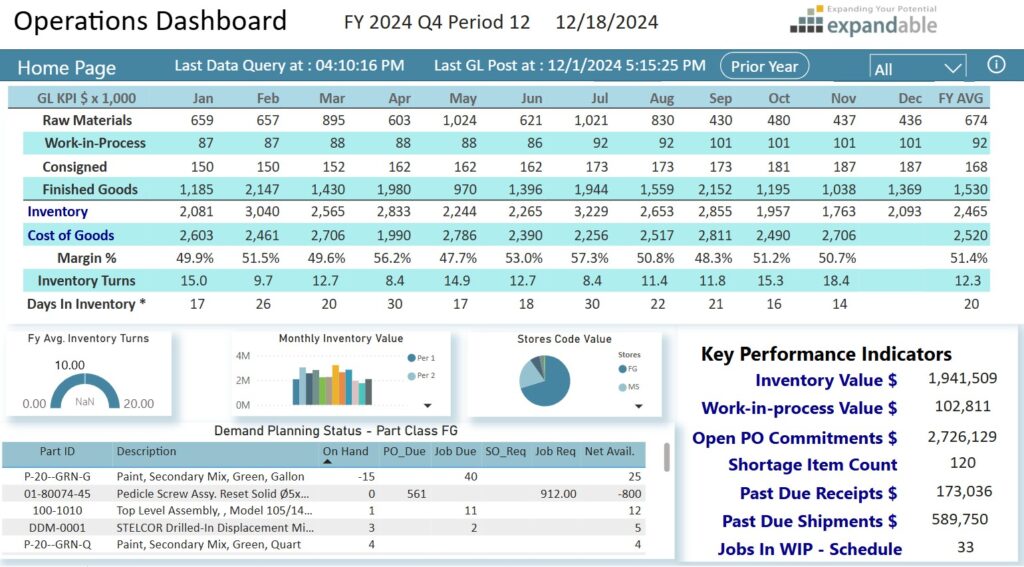
Although many if not most ERP systems now have imbedded Dashboard capabilities, it is important to focus on the few key metrics that drive the business as opposed to the many “standard” metrics that systems “know” and can readily generate. In some cases, a key indicator may have to be derived using multiple data elements captured in the ERP.
In the case of MIE Solutions, MIE Trak Pro offers many features to help management teams stay ahead of production needs. One of the most popular options comes in the form of Quick Views. These powerful and highly customizable reports can provide greater insight into important business and production metrics and can be tailored to suit your team’s specific needs.
Expandable Software has three pre-built dashboards: Operations, Sales, and Finance. Users can begin using informative and interactive dashboards, with minimum training, upon deployment by using the included pre-built datasets. If additional dashboards are created and deployed, those dashboards will become instantly available to the users authorized to view those dashboards.
Data has to be Available in the System
A key criterion, however, is that the data you want to track has to be captured and exist in your system. You can’t report it if you don’t track it. This may mean using custom fields and input screens to collect the data you need.
Push Back from the User Community
There can be push back from the User Community whenever you create new metrics or reporting methods, particularly when some Users have been collecting and reporting data from offline sources or systems that they have been personally maintaining. In one large multi-billion multi-national Company, they had four separate User-generated systems reporting Bookings, Billings and Backlog, and all generated different answers, none of which matched Financial reporting. Eventually they were replaced with a single system that did match the Financials, but the hue and cry from the Users was significant when their personal systems were eliminated.
“Single Source of the Truth”
This is an absolute requirement and must be supported by Leadership. Without this, you get fractured and inconsistent data, which leads to innumerable problems and debates. If Leadership allows multiple sources of data, the credibility of all systems is questioned.
Data vs. Information
This is an important distinction that is often overlooked. Data is just that – DATA. Information is data that has been synthesized and analyzed to make it relevant to the User. Pages full of numbers are not particularly useful to Managers; more often or not it will just be discarded. Data that has been synthesized so a Manager has something tangible to act on IS useful. In one Company, a Manufacturing Manager described it this way: “Every quarter, Finance drops a phone book on my desk [reports full of data] and tells me I’m a butt. By the time I get through it all, the next quarter is over and I’m a butt again.”
What’s Next?
All of the individuals presenting their KPI’s shared one common comment: “This is just the beginning.” They all saw the need for ongoing development and continuous improvement. The most common direction is to incorporate AI to assist with the synthesis and analysis of data to be able to generate better predictive analysis of what might happen and recommend corrective action if needed.
KPI’s vs. KPD’s – Key Performance Drivers
In recent years, there has been discussion of something beyond KPI’s – Key Performance Drivers (KPD’s).
Key Performance Drivers or KPD Metrics are an important concept for improving operational performance and hence business results. A KPD is a measure that directly affects a business outcome or achievement of a KPI. [1]
KPD Metrics can be:
A leading indicator or early warning that a situation exists that if not addressed will lead to a poor result, such as Customer Satisfaction as a leading indicator of Customer retention.
A performance metric that is associated with a preceding step in a value stream or business process, such as Lead Time as a driver for On-Time-In-Full Shipments KPI.
A metric that contributes directly to a KPI and may be a component in the way a KPI is calculated such as Unit Sales, Average Selling Price and Direct Cost supporting a Gross Margin KPI.
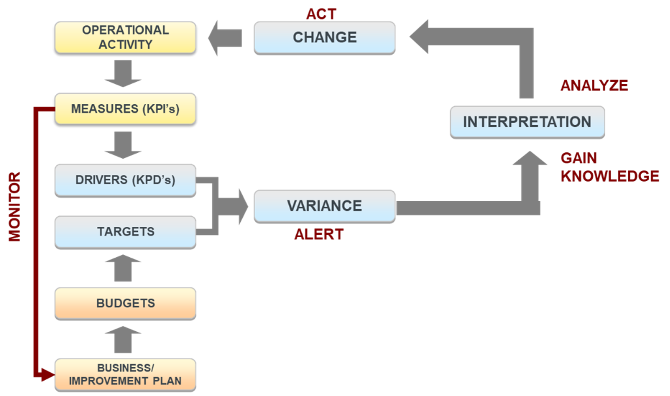
In the simplest terms, a KPD is the action that makes the KPI move in a positive or negative direction. If “Speed” is your KPI for driving, the KPD’s are pressure on the accelerator to go faster, pressure on the brake to slow down.
KPD metrics can be used as a part of a closed loop continuous improvement model
Monitoring measures drivers against targets, goals and best practices, identifying issues, understanding the nature of the issues and ultimately identifying corrective action as needed.
KPD metrics must be actionable to positively impact business outcomes
Measured against a goal or best practice
Monitored frequently so issues can be identified and corrected quickly
Assigned to an Owner who is responsible for results AND has the authority to take action
A Closed Loop Model Using KPD’s
Thanks and credit to all our Sip Club Participants and Presenters — Clay Tallon, Sean Duffy, Jonathan Nordquist, Michael David, and Bill Haynes — for their contributions and insights for the Sip Club.
Sip Club is a monthly, online knowledge-sharing event sponsored by Mirador Software Group and its subsidiary Companies. It’s designed primarily for our Customers – Manufacturing Professionals in Operations, Finance, and IT roles. Each session offers a safe space for our community to learn from one another, exchange ideas, and gain fresh perspectives from industry leaders.
Jeff Osorio is a Consulting CFO with over 40 years of experience in operationally oriented companies
ranging from pre-Revenue to $4B with over 40 ERP implementations in his portfolio. He is also an Adjunct Professor in the MBA program of the Leavey School of Business at Santa Clara University. https://www.linkedin.com/in/jeff-osorio-1412181/
Rapid growth—or rapid decline—can shake even the most confident companies. In younger organizations, it often leads to mixed messages, rushed decisions, and a general sense of “too much happening at once.”
Leaders don’t just need to keep the wheels on the bus. They need to keep the team aligned, protect the business, and still leave room for innovation.
Three Helpful Lenses
1. The Entrepreneur’s Dilemma
Entrepreneurs constantly juggle two tough tradeoffs:
Spend now or conserve cash?
Chase growth or protect profitability? You usually can’t prioritize both, and that tension creates pressure.
2. The Innovator’s Dilemma
Christensen’s classic idea: big companies lose ground because they keep improving high-end products, while smaller players quietly improve the low-end until—suddenly—they’re competitive. It raises a practical question: do you push the cutting edge, or deliver a simpler version that wins on cost and speed?
3. The Investor View: “RIP Good Times”
Sequoia’s 2008 memo was blunt: reduce risk, cut unnecessary spending, move quickly, and don’t assume growth will save you. The takeaway for today: speed and clarity matter. In uncertain environments, hesitation is expensive.
What Leaders Can Do Right Now
1. Make finance a true partner
Your finance team shouldn’t just report what happened—they should help forecast what’s coming, highlight risks, and support decisions.
2. Look ahead, not just backward
Companies need a shared sense of direction. Forward-looking data—not just last quarter’s results—should guide decisions.
3. Strengthen processes before buying more tools
Great software won’t fix unclear processes. Build the foundation first, then make sure your systems can scale with you.
4. Treat planning as a cycle, not an annual event
Plans should be updated often and communicated quickly. Short, frequent planning beats long, rigid plans every time.
5. Be honest about what the numbers actually say
Avoid building plans around the rosiest assumptions. Make decisions based on reality, even when it’s inconvenient.
6. Build teams you trust—and let them work
The right people make everything easier. Hire well, delegate, and avoid the trap of micromanaging.
7. Protect cash
Cash gives you options. Keep it top of mind, plan for multiple scenarios, and reduce unnecessary risk where you can.
What High-Performing Companies Have in Common
Top companies tend to be really good at a few things:
They focus the team around a clear direction
They communicate quickly and often
Their systems and processes scale
Their decisions are grounded in insight, not wishful thinking
They hire talented people and give them space to deliver
Jeff Osorio is a Consulting CFO with over 30 years of experience in operationally oriented companies ranging from pre-Revenue to $4B with over 40 ERP implementations in his portfolio. He is also an Adjunct Professor in the MBA program of the Leavey School of Business at Santa Clara University.
5David AJ Axson, “Collecting More Data But Gaining Less Insight” Financial Executive, vol. 14, no. 3, May-June 1998, pp. 16+. Gale Academic OneFile, link.gale.com/apps/doc/A20929784/AONE?u=anon~f92c2cbc&sid=googleScholar&xid=cb530cf4
6“If You’re the Smartest Guy at the Table, You’re in Trouble” Presentation by Marthin De Beer, SVP Emerging Technologies, Cisco Systems
An Interview with Ryan Sorensen, Vice President of Information Technology at Innovative Labs
Presented by Expandable Software – ERP for High-Tech and MedTech Manufacturers
A Familiar Debate with New Urgency
Across the manufacturing world, there’s always been a lively debate between engineering, manufacturing, and finance teams over whether a Manufacturing Execution System (MES) is truly necessary—or whether the embedded functionalities inside an ERP can get the job done.
At Innovative Labs, Vice President of Information Technology Ryan Sorensen has lived that debate firsthand. His perspective? “The truth is, MES and ERP aren’t competing systems—they’re complementary. ERP plans the work. MES proves it was done.”
For high-tech and medtech manufacturers, where compliance, traceability, and precision define success, that partnership between MES and ERP has become critical to digital transformation.
Defining MES vs ERP: The Nerve Centers of Modern Manufacturing
In a modern manufacturing environment, MES (Manufacturing Execution System) focuses on real-time production management on the factory floor, tracking raw materials to finished goods, while ERP (Enterprise Resource Planning) manages broader business processes such as finance, human resources, and supply chain management.
“Think of MES as the digital nervous system of your production line,” Sorensen explained, “and ERP as the central nervous system of your company.”
An MES executes production and provides real-time data that keeps ERP accurate and current. It’s that real-time connection, Sorensen said, that allows the enterprise to operate on facts instead of estimates.
Understanding the Need for MES
Sorensen described MES as “the missing link” between business plans and operational reality. “ERP will tell you what should be happening. MES tells you what actually is happening.”
Among the many benefits derived from MES:
A vital bridge between planning and execution – MES connects Sales & Operations Planning (S&OP), business planning, and financial reporting.
Improved ERP accuracy – By capturing live shop-floor data (actual counts, scrap, downtime, and labor), MES ensures ERP operates on verified numbers.
Enhanced inventory management – Real-time updates for lot quantities, expiration tracking, and location data ensure precise on-hand and available-to-promise visibility.
Production scheduling support – ERP defines planned orders and capacity; MES translates them into executable jobs and feeds back actual start, stop, and completion times.
Increased visibility – MES gives ERP users real-time production insights—status, equipment performance, WIP—reducing blind spots and delays.
Accurate cost accounting – By recording true material usage, rework, and downtime, MES enables ERP to calculate standard versus actual costs and margins.
Regulatory compliance – MES helps maintain 21 CFR Part 11 and ISO compliance by capturing electronic signatures and quality data, then pushing verified results to ERP.
Improved financial and cost reporting – MES tracks real labor, yield, and waste metrics to give ERP the data needed for real-time cost reconciliation.
“The KPIs don’t lie,” Sorensen said. “On-time delivery, yield, scrap reduction, labor efficiency, and inventory accuracy all show measurable improvement once MES and ERP are integrated.”
Integrating MES with ERP
When asked if MES should integrate with ERP, Sorensen’s answer was clear: “Absolutely. Integration is what turns data into insight.”
MES-ERP integration improves visibility across departments and enables unified dashboards. Finance can see production variances, logistics can view real-time inventory status, and quality can monitor batch performance—all from shared data.
Common integration points include production orders, inventory transactions, quality results, lot genealogy, material consumption, and WIP tracking.
Integration eliminates duplicate entry, synchronizes production and inventory data, and ensures that financial and operational systems reflect the same version of reality.
“When you automate order release and synchronize production and material availability instantly, ERP’s MRP engine can finally plan based on what’s actually happening,” Sorensen explained.
Two-way (bi-directional) integration offers the greatest benefit: ERP sends master data and work orders to MES, while MES returns real-time production feedback. The result is a closed feedback loop for scheduling, costing, and quality—supporting a connected, data-driven environment that fuels digital transformation.
Challenges of Integrating MES with ERP
Sorensen was candid about the challenges. “The number one issue in MES-ERP integration is data quality. If your master data isn’t clean, your integration will just automate bad information faster.”
Clean master data—accurate part numbers, BOMs, units, and routings—ensures smooth synchronization. Poor data quality leads to mismatched inventory and reporting discrepancies.
Other common challenges include:
Data mapping inconsistencies – Shared data must be formatted and defined consistently between systems.
Unclear ownership of master data – Item Masters, BOMs, product costs, and vendor data must live in a single source of truth with a designated owner.
Time granularity mismatches – Operations runs in minutes and hours; finance runs in weeks and months. Data synchronization must respect both.
Lack of real-time synchronization – “If different departments are looking at different snapshots, you’ll get conflicting answers—and lose trust in the data,” Sorensen warned.
Integration success requires both technical and organizational alignment.
Make or Buy?
When it comes to selecting an MES, Sorensen’s advice was simple: “Buy. People love to say, ‘We’re different.’ But most manufacturing operations face the same challenges.”
While some teams may advocate building their own system, homegrown software often ends up reinventing the wheel and introducing bugs or scalability issues that commercial vendors have already solved.
However, Sorensen emphasized that success depends on inclusive decision-making: “Involve operations, quality, and finance early. You may not get 100% of every wish list item, but achieving 80% with a stable, supported system is a win.”
Consensus, he said, is critical to long-term adoption and effectiveness.
Best Practices and Lessons Learned
Sorensen shared several best practices drawn from his own experience:
Clean data and robust processes – “If your processes aren’t sound, integration just makes bad data move faster. Define ownership and governance first.”
Understand data sources and flows – Typically, work orders, BOMs, and item masters flow from ERP to MES; production completions, scrap counts, and quality results flow from MES to ERP.
Phase the rollout – Start with critical modules like inventory, batch tracking, and production execution, then expand to quality, maintenance, and planning.
Use standard integration technologies – REST or SOAP APIs, middleware (such as Dell Boomi or MuleSoft), message queues, or direct SQL synchronization.
Build consensus – “Integration isn’t just IT—it’s a company-wide initiative. Everyone needs to buy into the same version of truth.”
The Takeaway
“MES isn’t replacing ERP—it’s completing it,” Sorensen concluded. “ERP plans. MES executes. Together, they form the backbone of a truly connected, data-driven factory.”
For small and midsize high-tech and medtech manufacturers, integrating MES and ERP is no longer optional—it’s a strategic imperative for operational visibility, accuracy, and agility.
About Expandable
From established enterprises that have grown with us from the pre-revenue phase to ground-breaking startups that need a dependable partner for their growth journey, Expandable is a leading provider of ERP solutions for highly regulated discrete and process manufacturing environments that demand audit trails, serial number and lot tracking, RMAs, kitting, and the like. Expandable’s customer base includes some of the most innovative high-tech and MedTech manufacturers worldwide. The platform unites every part of your operation—from product management and engineering, to production, quality, inventory, and after-sales service—into one affordable, fully integrated system.
Medical device erp systems have become critical infrastructure for an industry projected to reach $615 billion by 2025 and $800 billion by 2030. This growth trajectory creates unique operational pressures, particularly since medical device manufacturing ranks among the world’s most heavily regulated sectors.
The stakes are considerable for manufacturers operating in this space. Medical device recalls recently hit a 15-year high, underscoring the urgent need for robust tracking and compliance systems. Both consumable and large capital equipment segments face intensified regulatory scrutiny.
Specialized erp for medical device manufacturers serves a purpose beyond standard operations management—it ensures regulatory compliance through automated validation processes and detailed audit trails. Every component and batch must be traceable to its source, creating the accountability and safety documentation that regulatory standards require.
Our evaluation covers dozens of medical device manufacturing software solutions to identify the 12 strongest options available today. The rankings reflect the distinctive compliance requirements, traceability demands, and manufacturing complexities that characterize this expanding yet strictly regulated industry.
Expandable ERP targets growing medical device manufacturers who require FDA compliance capabilities without the complexity of enterprise-level systems. The platform focuses specifically on high tech and med tech companies navigating the transition from startup to established business.
The system provides functionality designed around medical device manufacturing requirements:
Complete lifecycle traceability for serialized and lot-controlled items, tracking finished goods back to raw materials to satisfy government reporting requirements
Quality management foundation that supports quality procedures, incident tracking, corrective action, and root cause analysis
Surgical Kit module for tracking inventory consigned to hospitals, clinics, and surgery centers
Mixed manufacturing support allowing companies to build to stock, build to order, or configure to order within one system
Multi-level BOM tracking with serialized and lot-controlled components
Built-in compliance tools for FDA and ISO 13485 standards
The platform also handles product lifecycle management, CAPA, RMA processing, production control, inventory management, and integrated financial systems—all within complex medical device manufacturing environments.
Expandable ERP pros and cons
Pros:
Purpose-built for regulated industries with comprehensive compliance features
Scales with business growth from startup to established enterprise
Supports both discrete and process manufacturing environments
Offers both cloud and on-premise deployment options
Integrates entire operation from engineering to after-sales
Cons:
Less brand recognition than some enterprise-level competitors
Windows platform limitation may affect some deployment scenarios
As with most ERP implementations, requires careful planning to avoid pitfalls
Expandable ERP pricing
Expandable positions itself as “one of the most affordable, comprehensive, fully-integrated ERP systems on the market”. The company markets the system as budget-friendly for growing companies, making it accessible to startups and SMEs preparing to compete in the USD 955.00 billion MedTech market. Pricing structures aren’t publicly disclosed, but cost-effectiveness serves as a key differentiator.
Expandable ERP best fit
Expandable works particularly well for:
Medical device startups transitioning from prototype to production
Manufacturers of FDA-regulated medical equipment, diagnostic instruments, or implantable devices
Growing companies that need sophisticated compliance features without enterprise-level costs
Organizations managing mixed production methods including discrete builds, kitted surgical systems, and serialized diagnostic assemblies
Companies implementing specialized manufacturing ERP software like Expandable report 14% faster product delivery times and 10% more orders delivered on schedule. With 67% of medical device manufacturers struggling without specialized ERP systems, Expandable addresses a critical need for industry-specific functionality.
QAD
QAD has served as a trusted partner to medical device manufacturers for decades, delivering a robust medical device ERP system that targets the upper mid-market and lower enterprise sectors. The platform distinguishes itself through integrated supply chain components, supported by comprehensive ERP capabilities designed for regulated medical manufacturing environments.
QAD key features
QAD delivers a comprehensive toolkit specifically designed for life sciences manufacturers:
End-to-end supply chain visibility across manufacturing operations, including suppliers, customers, and outsource partners
FDA compliance tools supporting CFR Part 11, GMP, cGMP, and Eudralex Volume 4 regulations
Medical device-specific capabilities including serialization support for Unique Device Identification (UDI), Drug Quality and Security Act (DQSA), and Falsified Medicine Directive (FMD) compliance
Mixed-mode manufacturing with native discrete and process manufacturing capabilities plus forward and backward recall traceability
Model-driven architecture allowing customization without changing the source code
QAD pros and cons
Pros:
Strong supply chain perspective with deeper transportation and international trade management capabilities
Cloud maturity since 2008—significantly longer than competitors like SAP
Greater flexibility and easier configuration compared to SAP S/4HANA
Generally less expensive than SAP on both software and implementation
Serves customers across 60 countries generating USD 968.00 billion in annual revenue
Cons:
Limited brand awareness compared to SAP or Oracle, affecting executive confidence
Not as prolific a VAR ecosystem as Microsoft, SAP, or Oracle
Technology modernization announced but might take years to stabilize
Less suitable for manufacturers developing large complex capital equipment with thousands of dependent components
Smaller partner/consultant pool than SAP/Oracle ecosystems
QAD pricing
QAD typically costs less than SAP for both software licenses and implementation. The company structures pricing plans based on organization type and specific requirements. Detailed pricing information requires direct consultation with a QAD advisor.
QAD best fit
QAD works effectively for:
Mid-market to upper mid-market medical device manufacturers
Companies where supply chain management and traceability are priorities
Organizations requiring strong FDA compliance capabilities
Manufacturers operating mixed-mode production environments
Smaller enterprises using it as primary ERP or subsidiaries of larger companies using SAP/Oracle for corporate financial ledgers
Life sciences companies needing flexible solutions that adapt to changing business conditions
SAP S/4 HANA
For global medical device manufacturers managing complex compliance requirements, SAP S/4 HANA provides an enterprise resource planning solution designed for scale. This platform combines core business processes with advanced technologies to support highly regulated operations across international markets.
SAP S/4 HANA key features
Cloud-based architecture available in public and private editions, eliminating physical server requirements while providing worldwide data access
Intelligent technologies including artificial intelligence, analytics, and machine learning for operational optimization
Regulatory compliance tools supporting FDA requirements (21 CFR Part 11) and EU Medical Device Regulation standards
Real-time processing of massive datasets through the HANA in-memory database, critical for UDI tracking and serialized inventory management
Enhanced traceability capabilities connecting UDI data directly into manufacturing, warehousing, and logistics processes
Simplified data model reducing redundancy and complexity across operations
SAP S/4 HANA pros and cons
Pros:
Superior financial control with built-in visual workflow for each transaction
Real-time analytics enabling better decision-making and operational efficiency
Product model supporting various configurations and mixed-mode manufacturing
Enhanced scalability allowing medical device companies to expand operations efficiently
Advanced supply chain visibility across global operations
Cons:
Integration challenges with best-of-breed solutions despite robust options available
Excessive customizations and controls that may overwhelm smaller organizations
Limited last-mile medical device manufacturing capabilities requiring expensive customizations
Complex and potentially risky migration process from legacy systems
Steep learning curve for users transitioning from other platforms
SAP S/4 HANA pricing
SAP S/4 HANA typically costs between $250,000 in the first year to hundreds of millions for both licensing and implementation. The pricing model includes options for on-premise deployment (one-time fee plus 18-22% annual maintenance) or cloud subscription (monthly fees ranging from $20,000-$100,000). Named user licenses range from $1,500-$4,000 per user for on-premise or $100-$250 monthly per user for cloud deployments. Implementation services alone typically start at $75,000, with final costs depending on project complexity.
SAP S/4 HANA best fit
SAP S/4 HANA works effectively for:
Large, global medical device manufacturers with revenues exceeding $1 billion
Publicly traded companies requiring superior transactional traceability
Organizations managing compliance with strict regulatory requirements
Companies operating complex supply chains spanning multiple countries
Businesses seeking to modernize and consolidate enterprise systems
Medical device manufacturers requiring strong integration between ERP and quality management processes
Oracle Cloud ERP
Oracle Cloud ERP targets large medical device organizations requiring unified operations across complex business structures. With over 11,000 Fusion Cloud ERP customers worldwide, this platform addresses the operational demands facing major medical manufacturers navigating regulatory complexity.
Oracle Cloud ERP key features
Single data platform integrating finance, HCM, PLM, and supply chain data for enhanced product launch insights
Built-in AI capabilities that improve forecast accuracy for patient volume, revenue, and related expenses
Quarterly update cycles delivering new features every 90 days
Comprehensive supply chain management tools addressing the entire process from procurement to delivery
Regulatory compliance features minimizing risk and ensuring patient safety
Enhanced financial reporting with AI-powered management reporting narratives
Oracle Cloud ERP pros and cons
Pros:
Core ERP capabilities with deep supply chain and logistics functionality
Support for multiple business models within one global solution
Robust financial controls including SOX compliance and financial traceability
Strong integration between finance, HR, and supply chain functions
Cons:
Limited last-mile functionality for medical device manufacturing (device history records, FDA 21 CFR 11 reporting)
Extended configuration and customization timeframes
Less intuitive for plant-level employees due to complex interface
May require external support for customization implementation
Steeper learning curve for new system users
Oracle Cloud ERP pricing
Oracle follows a subscription model with monthly per-user pricing starting at approximately $500. The platform requires a minimum of 25 users to begin implementation. Implementation services typically start at $200,000, though final costs depend on project complexity and customization requirements. For detailed pricing information, Oracle recommends contacting their sales team directly.
Oracle Cloud ERP best fit
Oracle Cloud ERP serves large, global medical device manufacturers with revenues exceeding $1 billion. The platform works well for organizations managing diverse entities—including commerce, consumables, large equipment, consulting, contract manufacturing, and research center subsidiaries. It functions effectively as a corporate financial ledger for companies seeking to minimize subsidiary-level ERP systems. Organizations undertaking comprehensive operational transformation within the healthcare sector typically find maximum value in this platform.
Microsoft Dynamics 365
Microsoft Dynamics 365 provides a practical option for medical device manufacturers who need regulatory compliance capabilities alongside familiar Microsoft integration. The platform’s cloud-based foundation supports heavily regulated GxP environments while connecting seamlessly with established Microsoft business tools.
Microsoft Dynamics 365 key features
Complete lifecycle tracking with lot and serial traceability ensuring regulatory compliance from design through sales and service
Document management capabilities storing all regulatory and FDA requirements documentation in one central location
Quality control integration supporting test plans, defect reporting, and vendor quality assurance
Change order management tracking product modifications to drive continuous improvement
FDA traceability reporting with serialization and lot control for accurate patient information tracking
Business analytics providing deep financial and operational insights via Power BI dashboards
Microsoft Dynamics 365 pros and cons
Pros:
Natural integration with Microsoft ecosystem (Office 365, Teams, Forms)
Built-in quality and compliance modules for medical device manufacturers
Real-time production and inventory tracking capabilities
Flexible deployment supporting both cloud and on-premise options
Strong data security through Azure Cloud and Dataverse technologies
Complex implementation process requiring expert guidance
Higher initial investment compared to general-purpose ERP solutions
Performs best when operating within full Microsoft ecosystem
Industry-specific needs require customization
Microsoft Dynamics 365 pricing
Dynamics 365 operates on a subscription-based model with multiple licensing options. Sales Professional licenses start at $65 per user monthly, whereas Sales Enterprise licenses cost $95 per user monthly. For comprehensive deployments, implementation typically starts at $25,000. Business Central licenses range from $70-100 per user monthly, offering a more affordable entry point for smaller manufacturers.
Microsoft Dynamics 365 best fit
Dynamics 365 serves well for:
Medical device manufacturers requiring strong documentation capabilities
Organizations already invested in Microsoft technology stack
Mid-sized manufacturers needing flexibility in deployment options
Businesses seeking integrated quality control with business operations
Acumatica Cloud ERP
Acumatica Cloud ERP provides medical device manufacturers with a unified platform built to address the particular challenges of operating in a heavily regulated environment. This cloud-based solution balances modern functionality with affordability, helping companies maintain operational control while meeting industry compliance standards.
Acumatica Cloud ERP key features
End-to-end traceability with lot and serial tracking from receipt to shipment
Quality management with embedded inspections, testing, and CAPA reporting
Regulatory compliance support for FDA and ISO 13485 standards
Engineering control with ECR/ECO workflows and structured approvals
Supply chain visibility providing real-time dashboards for inventory management
Cloud accessibility enabling teams to work efficiently across multiple locations
Acumatica Cloud ERP pros and cons
Pros:
Unlimited users with consumption-based pricing rather than per-user fees
Modern cloud platform offering seamless integration capabilities
Flexible, modular design supporting business growth without system overhauls
Direct integration of quality checks into manufacturing processes
Advanced document management for audit trails and traceability
Cons:
Can be expensive for smaller businesses requiring significant investment
Limited industry-specific features as a general-purpose ERP solution
Steep learning curve for new users due to comprehensive functionality
Reported issues with customer support quality
Acumatica Cloud ERP pricing
Acumatica’s pricing model differs from traditional per-user structures by charging based on applications and resource consumption. The General Business Edition starts at $6,396 annually for up to 10 users and 1,000 monthly transactions. Mid-sized businesses typically spend $25,000+ annually on subscription costs. Implementation expenses range from $60,000 to $100,000+ depending on complexity.
Acumatica Cloud ERP best fit
Acumatica serves growing medical device manufacturers particularly well when they need to:
Streamline operations while maintaining regulatory compliance
Improve operational efficiency and reduce compliance risk
Accelerate time-to-market for new medical devices
Manage multiple suppliers and complex production schedules
Scale their business without costly system replacements
The platform delivers the visibility, traceability, and control that medical device manufacturers need to meet strict regulatory standards while maintaining operational flexibility.
DELMIAWorks
DELMIAWorks (formerly IQMS) takes a different approach to medical device manufacturing software, built from the ground up with a “shop floor first” philosophy. This Oracle-powered system centralizes business activity across the entire supply chain while eliminating the complexity of managing multiple databases.
DELMIAWorks key features
The medical quality suite provides essential tools for device manufacturers operating under strict regulatory oversight:
Comprehensive compliance framework supporting ISO 13485/9001 standards, Current Good Manufacturing Practice (CGMP), and FDA requirements
Complete audit trail of manufacturing processes with secure electronic signatures complying with 21 CFR Part 11
Advanced tracking capabilities with unlimited track and trace, product identification, and serialization
Device History Record (DHR) module that automates collecting complete production history from design through the product lifecycle
Corrective Action/Preventive Action (CAPA) functionality with non-conforming product review and tracking
Optimized scheduling that identifies the best start time for jobs and constraints affecting delivery
DELMIAWorks pros and cons
Pros:
Single-source development ensuring less complex and more cost-effective implementation
Intuitive user interface resulting in training costs that are a fraction of competitors’ fees
Real-time monitoring system collecting data as jobs run, visible on a single screen
Built specifically for manufacturers by manufacturers, with ground-up development
Strong customer satisfaction with ease of use rated at 8/10 and functionality at 8/10
Cons:
Learning curve requiring ongoing training for full system utilization
Support sometimes functions as a sales team for training rather than direct assistance
Some users report labels taking too long to generate and system “locking up” during printing
Implementation requires experienced team members
UI described by some users as needing modernization
DELMIAWorks pricing
Per-user monthly costs start at approximately $150-250, with a minimum of 5 users required. Implementation services begin at $20,000, though final costs depend on project complexity. Total investment ranges from $25,000 to $300,000 based on organizational requirements.
DELMIAWorks best fit
DELMIAWorks serves Class 1, 2, and 3 medical device manufacturers who need robust traceability and regulatory compliance capabilities. The system works particularly well for companies operating in highly regulated environments where ISO and FDA compliance are non-negotiable. Organizations focused on quality management—specifically those requiring Statistical Process Control, CAPA, and detailed audit trails—will find significant value. Companies needing complete visibility from initial order through inventory, production, shipping, and final billing should consider this platform.
SYSPRO
SYSPRO ERP serves small and medium-sized medical device manufacturers with particular strength in consumables and diagnostic segments. The platform’s design reflects a clear understanding of distribution and commerce-focused operations that characterize much of the medical device sector.
SYSPRO key features
The system addresses core manufacturing requirements through integrated functionality. Full traceability capabilitiestrack materials from receipt through delivery, enabling manufacturers to rapidly identify potentially defective products. Electronic signature capture and comprehensive audit trails support FDA 21 CFR Part 11 and GMP requirements.
Real-time inventory visibility provides the operational control that medical device manufacturers require. Quality management tools improve governance while driving compliance. The platform’s native process manufacturing support proves beneficial for contract research organizations developing both drugs and devices.
Unlike many ERP solutions, SYSPRO offers customization options without affecting upgrade paths—a significant advantage for growing companies that need flexibility.
SYSPRO pros and cons
Pros:
Applicable across numerous manufacturing sub-industries with strong quality process focus
Out-of-box processes enable quick implementation without extensive customization
Customizable while maintaining upgrade capabilities
Strong inventory and supply chain management capabilities
Cons:
User adoption can be challenging with steeper learning curve for new users
Interface appears dated compared to modern ERP solutions
Self-service reporting limitations versus newer platforms
Primarily designed for smaller facilities with single legal entity structures
SYSPRO pricing
The subscription-based model starts at approximately USD 150.00 per user monthly. Organizations need a minimum of 10 users to begin implementation. Implementation services typically start at USD 25,000, with final costs varying based on project complexity. On-premise customers face higher upfront licensing costs depreciated over 5-10 years plus annual maintenance fees.
SYSPRO best fit
SYSPRO proves most valuable for SMB medical device companies, particularly those in consumables or diagnostic segments. Organizations requiring strong inventory and supply chain management find the platform well-suited to their needs. Companies needing robust quality controls and compliance documentation benefit from its integrated approach.
The system works best for single-facility operations rather than complex multi-entity structures. Businesses seeking customizable solutions that maintain upgrade paths will find SYSPRO addresses this common ERP challenge effectively.
Epicor Kinetic
Epicor Kinetic addresses the operational challenges facing medical device manufacturers who must balance regulatory compliance with efficient production processes. This AI-powered cloud ERP system targets the specific requirements of companies operating in highly regulated environments.
Epicor Kinetic key features
Regulatory compliance forms the foundation of Epicor’s approach, with specialized Life Sciences Cloud infrastructure supporting FDA CFR 21 Part 11 and EU Annex 11 requirements. Core capabilities include:
Comprehensive traceability with lot and serial tracking from raw materials to finished products
Quality management capabilities including complaint handling and corrective actions
Consistent upgrade cadence with deferred updates that maintain compliance
Microsoft Azure cloud infrastructure enhancing security and reliability
Epicor Kinetic pros and cons
Pros:
Mixed-mode manufacturing capabilities supporting various production methods
Superior user experience with advanced cloud-native features
Limited financial layers supporting only three hierarchical levels
Reliance on third-party quality modules
Learning curve requiring ongoing training
Report generation challenges noted by some users
Epicor Kinetic pricing
Per-user monthly pricing starts at USD 125.00 with a minimum requirement of 10 users. Implementation services typically begin at USD 50,000.00, depending on project complexity. Both leasing and subscription financing options help spread costs over time.
Epicor Kinetic best fit
Epicor Kinetic serves small to mid-market discrete medical device manufacturers effectively. The system works particularly well for companies managing complex inventory requirements where devices may serve multiple indications. Its distribution-focused planning capabilities make it suitable for commerce-oriented medical device organizations.
Infor CloudSuite Industrial
Small to mid-sized medical device manufacturers frequently select Infor CloudSuite Industrial for its dedicated quality management system and regulatory compliance tools. This ERP solution (formerly SyteLine) addresses the medical device sector’s distinctive operational challenges with specialized functionality.
Infor CloudSuite Industrial key features
Infor provides medical device production capabilities through its FDA Extended ERP solution framework. The platform incorporates advanced security features, comprehensive data auditability, and streamlined electronic record management. Core functionality encompasses batch records tracking, customer complaint management, and lot/serial genealogy for product traceability, along with electronic records support meeting 21 CFR Part 11 requirements. The built-in quality module maintains separate inventory for quality-controlled components while providing extensive in-process quality coverage.
Infor CloudSuite Industrial pros and cons
Pros:The system’s design reflects an OEM perspective with serializable unit support. Quality management integrates deeply into core operations, while field service capabilities coordinate resources effectively. FDA validation tools include packaged operational validation scripts.
Cons:The interface lacks a cloud-native feel with some critical limitations. The system proves unsuitable for distribution-centric medical device manufacturers. FDA-specific regulatory capabilities don’t match some competitors’ strengths, and the extensive feature set requires significant training investment.
Infor CloudSuite Industrial pricing
Per-user monthly pricing starts at USD 150.00 with a minimum requirement of 5 users. Infor’s subscription-based model scales with organizational growth. Leasing options help spread costs over time while providing potential tax benefits.
Infor CloudSuite Industrial best fit
Infor CloudSuite Industrial serves effectively as a subsidiary solution within large medical device companies or as the primary ERP for smaller manufacturers. The system excels where strict quality management and detailed product information are essential for meeting regulatory requirements. Medical device manufacturers needing to maintain ISO 13485 certification and FDA compliance will find particular value in this platform.
Rootstock
Built natively on the Salesforce platform, Rootstock delivers a medical device ERP solution that unifies compliance, production, and financial operations within a single system. This platform-native approach creates advantages for manufacturers already operating within the Salesforce ecosystem.
Rootstock key features
The system’s complete visibility and traceability over manufacturing operations automates compliance processes while maintaining the detailed documentation medical device manufacturers require. Real-time inventory analysis provides detailed tracking of costs and sales, giving manufacturers the financial insight needed for informed decision-making.
Rootstock has demonstrated measurable improvements in complaint handling, reducing timeframes by an average of 60%. The platform covers order management, inventory control, production, and supply chain planning through extensive functionality that connects directly with other Salesforce applications, creating a comprehensive business platform.
Rootstock pros and cons
Pros:
Excellent reporting capabilities with customizable interfaces
High customer satisfaction ratings of 4.7/5 from verified customers
Strong retention rates within the industry
Cons:
Some performance issues reported by users
Limited financial reporting capabilities
User interface needs improvement according to some reviews
Rootstock pricing
Rootstock structures pricing across three tiers: Growth starting from $100.00 per user, Advanced starting from $145.00 per user, and Enterprise with custom pricing.
Rootstock best fit
Rootstock works particularly well for medical device manufacturers requiring FDA compliance capabilities who want seamless integration with Salesforce. The system excels in environments needing robust traceability, quality control, and efficient complaint management processes. Organizations already invested in Salesforce infrastructure will find the native integration eliminates many of the complexity issues associated with connecting disparate systems.
Deacom ERP
Deacom ERP, part of ECI Software Solutions, operates on a distinctive “ONE” philosophy that sets it apart from other medical device manufacturers solutions. This unified platform targets companies requiring stringent FDA compliance and tracking capabilities within a single integrated system.
Deacom ERP key features
Deacom consolidates medical device manufacturing operations through targeted functionality:
Hyper-Tight Process Control™ with quality checkpoints across the complete product lifecycle
Native lot traceability maintaining regulatory compliance throughout supply chain operations
Document creation and management handling vendor scorecards, specifications, and compliance documentation
Real-time reporting with live transaction data posting
Deacom ERP pros and cons
Pros:
98% implementation success rate, well above industry standards
Single-screen operational visibility across all business functions
In-house support structure eliminating third-party dependencies
Cons:
Limited functionality for complex discrete manufacturing applications
Not suitable for large capital equipment manufacturers
Interface challenges reported by some users
Deacom ERP pricing
Deacom provides transparent pricing without hidden fees. Two main options include:
Deacom Enterprise designed for established manufacturers with complex operational requirements
Deacom ERP best fit
Deacom performs strongest for diagnostic, drug, and smaller consumable device manufacturers. Companies distributing fast-moving medical goods requiring comprehensive track and trace capabilities will find the most value from this platform.
🏆 Editor’s Choice for 2026
After comprehensive evaluation of the top medical device ERP systems, Expandable ERP stands out as our premier choice for growing medical device manufacturers in 2026. Its unique combination of comprehensive FDA and ISO 13485 compliance features, scalability from startup to enterprise, and flexible deployment options make it the ideal solution for companies navigating the complex regulatory landscape without the overhead of enterprise-level complexity.
Why Expandable ERP Leads in 2026:
Purpose-Built for Compliance: Designed specifically for medical device manufacturers, Expandable ERP offers complete lifecycle traceability, surgical kit management, and built-in regulatory tools that ensure audit readiness and reduce recall risks. With medical device recalls at a 15-year high, having a system that automates compliance processes is no longer optional—it’s essential.
Proven Operational Impact: Manufacturing companies implementing specialized ERP systems like Expandable report 14% faster product delivery times and 10% more orders delivered on schedule. These aren’t theoretical benefits—they represent measurable improvements to your bottom line and customer satisfaction.
Scalability Without Compromise: Whether you’re transitioning from prototype to production or scaling operations across multiple facilities, Expandable ERP adapts seamlessly to your evolving business needs. You won’t outgrow the system as your company matures.
Cost-Effective Entry Point: Positioned as one of the most affordable, fully integrated ERP systems tailored for regulated industries, Expandable removes the traditional barrier where sophisticated compliance features were only accessible at enterprise price points. Growing companies can now access the same regulatory capabilities without six-figure implementation costs.
Deployment Flexibility: Available as both cloud and on-premise solutions, it fits diverse IT strategies and operational preferences—a critical consideration for companies with existing infrastructure investments or specific data sovereignty requirements.
For medical device companies seeking a compliance backbone that supports growth and operational excellence, Expandable ERP offers unmatched value and industry-specific functionality. While enterprise solutions like SAP and Oracle serve global manufacturers with billion-dollar revenues, and mid-market options provide general manufacturing capabilities, Expandable specifically addresses the sweet spot: growing medical device companies that need enterprise-grade compliance without enterprise-grade complexity.
System Comparison Overview
The table below provides a side-by-side comparison of key specifications across all 12 medical device ERP systems. This reference helps manufacturers evaluate options based on their specific operational requirements and budget constraints.
Medical Device ERP Comparison
Search, sort, and filter ERP systems by company size, pricing signal, and deployment model.
Color key:CloudHybridLower entryPremiumEnterpriseContact vendor
Conclusion
Selecting an ERP system represents a pivotal business decision for medical device manufacturers operating under strict regulatory oversight and operational pressures. Our analysis of these 12 solutions reveals distinct patterns in how different platforms serve various market segments within this highly regulated industry.
The medical device market’s rapid expansion means manufacturers face mounting pressure to maintain compliance while optimizing production efficiency. Your specific requirements for traceability, quality management, and regulatory adherence should drive the selection process.
Enterprise manufacturers with revenues exceeding $1 billion typically require the comprehensive capabilities of SAP S/4 HANA or Oracle Cloud ERP, which deliver robust financial controls and global supply chain visibility. Mid-market organizations often find better value in Microsoft Dynamics 365 or QAD due to balanced functionality and reasonable implementation costs. Growing medical device companies may benefit most from Expandable ERP or Acumatica, which provide industry-specific compliance features without enterprise-level complexity.
The right ERP solution must address your regulatory requirements—FDA compliance, ISO 13485 certification, UDI tracking. These systems become the operational backbone for maintaining audit trails, managing device history records, and ensuring complete lot and serial traceability.
Evaluate potential solutions based on your manufacturing approach, company size, budget parameters, and compliance obligations. Implementation timeframes, user experience, and ongoing support quality matter as much as core functionality when making this decision.
Medical device manufacturers implementing specialized ERP systems typically see improved compliance rates, enhanced operational efficiency, and reduced recall risk. This technology investment protects both business reputation and patient safety—two factors that define success in this critical industry.
The bottom line: choose a system that grows with your business while ensuring you never compromise on the regulatory compliance that keeps patients safe.
Key Takeaways
Medical device manufacturers face unique ERP challenges due to strict regulatory requirements and the need for complete traceability in a rapidly growing $615 billion industry.
• Specialized ERP systems are essential – 67% of medical device manufacturers struggle without industry-specific ERP functionality for FDA compliance and traceability
• Enterprise vs. SMB solutions differ significantly – Large manufacturers ($1B+) benefit from SAP/Oracle, while growing companies need scalable options like Expandable or Acumatica
• Compliance features are non-negotiable – Systems must support FDA 21 CFR Part 11, ISO 13485, complete lot tracking, and device history records
• Implementation costs vary dramatically – From $25,000 for smaller solutions to $250,000+ for enterprise systems, with pricing models ranging from per-user to consumption-based
• Real-time traceability drives ROI – Proper ERP implementation delivers 14% faster product delivery and 10% more on-time orders while reducing recall risks
The right medical device ERP system serves as your compliance backbone, ensuring patient safety while optimizing operations in this heavily regulated industry.
FAQs
Q1. What are the key features to look for in a medical device ERP system? Essential features include end-to-end traceability, quality management tools, regulatory compliance support (e.g., FDA 21 CFR Part 11), and integrated document management. Look for systems that offer real-time visibility into manufacturing processes and supply chain operations.
Q2. How does ERP software help medical device manufacturers maintain compliance? ERP systems designed for medical device manufacturers provide tools for maintaining detailed audit trails, managing device history records, and ensuring complete lot and serial traceability. They automate many compliance processes, reducing the risk of human error and supporting adherence to FDA, ISO 13485, and other regulatory standards.
Q3. What are the differences between ERP solutions for large enterprises versus small to medium-sized medical device companies? Large enterprise solutions like SAP S/4 HANA and Oracle Cloud ERP offer comprehensive functionality and global scalability but come with higher costs and complexity. Smaller companies often benefit from more specialized systems like Expandable ERP or Acumatica, which provide industry-specific features at a lower price point and are easier to implement.
Q4. How much does a medical device ERP system typically cost? Costs vary widely based on the size of the organization and the complexity of the system. Small to medium-sized businesses might spend $25,000 to $100,000 for implementation, while large enterprise solutions can exceed $250,000. Monthly per-user fees typically range from $100 to $500, with some vendors offering consumption-based pricing models.
Q5. What benefits can medical device manufacturers expect from implementing a specialized ERP system?Manufacturers implementing industry-specific ERP systems often see improved compliance rates, enhanced operational efficiency, and reduced risk of costly recalls. Benefits can include faster product delivery times, improved order fulfillment rates, better inventory management, and streamlined quality control processes. The right system serves as a backbone for maintaining regulatory compliance while optimizing business operations.
We talk with a lot of manufacturing leaders, and we’ve noticed the same challenges come up again and again in Sales and Operations Planning. Maybe these sound familiar:
Building a “forecast” by taking one big order from a customer and dividing it by 12 months, generating an inaccurate or obsolete forecast causing unnecessary inventory build-up.
Finding out that sales and operations “leaned forward” on procurement of inventory to meet lead time on a large upcoming order, only to find out it was delayed or cancelled, uselessly tying up cash.
Planning production based on only what’s already in the order backlog, instead of aligning with true future demand, causing extended lead times and potential lost sales.
Focusing on unit volumes only, and not factoring in product mix, seasonality, or margin impact, unnecessarily constraining available manufacturing capacity to handle spikes in demand.
These kinds of shortcuts feel efficient in the moment, but they often lead to missed targets, stockouts, reduction of cash, increase in inventory and misalignment between sales, operations and finance.
These problems and more were the focus of the new Sip Club, hosted by Expandable Software and MIE Solutions (subsidiaries of Mirador Software Group) on September 18th, 2025. Once again, industry leaders gathered to discuss issues and share insights on their solutions, with David Gavlik, Chief Financial Officer of BSC Industries, as the featured guest.
So, what is sales and operations planning?
Sales and Operations Planning, or the S&OP Process, is a process by which a company consolidates forecast information from the various functions of the enterprise in a structured manner to prepare a business plan for the company and communicate and establish coordinated priorities for all parts of the organization.
“Sales and operations planning is a widely used, effective tool for gaining a greater degree of control over [a] company’s operations. Though the use of this tool, a company can coordinate the actions of each functional area through consistent, frequent links between the business plan and each department’s operations by
Orchestrating communications
Developing a realistic plan capable of achieving company objectives
Ensuring that each business decision is made with a deliberate view of its impact on the entire organization
Ensuring that purchasing is buying the correct items, manufacturing has the capacity to make items, and finance can pay for and forecast results, all in an effort to ensure customer demand is met.
“This dynamic process enables a company’s sales and marketing groups to carefully coordinate the impact of market demand with departments such as manufacturing, engineering and finance. The net result is a dramatically increased ability to anticipate changes in customer needs.” [1]
All companies perform this process in some sort of manner (though some are very informal) but if not organized and cross-functional, it can lead to incorrect, costly decisions.
Who needs to be involved in sales and operations planning?
The short answer is any function in the company that is involved with selling, producing and delivering products to customers. They include:
Marketing: Providing input regarding programs and company initiatives to promote various product lines and programs to influence future customer buying behavior.
Sales: The direct interface to the customer and product demand
Purchasing: To ensure they have the information needed to procure inventory in a timely fashion.
Operations: To ensure they have capacity and plans in place to handle upcoming customer needs.
Finance: Sometimes forgotten in this process, finance is the gatekeeper in challenging assumptions, monitoring cash flow, and updating financial projections and the impact to gross margin and overall profitability.
What are some typical S&OP failures?
Inventory buildup – With inaccurate or incomplete forecasts and being unable to react quickly enough to changing demand, inventories can increase dramatically.
Tying up available cash– “Leaning forward” on inventory purchases (aggressive forecasting) for large orders that are delayed or cancelled uselessly consumes cash.
Stock outs and/or long lead times impacting sales – Buying only to current demand and not to forecasted demand and sales can create shortages and missed revenue opportunities.
Uneven manufacturing capacity – Leading to long lead times and excess spending to compensate for demand spikes (this can occur by not considering seasonality of the industry or customer buying patterns).
To ensure and drive alignment across the organization on S&OP decisions, best practice says this is a formal recurring process and integrated with the financial planning process and projections.
What is the typical S&OP process?
Ideally in a manufacturing environment, this should be a regularly scheduled recurring meeting. In some cases, finance may lead the meeting as the coordinator and facilitator across the various functions.
Depending on the volatility, cycle times, size and complexity of the company, this meeting can be scheduled biweekly. If held too often, it can lose meaning and becomes repetitive; if not often enough, decisions can be missed; if not scheduled, it can lead to poor decisions.
The process is a cycle. Sales and marketing provide forecast data from their various perspectives which “syncs up” into a demand forecast (what I want). This is provided to manufacturing (including purchasing) to generate material and capacity planning and a response to the demand forecast (what I can produce). There may be multiple cycles here, but eventually a consensus is reached and provided to finance to generate the financial forecast. [2]
Who makes the decisions?
Ideally, it’s a group consensus with alignment. However, it is important to have an escalation process or overall decision maker.
Is someone in the S&OP meeting the final decision maker? OR
What is the process to decide if and when there is an impasse? (CEO/CFO/COO, etc.)
What’s the feedback mechanism?
For the S&OP process to be most effective, there needs to be a solid feedback loop to all the constituents. Specific details need to be provided to all involved as an outcome of the process.
Sales and marketing need to know what volume and mix of products will be available to sell.
Purchasing and manufacturing need to know what to buy and what to build.
Finance needs to know what will be built, what will be bought, what will be sold, and, most importantly, when, to build an attainable financial forecast and cash plan.
There is also a need for ongoing feedback during the ensuing period: sales communicating “what’s selling” and manufacturing providing what’s available (“what I’ve got”), turning the sales funnel into a megaphone (i.e., “I’m out of Prime Rib! Push the Meatloaf!”)
Turning the Sales Funnel Into a Megaphone [2]
What’s the bottom line?
The S&OP process works. It can be painful to start, but once it’s operating, it adds immense value to your business.
Thanks and credit to David Gavlik for his contributions and insights for the Sip Club.
David Gavlik is an operationally focused finance professional with 25+ years of financial experience in multiple products and industries (including biological products, complex hardware solutions, and storage / workspace equipment manufacturing and distribution) in companies ranging from $50-100M. https://www.linkedin.com/in/david-gavlik-7924666/
Jeff Osorio is a Consulting CFO with over 30 years of experience in operationally oriented companies ranging from pre-Revenue to $4B with over 40 ERP implementations in his portfolio. He is also an Adjunct Professor in the MBA program of the Leavey School of Business at Santa Clara University. https://www.linkedin.com/in/jeff-osorio-1412181/
[1]“Orchestrating Success”, Richard C. Ling and Walter E. Goddard, Copyright 1988 by John Wliey & Sons, Inc
[2]“Managing For Performance”, Jeff Osorio, Copyright 2024
Project Lead
The project lead should be a person with broad knowledge of the company’s business, processes, have the ability to articulate the ERP solution vision, have respect of the executive sponsor/committee and the personality strength to work with and ability to communicate effectively across functional lines, the implementation team, and the Executive sponsor/committee.
The project lead should be a key operational stakeholder. The project lead, for manufacturing companies, typically comes from the manufacturing, finance, or IT organization. I strongly recommend an IT employee not lead the project for a few reasons including the greater likelihood the project will be viewed as a corporate IT project (which it is not). Even the best IT employees do not understand the working requirement nuances of manufacturing and finance well enough, and it places the accountability on a support function as opposed to the people who will reap the benefits for the project’s success.
Cross Functional Teams
Core Team: It is imperative that an adequate number of key personnel from all impacted functions be assigned to the core implementation project team led by the Project Lead. These core team members will be relied upon to make/communicate important workflow decisions, obtain input at the appropriate time, and communicate decisions and status to the functional working team (discussed below).
Functional Working Team: Best practices have a separate working team for each function, led by the function’s Core Team member. The Core Team member’s responsibility to:
Be the project manager for the function they represent
Uncover any “gotchas” that need to be addressed prior to the ERP system go-live event
Communicate appropriate issues raised by the functional working team to the Core team
Drive tasks and open issues to closure
Ensure adequate resources are being assigned to the project within the function
Motivator and cheerleader for the functional working team members and across the function company wide